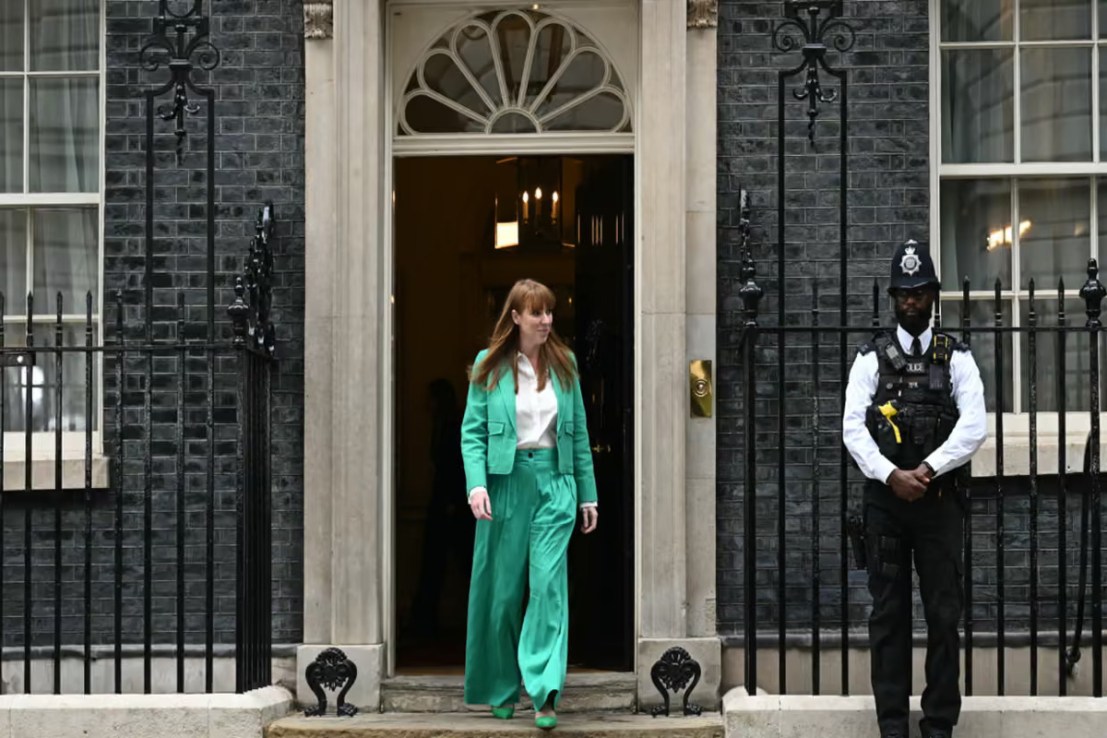
Angela Rayner taking to Downing Street poses one of the top risks to the banking sector heading into 2026, top analysts have warned.
The former Deputy Prime Minister and darling of the Labour left is among names tipped to take the top job as Sir Keir Starmer fights to save his premiership amid all-time favourability polling.
But Rayner in Number 10 ranks among the top concerns for UK banks, which enjoyed a bumper stock surge in 2025 far out performing the wider City index.
“Potential for change at the top of Government may hang over the sector,” said equity analysts Jonathan Pierce and Priya Rathod.
Chancellor Rachel Reeves has maintained a close-knit relationship with top banking chiefs since taking to No.11, even sparing the sector from a highly-anticipated tax raid in both of her Budgets.
John Cronin, banking analyst at Seapoint insights, told City AM: “While banking industry executives have been pleased with Reeves’ favourable stance, it is less clear as to whether a new Chancellor would continue to press forward on the regulatory loosening agenda with the same gusto.”
A report from the Financial Times suggested Reeves had urged bank bosses to publicly support her Budget. Whilst this did not directly come to fruition, top lenders including Lloyds, and Barclays as well as US giants JP Morgan and Goldman Sachs all announced hefty injections of capital into the UK economy in the days following.
“Any leadership battle will be uncomfortable for equity investors and the gilt market,” Pierce and Rathod said.
“And bank holders may be particularly concerned by certain potential combinations”.
A return to government for Rayner would follow her unceremonious departure in September after it was revealed she underpaid tax on her Hove flat – during her tenure as housing secretary.
Bankers would breathe a sigh of relief at McFadden in No.11
Jefferies analysts pointed to a Rayner premiership with Torsten Bell in No.11 as likely to “lift bank taxes, as proposed in the former’s leaked memo from early 2025”.
In May, a leaked memo penned by Rayner to Reeves revealed Starmer’s second-in-command at the time lobbying for a cash grab on UK banks.
Rayner proposes raising the surcharge, which sits on top of corporation tax, to five per cent from two per cent effectively setting the sector’s total corporation tax at 30 per cent.
Whilst lenders were able to escape such a move in November’s Budget the tax rate on the UK banking sector rose 0.6 per cent to 46.4 per cent, widening the gap between London and other financial hubs.
Jefferies analysts said prediction markets had put the chance of a harder left Prime Minister by the year-end at 25 per cent, with “more importantly” current work and pensions secretary Pat McFadden the “most likely replacement for Rachel Reeves”.
“That may be taken well by markets,” Pierce and Rathod said.
When weighing up the figures likely to spearhead a government, they said the probability of a “Wes Streeting-Pat McFadden government is somewhat higher than a Angela Rayner-Torsten Bell – and this could be viewed positively by the market”.
McFadden has become renowned for wanting to enforce fiscal discipline and said welfare reform “must happen” after reshuffled into his post in the Department of Work and Pensions in September.
Whilst Pierce and Rathod stated that the ‘status quo’ remains the most likely outcome, they warned that any shift toward a less market-friendly leadership would ‘clearly’ subvert investor risk appetite and leave bank stock prices suppressed.
Cronin said whilst a hard left Chancellor taking the helm appears “extremely unlikely” it would trigger “significant selling pressure” on bank equities.
Though he warned McFadden may offer some downsides to the City due to previous positions on loosening regulation.
In 2021, the Labour MP warned weakening ring-fencing – a key disdain among top banking chiefs which Reeves has indicated an openness to reforming – to suit big banks would be the wrong option to protect financial services resiliency.