In 1783, the King needed a fifth Prime Minister in two years. Despite others’ doubts, he turned to 24-year-old William Pitt, on this day, to turn the country around, writes Eliot Wilson
As 1783 drew to a close, Britain was on its fourth Prime Minister in two years. On 27 March 1782, Lord North had paid the price for losing the American colonies. Lieutenant General The Earl Cornwallis’s surrender at Yorktown had ended the fighting in North America, and the House of Commons went on to pass a motion to cease “further prosecution of offensive warfare on the continent of North America”. North treated it as a confidence matter and the government was defeated 234 to 215.
It took a month for North to persuade the King to accept his resignation. George III grudgingly invited the 51-year-old Whig grandee the Marquess of Rockingham, whom he disliked and who had previously been Prime Minister as long ago as 1765-66, to form a government. But 97 days later Rockingham died of influenza; he was replaced by the home secretary, the Earl of Shelburne, an unusually intellectual Anglo-Irish landowner whom the King liked little more than Rockingham.
Shelburne had been a critic of the war in America and an ally of William Pitt the Elder. His main task now was to agree a peace settlement with the new United States of America, and negotiations had been underway in Paris with an American delegation including Henry Laurens, Benjamin Franklin and John Adams. His authority suffered an immediate blow when two leading Whigs refused to serve under him: the foreign secretary, Charles James Fox, walked out along with Lord John Cavendish, Chancellor of the Exchequer.
In Fox’s place, Shelburne named a former ambassador, Lord Grantham, who had previously been an MP for nine years and had spoken just once in the House. The new Chancellor was William Pitt the Younger, second son of Shelburne’s old ally, barely 23 and an MP for only 18 months. But he was clever, diligent and serious – he had gone up to Cambridge at 14 – and had impressed the Commons with his maiden speech on Edmund Burke’s Civil List and Secret Service Money Bill.
The peace negotiations proceeded with some promise, but Shelburne’s government was fragile from the beginning. An improbable coalition was coalescing against him, between Fox, who hated both the Prime Minister and the King but was adept at making ambition and principle align, and the man Fox had hounded over America for so long, Lord North, who had once been George III’s favourite.
At the beginning of 1783, Shelburne’s government reached agreements with America, France and Spain. The terms with the United States were generous, as Shelburne hoped to foster trade with the former colonies and prise them away from French influence. Nevertheless, in February, the Fox-North coalition defeated the government twice on aspects of the settlement, and Shelburne resigned. The King could scarcely contemplate calling for Fox or North, seriously considering abdication, and five weeks went past as he agonised.
In April, the Duke of Portland, a relatively undistinguished conservative Whig, kissed hands as the nominal Prime Minister in a government driven by Fox, back at the Foreign Office, and North as home secretary. But the unlikely allies who had unseated Shelburne had little time to celebrate.
The India Bill, a “vigorous and hazardous” measure drafted by Burke to transfer political rule over India from the East India Company to commissioners appointed by the government, was passed by the Commons but defeated in the House of Lords on 17 December. George III feared the patronage it would put in parliament’s hands, and had made peers aware that he would regard anyone who supported it as an enemy. The following day, he dismissed Portland, Fox and North.
William Pitt the Younger is made Prime Minister
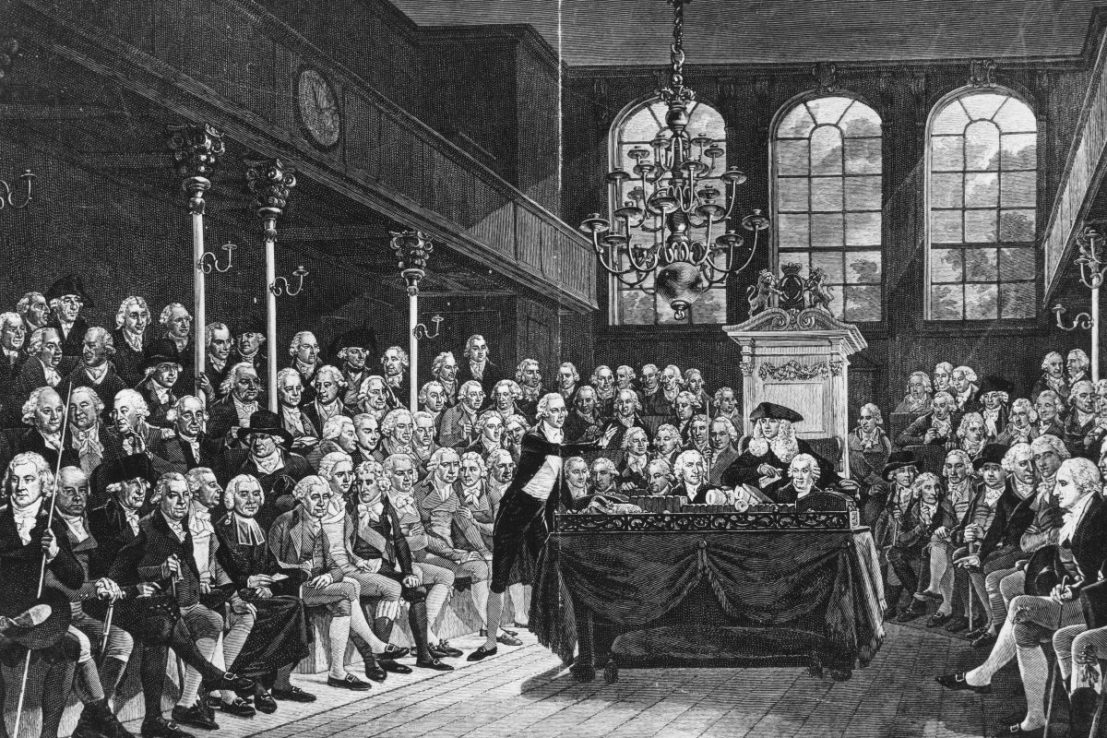
The King needed a fifth Prime Minister in two years. On this day, 19 December, he turned to William Pitt, now 24, to form an administration. It seemed absurd to some: the young Pitt did not command a majority in the Commons, and he was unable to retain any of the previous ministry because he would not include North. Many suspected he was simply a placeholder who would make way for a more experienced figure.
They underestimated Pitt. He had the firm support of the King, and his very youth distanced him in the public mind from the loss of the American colonies. His serious demeanour and support for modest parliamentary reform added to the sense of a new chapter. Within weeks, the Commons passed a censure motion against Pitt, and other defeats followed, but he faced them down and refused to resign as parliamentary and public opinion gradually moved in his favour. A general election in March 1784 saw the Pittites gain a majority of 120, vanquishing Fox and North.
Whig hostess Lady Crewe remarked that Pitt “could do what he pleased during the holidays, but it would only be a mince-pie administration”, one which would not last beyond Christmas. She was wrong: Pitt would be Prime Minister for the next 17 years. He led Britain through the Revolutionary Wars with France, restored the public finances, increased revenue by reforming taxation and expanded the Royal Navy to give Britain mastery of the seas. When he died in 1806, worn out at 46, the country was set for a century as the world’s greatest power.
Eliot Wilson is a writer and historian; senior fellow for National Security, Coalition for Global Prosperity; and contributing editor at Defence on the Brink