Humans have taken solace in the stars for tens of thousands of years. After his mother was diagnosed with cancer Luke Abrahams took a trip to South Africa and amid the grief, found himself comforted by the universe
Last April, I found myself alone in the African bush. It was just after 11am and I was watching a family of elephants guzzle down water from the Sand River. The autumn sun was merciful, as were the seasonal winds sweeping over the tundras of the Sabi Sands private game reserve. The moment would have seemed perfect to an unsuspecting onlooker.
But inside, I was screaming. “Luke, I’ve got cancer,” my mother had recently told me in a broken voice. If ever you’ve been unlucky enough to hear those words, especially from someone so close to you, you’ll know they cut you like a knife. Over the years, I have become all too familiar with the word ‘grief’. Close friends have died, as did a long-term relationship. Faced with the news of my mother’s recent diagnosis, I dealt with it in the most classically ‘me’ way possible: I ran far, far away.
My connection to Southern Africa is familial. My mother is half South African by way of her father, and so it seemed fitting that, despite me being thousands of miles away from her, Mother Abrahams was eerily there in spirit. Travelling has always been my tonic, and after years of grafting and hustling through Britain’s media institutions, I am privileged enough to do it as a job. I often look back at my travels when I’m down, remembering the moments when I was exposed to entirely new ways of living.
When most people think of an African safari, they have visions of lions, rhinos and exotic birds, but I was here for a very different reason: to get lost in the cosmos. Noctourism is a growing trend. With news of planetary alignments, once in a decade northern lights displays, and rare interstellar cosmic events, the stars are once again having their moment. The question is, why? For me, it’s simple. We live in an age of technological narcissism. Our lives are governed not by the cyclical rhythms of Mother Nature but emails and alarms and notifications. What most people crave, including myself, is connection to something larger.
Stargazing and grief: Luke’s stay at the Singita Ebony lodge
Time is also very much the topic du jour. We are always chasing it, and the paradoxical beauty is that when you look up, it is chasing you as you stare into the past. Here especially, out in the wild, you learn the art of pure escapism. The adrenaline rush of being so exposed, so defenceless, and so helpless out in the savannah is a dangerously addictive drug.
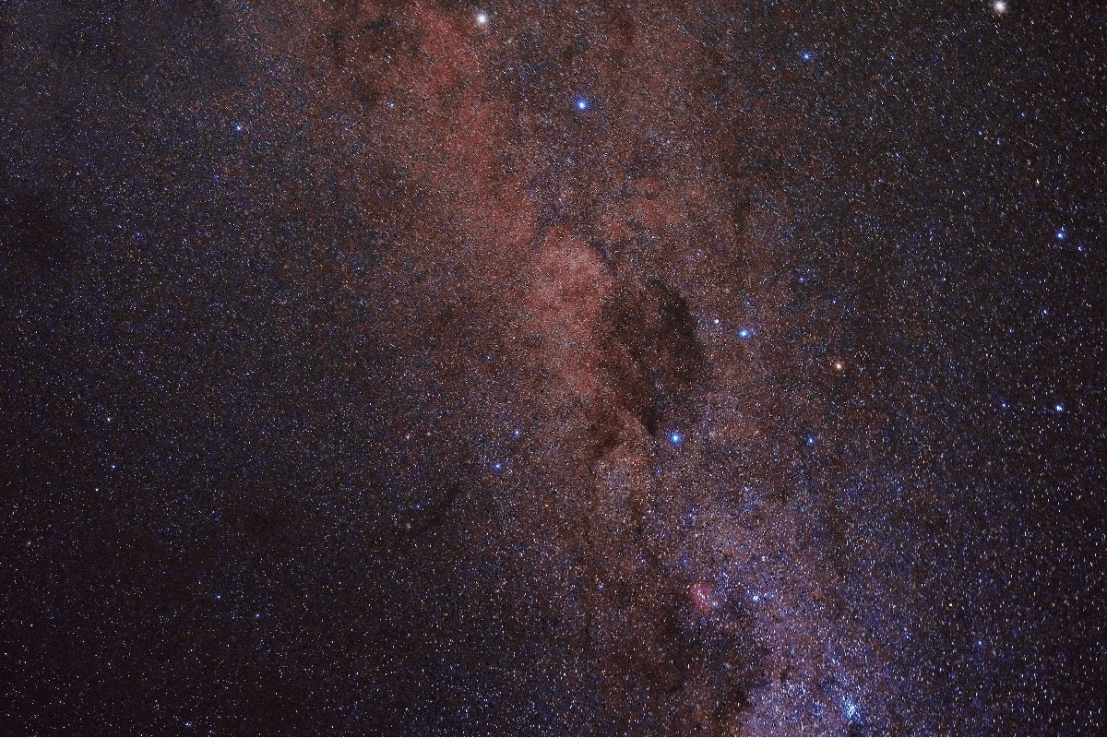
Stargazing is no different. One night I found myself in the middle of Singita Ebony lodge’s stretch of Kruger bushland while out on a drive and I asked my ranger to stop somewhere so I could look at the stars. Ten minutes or so passed and we arrived at an airstrip, the darkest and safest place to see them, I was told. Fuji Film XT5 camera ready, I marched to the middle of the tarmac and set up my tripod to capture a smidge of the universe in all its glory. Looking up for what seemed like an eternity, my eyes finally adjusted.
Like a thin veil of mist, the distant cloud of our galaxy began to reveal itself. As Jupiter began to rise, I felt humble beneath the Milky Way. A sense of awe shot through me. Its immensity feels beguilingly tranquil. I was in a daze, transfixed by the sights of shooting stars, constellations, hurtling satellites and nebula dust. Staring into the centre of our galaxy, my mind felt detached from my body. Cosmic perspective is a rare thing, especially for city types like myself.
The lowly journalist Luke Abrahams and his sick mother will once again swirl through the cosmos. I take great comfort in that.
Over the last decade, a number of researchers have found a connection between star-gazing and mental wellbeing, including the process of managing grief. It forces us to contemplate. A 2016 study by Coventry University found stargazing helps promote wellbeing through what researchers describe as an ‘increased sense of flow through fascination and loss of time’, or as South African researcher Dominic Gregory Vertue put it, “turn negative fixations into larger perspectives.” While cancer, work stress and the odd spell of depression were looming large over my life, they seemed insignificant under the grand scale of the night sky.
A month passed and I encountered the same feeling again in Tanzania. At Singita Explore, the conservation brand’s mobile safari in the Grumeti Reserve, I indulged in a night of planet spotting. I had never stared first hand at Saturn’s giant rings until peering through the camp’s telescope.
Seeing this distant and lonely gas giant only made me appreciate the fragility of our own planet even more. That night I realised for the first time – in my mid-thirties – the sheer unimaginable vastness of the universe. I became obsessed with everything from black holes to pulsars and nebulas, all a welcome distraction from my problems. Though billions of miles away, this space matter both guides and grounds us in ways I never thought imaginable.
Read more: This Botswana safari offers these things others in Africa don’t
Fast forward to January this year, and I found myself in Patagonia National Park in Chile for a few nights at Explora’s namesake lodge on another kind of safari; in search of the elusive puma.
Surrounded by giant snowcapped peaks and rolling hills, its desolate and remote landscapes are among the loneliest on earth. While the puma remained scarce, at night, the magic of this isolated wilderness came alive. At 10pm on a briskly chilly Wednesday evening, I ventured outside and, like clockwork, the sky turned a deep red. Venus, Mars, Jupiter and Saturn aligned with the Earth in near perfect unison. This was a rare and privileged night sky, and after three hours of staring blankly at it, universal contemplation turned to worldly realisation.
I am on a rock hurtling 67,000 miles per hour around a star orbiting a black hole on a 225 million earth year journey around the Milky Way. Along the way, we are dodging asteroids, gamma rays and radiation, things that could wipe us out in less than a millisecond. This cosmic voyage is the greatest journey any of us will ever embark upon, and we are seldom aware of it. While it might sound nihilistic, we will all be dead soon and traces of our existence will soon be lost to the sands of time.
One day, that great big star we see every day will swallow our planet whole and we will once again be nothing but stardust, used once again as building blocks in the pillars of nucleic creation. To some, that might seem terrifying, but the one thing the universe has taught me over the last year, is that there is beauty in death.
All the atoms and electrons that make up the lowly journalist Luke Abrahams and his sick mother will once again swirl through the cosmos. I take great comfort in that.
Read more: Three amazing winter breaks to escape London this January