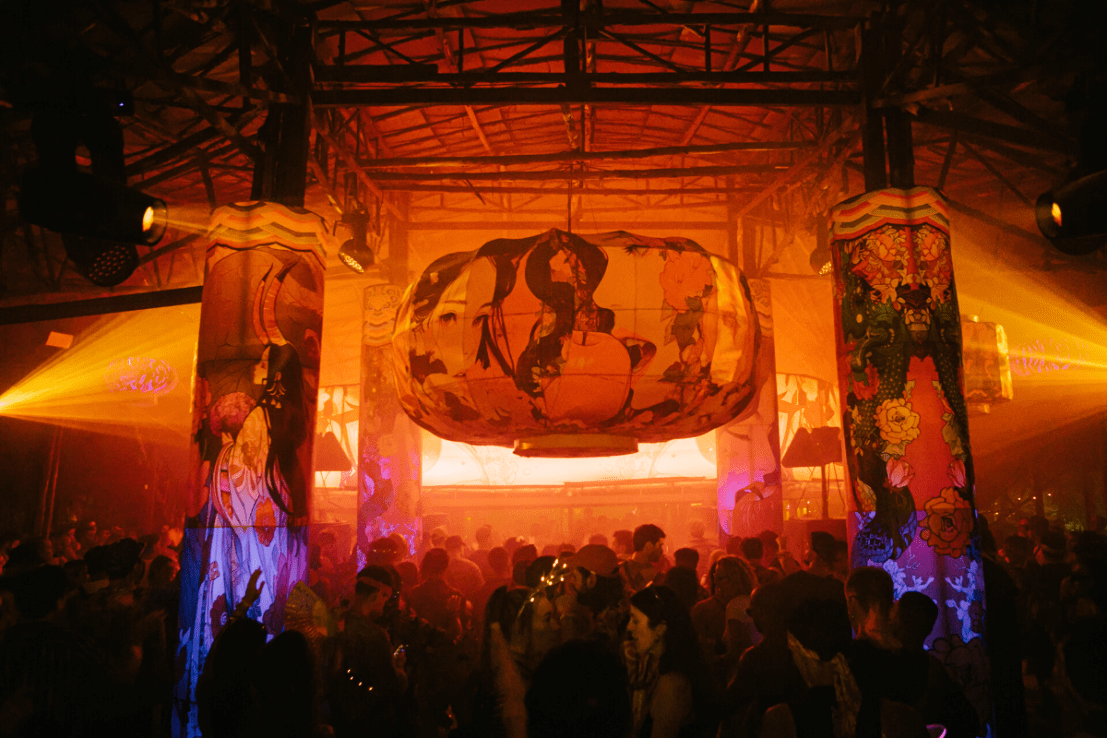
It’s 2am and 24 degrees in Pattaya, Thailand. In a field outside of the city, dozens of people are creating a terrible racket by making weird noises into loud hailers. The sound created could accurately be described as an infernal racket, and it’s being played on the speaker system to hundreds of people, who are laying around in the midnight heat. This is hardly music – more a weird exercise in community forming, the incredible sound of hundreds of people expressing themselves. The gathering together of ordinary noises, turned into an entertainment spectacle. It could only be Wonderfruit.
The festival, launched ten years ago by Pranitan “Pete” Phornprapha and Thai musician Montonn “Jay” Jira, features the sorts of tech-art crossover projects Glastonbury couldn’t dream of. The Polygon Stage is Glastonbury’s Gas Tower given a glow up: a mind-blowing 360 experience with sound that goes beyond the functional, placing speakers in a circle and having people stand inside to create artworks made of noise. Designed like a giant nest, twirls of metal inlaid with speakers spiral above your head, radiating warm neon lights that pulsate in sync with the DJ. At sunrise a track featuring an electronic crescendo plays as the first shards of light stray above the horizon; not quite sunrise, more that special moment an iota before, when the black begins to dim. Under the Polygon Dome, some carry on dancing, but most stand and stare up at the installation, the dancefloor morphing into something worthy of the Tate.
Thailand beyond the Full Moon party: experiencing Wonderfruit and Fly to the Moon
At Wonderfruit, full bottles of spirits are displayed on bar tops to show off the drinks available but no one snatches them. It’s partly because the vibe matches the country’s sun-and-sea image, partly because no-one’s binge drinking, and partly because no one’s a tosser. Weed is legalised and that makes the dance floor a warmer and more gently expressive place than any pumped-up club in the UK. It’s also too hot: you can’t be bothered necking a load of spirits in this heat.
This is shoulders-down partying without the barging about, without the huge headliners, and without the commercial stages enticing you to buy sugary drinks. Multiple venues encourage punters to lay on beanbags like they’re at a sound bath. It is beachfront relaxation but with something to do: surely the solution to all South-East Asia naysayers who lambast the idea of ‘laying around doing nothing’. As a busy Londoner, I’ve always relished the idea of stepping on a plane and heading abroad to experience international festivals. Gig-tripping feels like one of the most authentic ways to experience a city or destination, and certainly a wonderful way to mix with locals.
There are yoga classes and installations recreating traditional Thai houses and workshops with sound, as well as beautiful lakes to swim in. Activities go on all day and all night; after sunrise, special sets take place at a stage with staggering views of the nearby mountains.
It started with the Full Moon Party. The event began as a birthday bash under the full moon in the mid-1980s on Haad Rin beach at the southerly tip of the island of Koh Pha-ngan. During those halcyon days, the event was a jamboree for expressive thought, the sort of place where the people brave enough to go back-packing in the pre-commercial era could come together to look at the stars.
Even by 2000 when Danny Boyle’s The Beach with Leonardo DiCaprio hurled Thailand’s hippy culture into the limelight, heralding a new era of mass tourism, the Full Moon Party was relatively underground. But by the mid-noughties it had become something more cynical; thefts became common; stages collapsed; attendance for the one-night event spiked from hundreds to tens of thousands. These days the tabloids write stories about it. The Full Moon Party has turned into a students’ union transposed from regional England to one of the prettiest places in the world.
But through osmosis, some of the people searching for hedonism began building a new party scene. They are often collaborations between locals and the country’s expat community. Many move there because of the nation’s utopic reputation, but these expats have reacted to the over-commercialism of the Full Moon Party and islands like Koh Pii Pii, where the first thing you’ll see when you get off the ferry is a McDonald’s, by forging new creative paths. The results combine boundary-pushing experiments with music and technology with utterly stunning locations.
After Wonderfruit we drove east from Pattaya back to Thailand’s pounding, frenetic capital. After four hours in the car we reached the chaos of Bangkok, where thousands gather hundreds of metres up in skyscrapers for rooftop parties. On the streets, the bronze of the temples competes in the colour stakes against tuktuks splashed in magnificent primary blue, and there’s the stench of durian fruit from the market. But we sleep before an early rise: a taxi towards the province of Trat near the Cambodian border.
Read more: Can the poshest wellness retreat in Thailand cure me?
At Laem Sok Pier, on the Lae Sok Peninsula, a fiery seafood soup, then the ferry towards the island of Koh Mak for the Fly To The Moon festival. The island is small and not at all touristy. The boat is full of expats who have travelled down from Bangkok. I’m with friends who live in the country and when we board the 100-person ferry, they know a third of the boat. Many are in their forties and fifties, and for one reason or another, have chosen an alternative life away from the conventional pressures of the UK. Here it is rarer to hear conversations about children and traditional heteronormative set-ups; it’s more common to see people from different age groups mingling. For anyone who feels a little out of place in London, these authentic Thailand events provide a refreshing blast of unconventional thought.
On Koh Mak, there is one cash machine. It often runs out of money. There is no 7 Eleven, the popular supermarket chain, on the islands, and just one major concreted road runs around the circumference. You can walk across it at its skinniest point. We were staying at the By The Sea resort and walked over to Koh Mak Fantasia hotel to kayak out to Ko Kham, a close by island with a deserted luxury hotel complex and a lagoon. The annual Fly To The Moon Festival takes place at three remote beaches across the island and has the homemade feel of the UK’s Secret Garden Party. Elaborate stages are built under exotic treetop canopies skirting remote bays. There are hundreds (not thousands) of attendees, so it’s house party vibes but in paradise, and that’s not hyperbole. The intimacy means friendships form, something vanishingly rare at public events. One stage was a massive pirate ship, another a camp-looking dragon with loads of heads. All were about four elaborate dance moves away from the beach and the sea.
We got into a routine: laze on the beach all day then head to the festival to watch the sunset while sitting on the jetty, then dance until 2am before laying for a few hours on the dewey grass before rising again for the pilgrimage to sunrise. Partying in Thailand requires commitment: the culture is to arrive at sunset and stay until sunrise, and with the lunar calendar staying the same all year (sun up at 6am, down at 6pm), you better wear comfy shoes. By 7am people who used to have formal jobs in the City were sharing kayaks with new friends and paddling away from the shore, finding a moment’s peace to take in the night that had been.
Thailand’s Full Moon Party spirit endures. It’s just nowhere near Haad Rin Beach.
Fly to the Moon returns this December; go to flytothemoonfestival.com. Wonderfruit returns in 2026, go to wonderfruit.co