An increasingly vocal group says having children is at best selfish and at worst a moral crime. Cosmic Thapa meets the antinatalists
When we arrive at Speakers’ Corner, an ambulance is parked on the pavement, its blue lights flashing over the crowd as police patrol the perimeter. Preachers balance on step stools waving holy books above their heads, livestreaming their sermons while someone dressed as Superman flies past on roller skates. Next to them, a vegan activist is locked in a screaming match with a man in a leather jacket, jabbing fingers at each other beneath the twinkling lights of Winter Wonderland. Lawrence Anton and his friend Alexi Smith quietly set up a camera among the thicket of tripods and ring lights.
While the crowd clamours for attention, Lawrence keeps to himself, easy to miss in his muted layers. He holds up a placard in front of the camera reading, Procreation Requires Moral Justification, standing serious and unflinching even as a man beside him uses a streetlamp as a makeshift stripper pole.
It’s not long before people slow down their pace, watching Lawrence with curiosity. A man who has been observing them for a few minutes marches over to Alexi, pokes his shoulder and tells him to “die”, scrunching his face into a scowl. Alexi keeps his composure, explaining his point of view in the soothing tone you might use to calm a toddler mid-tantrum. Slowly, a wave of realisation sweeps across the man’s face, smoothing down the folds of his frown. “Oh,” he says, stepping back. “Never mind, I get your point.”
Another man waded into the argument but left laughing at a joke Lawrence made, nudging me as he walked off: “He’s hard to argue with, isn’t he?”
Lawrence, like thousands of others, describes himself as an antinatalist, a philosophy arguing that procreation is cruel and unethical because existence guarantees suffering. Putting his money where his mouth is, at 23 he laid on a surgical table and made a life-changing decision. The air smelt faintly of disinfectant as he stared up at the fluorescent lights above. Nervous laughter broke the stillness of the room as the doctor inserted a needle and made the first incision. “It felt like someone was just fiddling down there. I didn’t realise it had already happened until the doctor said, ‘Mate, I’ve just taken this out of you’,” Lawrence recalls. “It looked like a piece of cooked spaghetti. I really wish I didn’t see that.”
Antinatalist Lawrence Anton at Speaker’s Corner in Hyde Park
As I quietly rethink my dinner plans, Lawrence tells me that his vasectomy was one of the best decisions he’s ever made. “Once we exist, we can have dementia, cancer, be bereaved, lonely, depressed, and cause unintended harm to others. It’s better not to create someone so they’re not vulnerable to any of it.”
Antinatalism’s early ideas can be traced back to Schopenhauer, with strands going back as far as ancient Greece and India. South African philosopher David Benatar, one of the ideology’s key figures, puts it bluntly in his 2006 book, Better Never to Have Been: “[Parents] play Russian roulette with a fully loaded gun… aimed at… their future offspring.”
The movement, unsurprisingly, found a home online. On Reddit’s r/antinatalism forum, 233,000 members discuss its ethics and share personal stories. Lawrence documents his own journey on YouTube, posting educational videos for more than 7,000 subscribers. In these, he discusses the consent of birth, the environmental impact of human life, and the harm we inflict on other people and animals.
Lawrence and I meet in the inauspicious surrounds of Pret in Marble Arch. I can’t help but notice the irony as I weave through a sea of buggies and toddlers darting between tables. “It started when I became vegan, and I realised my views can be completely wrong,” Lawrence says, taking a bite of a vegan croissant. I peek down guiltily at the ham and cheese toastie in my bag; that’s two meals ruined.
Sterilisation isn’t a requirement for antinatalists, but it’s a choice some make. Across the pond in Canada, antinatalist Julia Brown (not her real name), chose to remove her fallopian tubes when she was 34. I reached her through a comment she posted on a video discussing antinatalism; she was eager to share her experience, agreeing to a video call on the condition she would remain anonymous.
“The surgery was simple. It was the recovery that was the worst part,” she says. “I was extremely nauseous and sick. It hurt to do anything.” Despite the pain, Julia says it was worth it in the end.
Unlike Lawrence, who managed to book his procedure through the NHS within a month, Julia was rejected three times by doctors, who were under the impression she would change her mind. “If you don’t have children and you’re unmarried, they won’t consider you, especially if you’re a woman,” she says.
“We’re just baby machines to them,” she says. “But I always knew I didn’t want children. The more I looked at the suffering around the world – war, death, colonisation – the more I realised antinatalism was the way to go.”
Though the movement is controversial, scepticism around parenthood is hardly fringe. Many are questioning whether they really want children and birth rates in developed countries continue to fall. In the UK they dropped to a record low in 2025, and a YouGov report earlier this year found almost 30 per cent of 18-40-year-olds without children say they definitely don’t want them in the future. While financial pressures topped the list of reasons, the second most common factor was the state of the world. This trend applies globally: a UN report found that a fifth of people over 50 have chosen not to have as many children as they would otherwise have liked due to fears for the future of the world, including climate change, wars and pandemics.
During my nightly doom-scroll, I stumbled across one of these people: Jannah Santana. Although she doesn’t describe herself as an antinatalist, she relates to some of their views. “The world is f*****d: hunger, poverty, everything going on in Palestine, bloody genital mutilation…” she says. “I love children and that’s why I would never want to bring them into this place just to leave them to deal with the consequences.”
Jannah, 31, describes herself as a life coach, posting advice videos on TikTok including a fiery rant against men who tell women they should have children. “I get a lot of comments from people online saying I’m too young to know and that I’ll change my mind,” she tells me on a video call, her voice tightening with frustration. “And then when they find out I’m 31, they tell me I’m damaged goods and too late to have kids anyway.”
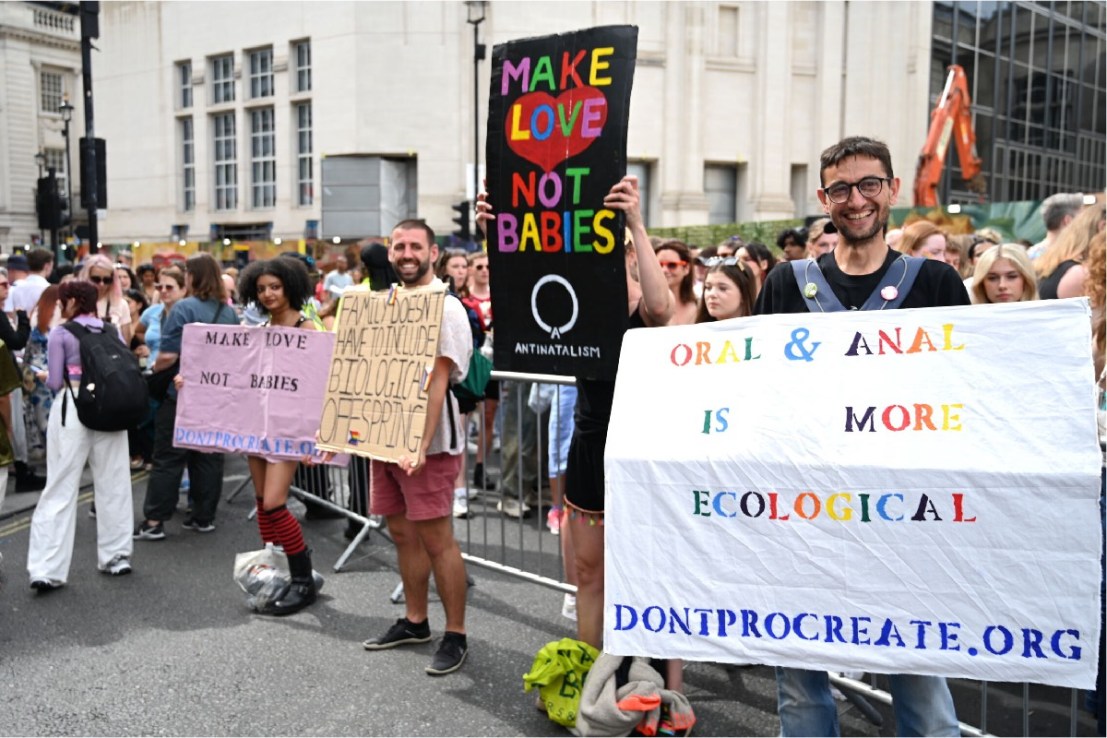
Lawrence is no stranger to hostility, either. “People get pissed off and ask me why I haven’t killed myself,” he says. “All antinatalists are saying is that it’s not okay to create new life. But when you’re here, you can do as you wish and make the most of it.” Lawrence often campaigns alongside other antinatalists around London, their placards bearing slogans including: “Make Love Not Babies”, “The Only Perversion is Reproduction” and, my personal favourite, “Oral & Anal is More Ecological”. This is how I ended up at Speakers’ Corner, where he arrived alongside his friend Alexi Smith, 31, the latter lugging three tightly packed equipment bags. Alexi volunteers to help Lawrence film some of his content, having met him online after stumbling upon his YouTube channel.
Originally from Nicaragua, Alexi was adopted at 19 months old, alongside his sister Tania, by his British mother Jenny Smith. Both born into extreme poverty in the early 1990s, Tania had been hospitalised seven times due to malnutrition before she was even a year old. “It’s really weird but I never really gave adoption much thought before I became an antinatalist. Unlike my mum and sister, who feel very strongly for it,” Alexi says. “Since becoming one, it’s given me more of a relationship and a peace with it that I never had before. There’s a lot of kids out here who need love and care,” he says.
Alexi tells me his beliefs have caused difficulties in romantic relationships. “When I first met my now ex-girlfriend, I wasn’t an antinatalist. I sort of had these thoughts in the back of my mind, but I didn’t know it was a thing,” he says. After researching the philosophy, Alexi decided to tell her. “It caused huge problems. She definitely wanted children. She came from a big Irish family, and it was really important for her,” he says. “It’s crucial next time for me to tell them upfront, before we get hurt.”
Nimrod Harean, an antinatalist from Israel, makes a colourful case for alternative methods of gratification
The movement has recently found itself dragged into headlines for the wrong reasons: the bombing of a Florida IVF clinic earlier this year, carried out by 25-year-old Edward Bartkus, has led to accusations the fringe philosophy is dangerous. In a manifesto on his now-deleted website, Bartkus said he planned to attack an IVF clinic because he didn’t consent to exist. He described himself as a pro-mortalist, a more radical offshoot of antinatalism that argues it is better for existing beings to die. Bartkus died at the scene and four others were injured.
His website also mentioned the subreddit r/efilism, which had 12,000 members before it was banned after the bombing. A play on the word “life” spelt backwards, the term was coined by a YouTuber known as ‘Inmendham’ to emphasise that all suffering, not just human, is “the greatest problem in the universe”. Some users migrated to the r/antinatalism subreddit, while one user created r/efilism2.
The Florida bombing is one of countless examples of fringe philosophies spreading online before violently entering the public arena, of how isolated people can fall into extremist interpretations of otherwise non-violent ideologies. Jack Jiang, an anthropologist and PhD researcher at the New School for Social Research, says digital spaces have played a major role in amplifying antinatalism. “By nature, online communities get into feedback loops, so niche philosophical movements grow out of that condition. There can be something conspiratorial about it,” he says.
“Antinatalism absolutely does not encourage extremists,” says Lawrence. Just like being pro-choice or anti-communist, someone could adopt [any view] and rationalise it in their head to enact violence… If someone bombs a fertility clinic, they’re very likely mentally unwell.”
Alexi stresses that while some within the community can express negativity or take the idea to extremes, this does not undermine the philosophy’s fundamental message – to prevent suffering and pain. “It was a terrible thing that happened. Thank goodness no innocent people were killed,” he says. “Hurting others and causing harm to yourself is not in line with the true philosophy behind antinatalism. It’s all based on compassion.”
By the time we leave Speakers’ Corner, the air has turned sharp and cold. “I know most people here are set in their beliefs, just like me, or here to watch the spectacle,” Lawrence says, as we make our way out of the gates. “I’m not expecting everyone to agree. I just hope at least one open-minded person sees my videos… or at least leaves thinking more consciously about their choices.”