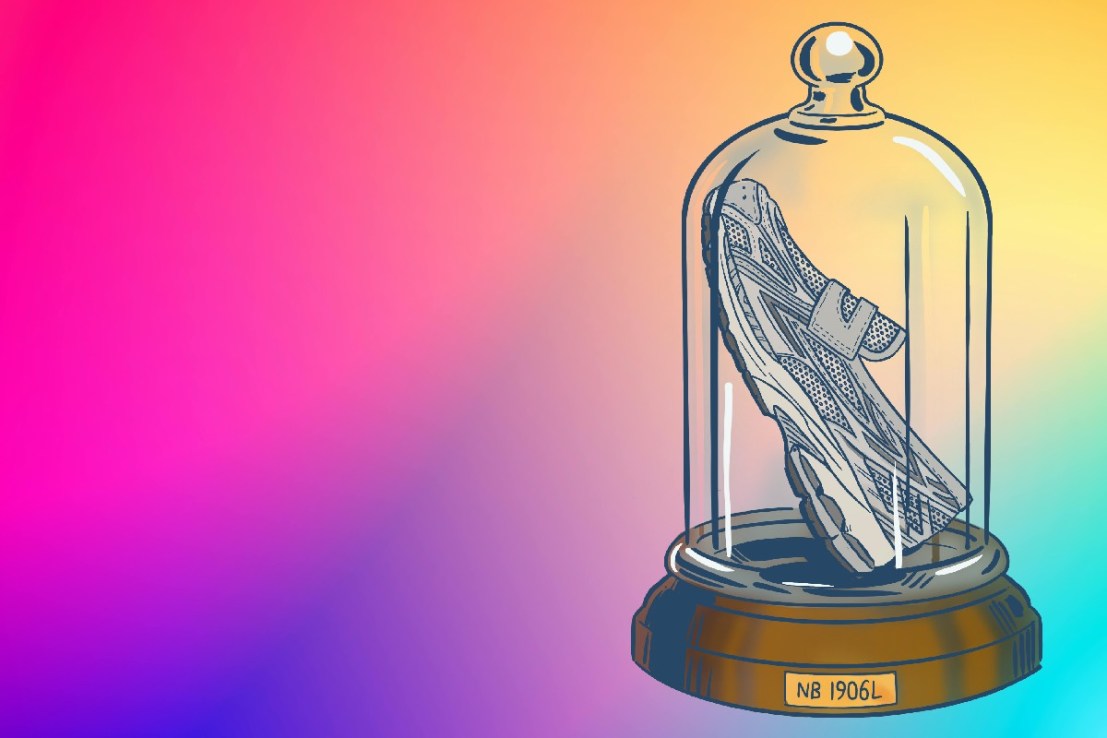
What does it say about society today that the shoe that most succinctly and perfectly typifies it also happens to be its ugliest? I am talking, of course, about the New Balance snoafer.
Officially called the 1906L, it boasts the silhouette of a penny loafer and the comfort of a sneaker, though it doesn’t fully belong to either camp. First debuting at Junya Watanabe’s Paris Fashion Week show in 2024, the snoafer quickly caught everyone’s attention. It didn’t have the sleek glamour of a stiletto or the flash of a maximalist sneaker, but it had something else: an unapologetic practicality wrapped in a self-aware awkwardness.
Social media quickly latched on, with some users poking fun at its dorky aesthetics while others praised its practical, hybrid nature. In TikTok “fit check” videos, you’ll see them worn with oversized trousers and chunky knit sweaters one day, then with cropped skirts and sharp blazers the next.
What’s perhaps most interesting isn’t the snoafer itself but what it says about the world in which we live. In an age of fading dress codes and an obsession with quiet luxury and comfort (Covid restrictions ushered in an era of athleisure that still influences fashion and culture today), the 1906L feels like the ideal shoe for an era with an identity‑crisis. It seems to ask: Who are we, really? Or, perhaps: Who do we want to be?
The 1906L represents “anti-perfectionist fashion,” according to Peter Martinez, co-founder of the Leather Skin Shop. “It’s deliberately awkward, comfortable and refuses traditional categorisation,” he says. “Most importantly, it says you are dressing for your real life, not an idealised version of it. The 1906L offers a compromise: it is professional enough for most office environments but comfortable enough for someone who’s been wearing slippers for two years. It represents the post-pandemic workplace reality where formality feels performative rather than professional.”
The ultimate dad shoe has now become a Gen Z favourite, with younger wearers drawn to its rule-breaking aesthetic
Stylist Julie Matos agrees: “The 1906L hits that post-pandemic sweet spot: structured enough for a meeting, comfortable enough to wear from the subway to a client dinner. The hybrid lifestyle so many of us are living now demands versatility, and this shoe delivers.”
The athleisure fits that dominated runways after stay-at-home orders came from a similar mindset. At first, this hybrid style seemed unsure of its place in the fashion world but, on closer inspection, it was redefining the rules of what you can wear.
The snoafer does the same. Perhaps most illustrative of the shoe’s uncanny reflection of the here and now is who is wearing it. According to both Martinez and Matos, the core audience spans Millennials and Gen Z, but for different reasons.
“The ultimate dad shoe has now become a Gen Z favourite, with younger wearers drawn to its rule-breaking aesthetic and comfort-first philosophy,” says Martinez. Creative professionals have also adopted it in droves, folks whose careers demand adaptability and elasticity.
The 1906L, after all, isn’t about picking a lane but dismantling the system all together. It’s a polished yet laid-back shoe. In a culture obsessed with categorising, it’s a rare product that refuses to be boxed in – a fact that paradoxically turns it into a statement: the whole point of today’s fashion is that we don’t have to choose between versions of ourselves anymore.
• Anna Rahmanan is a culture writer based in New York