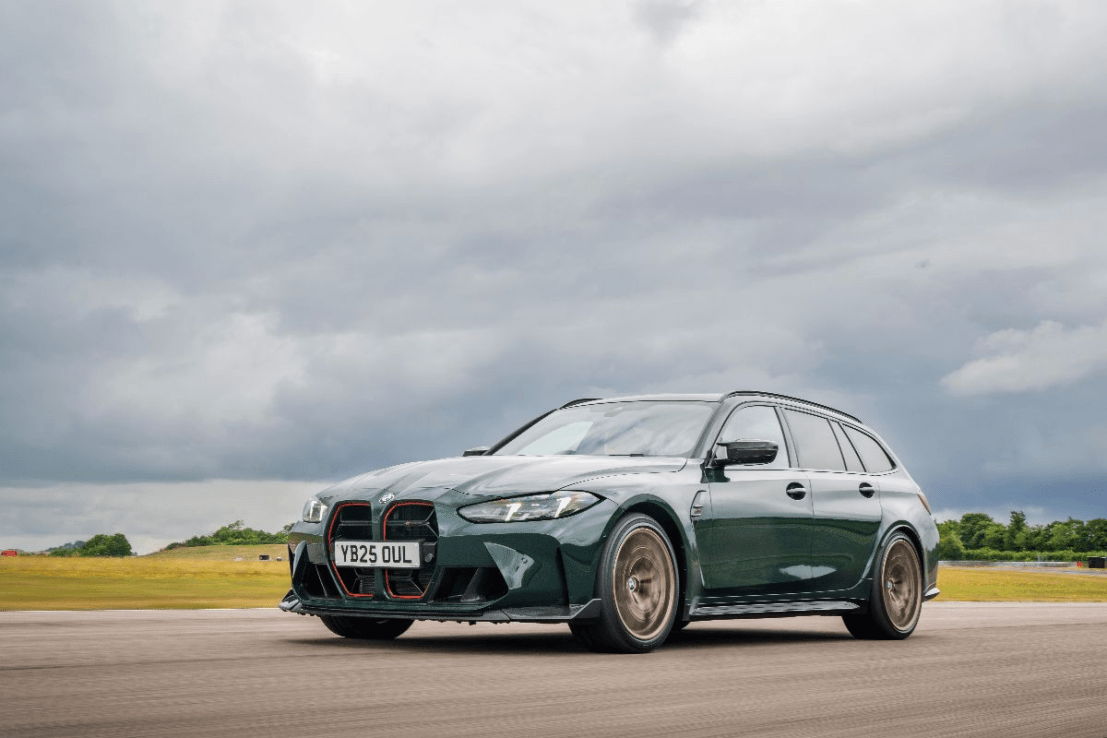
Powerful estate cars have traditionally been Audi’s territory, but BMW is fighting back. The first ever M3 Touring was launched in 2022, followed by the larger M5 Touring last year. Now there is a faster, more focused ‘CS’ evolution of the M3 wagon. If you want to outpace Porsches on a circuit, then lug an old filing cabinet to the tip, you are reading the right review.
The ‘Competition Sport’ versions of the M3 saloon and M4 coupe both achieved critical acclaim and sell-out success, so it seems logical for the estate to receive the CS treatment too.
Or does it? The heaviest, most practical car in the range is hardly an obvious starting point for a track-day tearaway. And at £126,375 – around £33,000 more than a standard M3 Competition Touring – the CS is fearsomely expensive. Can the talented folk at BMW M GmbH make it make sense?
BMW M3: Estate of the fast
Let’s start with some numbers. The CS is powered by the same 3.0-litre straight-six as the Competition, but bolting on larger turbochargers from the exotic M3 CSL lifts its output from 510hp to 550hp. Drive goes to both axles via an eight-speed automatic transmission – or you can change gear manually using new shift paddles made from carbon fibre reinforced plastic (CFRP).
A token 15kg saving means the CS weighs in at 1,850kg. That’s nearly 300kg more than the revered E46 M3 of the early 2000s, but also a whopping 700kg lighter than the current M5 Touring. Zero to 62mph takes 3.5 seconds, 124mph arrives in 11.4 seconds and top speed is 186mph. A lap time of 7min 29.5sec also makes the M3 CS Touring the quickest production estate car around the Nurburgring.
Back in the real world, the CS still offers space for five people and the same 500 litres of luggage – or 1,510 litres with the rear seats folded down. A split tailgate with a separately opening rear window also helps to access the boot in tight spaces.
Join the green party
Its huge nostrils still divide opinion, particularly with the lipstick red garnish seen here, but the BMW certainly packs plenty of presence. Adaptive M suspension, flared wheelarches and forged alloy rims (19 inches at the front, 21s at the rear) provide a squat and purposeful stance, while yellow daytime running lights are exclusive to the CS.
More lightweight CFRP can be found on the M3’s body, including its bonnet, front splitter, rear diffuser and door mirror caps. There is a choice of four paint colours, including retro Laguna Seca Blue (first introduced on the E46) and the British Racing Green seen here, which looks achingly cool when paired with matte gold bronze wheels.
Dynamic modifications comprise new springs and adaptive dampers, revised geometry, stiffer engine mounts and a substantial front strut brace to strengthen the M3’s shell. The twin-turbocharged six is hidden beneath black plastic, but the blue, violet and red stripes of BMW M on its cam cover have a potency all their own. To business, then…
Inside the BMW M3 CS Touring
Apart from a simplified carbon fibre centre console with no cup holders, the BMW’s dashboard looks almost identical to the standard M3 Competition. You get the same 14.9-inch central touchscreen, which works well despite the dearth of physical buttons.
Red ‘M1’ and ‘M2’ toggles on the chubby, Alcantara-wrapped steering wheel provide quick access to your preferred powertrain and chassis settings. There are one-push shortcuts to switch off annoying driver aids, such as the speed warning beeper, as well.
The heated bucket seats, with their odd-looking carbon fibre ‘codpiece’, lock you in position tightly – a little too tightly, perhaps, for those of a more generous build. There’s no comfort seat option in the CS, however, so you might have to follow the car’s example and lose a few pounds. It will be worth it.
BMW M3: Batteries not included
Hold down the red start button and the BMW’s engine barks gruffly into life, then idles intently. An angry snarl spews forth from its new titanium silencer and four fat tailpipes. Straight away, in the 50-metre test, the CS feels taut and eager for action – whether that action is blitzing a racetrack or collecting garden furniture from B&Q.
A 550hp output looks pretty modest in 2025 – especially when compared to EVs such as the Porsche Taycan or Lotus Emeya – but BMW’s inline six is a ball of exuberant energy. Thrillingly muscular in the mid-range, it spins up furiously to a 7200rpm cutoff, making light work of the Touring’s still-hefty kerb weight.
When this G80 generation of M3 was launched (officially, the estate model’s codename is ‘G81’), there were mutterings about its ZF automatic transmission, which is inherently slower and less responsive than a dual-clutch ’box. My 2023 review even called it ‘the only chink in the M3’s armour’.
Driving the CS Touring today, though, I wonder if my initial criticism was too hasty or the software has been updated. Shifts feel quick, crisp and mechanical, delivering just the right level of drama and encouraging you to take control via the paddles.
Baby’s got the bends
If its engine and gearbox provide the M3’s thumping backbeat, nuanced steering and handling are the melody on top. Its limits are higher than the 510hp Competition, particularly on dry roads with the optional Michelin Cup 2R rubber fitted, but the quality of feedback is also elevated. More than any of the ‘super SUV’s that could be considered its rivals, the CS drives like a sports car.
Chiefly, that manifests in a superb sense of balance; you feel like the axis around which the car rotates. The M carbon-ceramic brakes (a pricey £8,800 option) bite hard and the nose turns in aggressively, its damping firm and resolute. Then you exit the corner with slingshot four-wheel-drive traction – perhaps even a prod of the throttle to smudge the rear tyres sideways. It’s precise and predictable, with less zealous stability control (DSC) that is more willing to let you have fun.
On a circuit, the CS would doubtless be a riot – and reports from early drives at Thruxton suggest as such. However, I have my doubts about how many owners will subject their six-figure family car to a track day. Wouldn’t it be easier just to buy an M3 Competition Touring and spend the leftover £33,000 on a Caterham Seven or Lotus Elise instead?
And that’s the crux, perhaps, because the CS’s unflinching and occasionally jarring ride does compromise it as a road car. If many of your journeys are low-speed trundles around town, rather than maximum-attack laps of the Nurburgring (hello, guilty as charged), the standard M3 will be easier to live with.
Verdict: BMW M3 CS Touring
That said, given the money-no-object choice between regular M3 rare-groove M3s, I’d still plump for the CS. Its tuned engine and sharper chassis add an extra layer to the driving experience, even if ride comfort suffers a little as a result.
The CS also looks more special and will be built in modest numbers for a limited period (the M3 saloon and M4 versions have already disappeared from the BMW configurator). If you can afford the upfront premium, that means resale values should be stronger than for the standard Touring, too.
There’s at least one rational argument for buying a CS, then. Despite its versatility, though, this is a car that appeals to the emotions, rather than on a logical level. But who says cars always have to make sense?
• Tim Pitt writes for Motoring Research
BMW M3 CS Touring
PRICE: From £126,375
POWER: 543hp
TORQUE: 479lb ft
0-62MPH: 3.5 seconds
TOP SPEED: 186mph
FUEL ECONOMY: 26.9mpg
CO2 EMISSIONS: 238g/km