After winning Cardiff’s first Michelin star, Gorse is opening a new chapter for fine dining in the Welsh capital, writes Carys Sharkey
On a quiet street in the leafy Pontcanna neighbourhood of Cardiff is Gorse. A small, unassuming restaurant with an open kitchen and just a handful of tables, Gorse is the first place to be awarded a Michelin star in the Welsh capital. This is pretty surprising given that Wales is home to some of the best produce in the UK, and there is no shortage of starred restaurants across the country. But Welsh fine dining often feels attached to place; that the food must be destination worthy and enjoyed in situ, where you can smell pine resin in Powys or the salted breeze in Pembrokeshire.
And because of this, Cardiff has spent a long time in the shadow of other ‘foodie’ parts of Wales: the harder to get there, the sweeter the fruits will taste. But is the emergence of Gorse, and the winning of Cardiff’s first star, a sign of change? A cloche lifting on the capital? It should be said that there are already some really great places to eat in Cardiff, but Gorse, with its modern-Welsh tasting menu, seems to be laying down a new, and assuredly impressive marker.
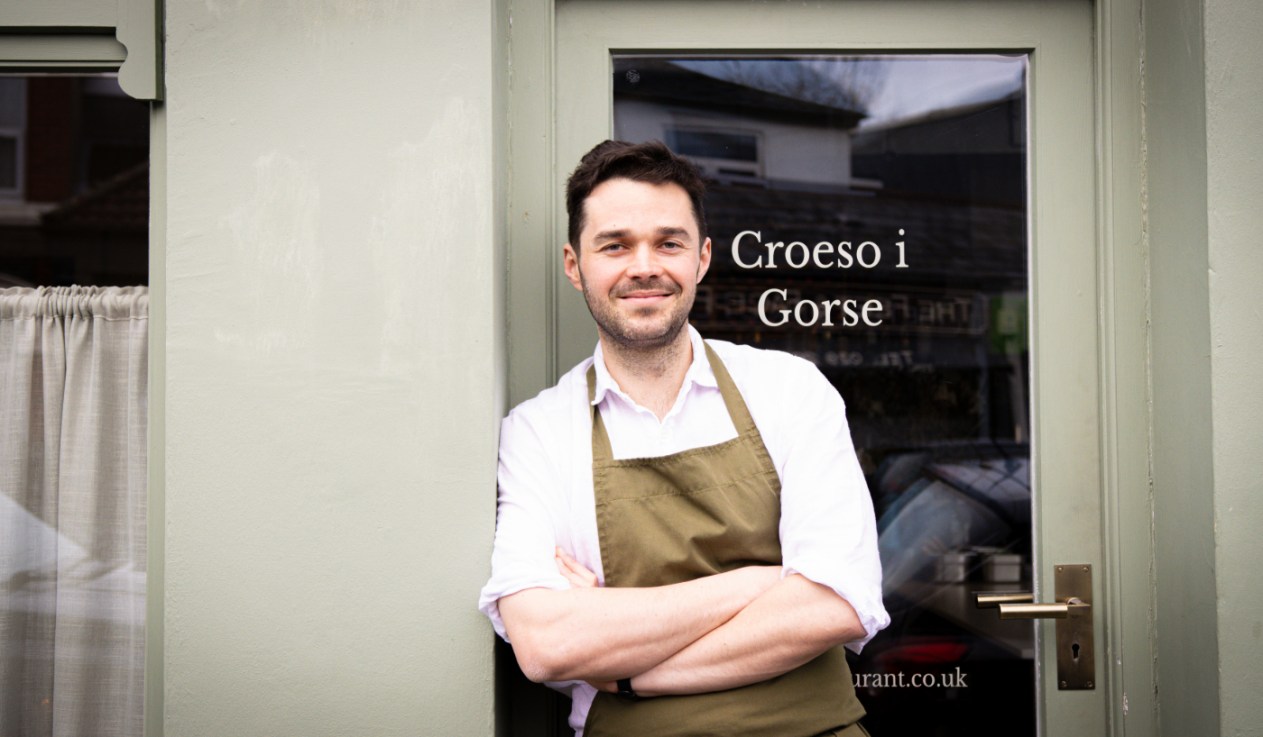
The restaurant is headed up by chef Tom Waters, who worked at a string of acclaimed restaurants, including The Square and The Fat Duck, before moving back to his native Wales. Waters says Cardiff has “come on massively in the last five years or so”, and now he has the chance to “play a role in pushing this narrative forward”.
“Comparatively, Cardiff doesn’t have the same culinary clout that London does in England. We’re trying to do our bit to change that. I spent a lot of my youth in Cardiff and live here now and love the city, so I want to see it go from strength to strength”.
Will Barker
For Waters, central to both Gorse and Cardiff’s narrative is the abundance of world-class Welsh produce, and the urge to capture a “snapshot” of the country in a concise tasting menu.
“The inspiration is Wales in its entirety, everything from the produce to our history, our culture and our landscape. We want to reflect this in everything we do,” Waters says
What’s most striking about Gorse is how gentle and lilting the cooking is. There is none of the spikiness of its namesake, but rather an undulating ripple of courses that never rely on a single showstopper. Waters is a chef that seemingly doesn’t need to use open flame or copious amounts of salt and fat to make his food sing. This quiet confidence starts with a broth of native seaweeds, an umami-rich Celtic dashi. More snacks follow, playfully reverent of Welsh produce: a mound of smoked pike-perch roe sits on a Communion wafer of rye; a cornetto of preserved mushrooms and juniper tastes like a woodland floor, sharp and earthy; and cubes of bara brith are topped with the sharp funk of mature Caws Cerwyn, pickled walnut and winter truffle.
The open kitchen is tucked away in the corner of the room, and it’s only after finishing the snacks that it strikes me just how quiet it is. On the design of the restaurant, Waters says “we wanted to make the space feel open and unpretentious but also holding a certain type of luxury and elegance that doesn’t immediately hit you when you first arrive.”
When I visited, Waters and a team of two chefs worked silently on induction hobs. There is no clatter and chatter, no screaming ego. The front of house team has mastered the same friendly and effortless ease, creating a laid back atmosphere in an intimate space.
Will Barker
Turning back to the food, next comes marbled orange cubes of lightly cured trout with a horseradish cream and a jumble of roe, the rich salinity of which is cleverly cut through by a gelatinous tomato broth. It’s a textural delight. A salt-baked slice of yielding kohlrabi sits in a puddle of buttermilk split by fig leaf oil and adorned with diaphanous slices of pickled green strawberry. The fish course is monkfish with lovage sauce and young leek puree. It’s the only time I found myself wondering if this was too restrained, if the fish would have been better served with a bit of aggression behind it, a bit of force and fire. It was a short lived daydream – the fish was balanced perfectly by the gently sweet and herbaceous sauces.
Gower salt marsh lamb – the crown jewel of Welsh produce that Waters labels “some of the best in the world” – is served here in plump, blushing slabs with a scattering of sea vegetables and punctured by a lavender gel and the pop of pickled mustard seeds. It’s simple and supreme confidence in the quality of the ingredients. The ‘second serving’ of the meat course is slow-cooked lamb shoulder with barley, puffed spelt and a generous lick of mustard. Hearty and refined, it feels like a Welsh cross between steak tartare and cawl (a hearty Welsh lamb stew). The dishes are served with golden-shining, salt-capped Parker House rolls for mopping up the juices. Generous cooking, delicious food and no culinary sleight of hand.
At this point in a tasting menu, it’s normal to feel slight relief to move onto the puddings – your taste buds, bombarded, are ready for sweet release. But you never feel like anything is too much at Gorse, you barely even register that the switch has happened as Waters’ cooking lulls you blissfully along as midday turns to two.
Will Barker
A salted buttermilk ice cream perched in a woodruff sauce with the velvet texture of sabayon sits on sharp raspberry. It is the best pudding I’ve had all year. A second dessert of oat llymru (‘flummery’ in English) is like a Welsh creme caramel, a toasty savouriness sweetened by apple caramel and elevated by a smoked cherry jam. The meal is rounded off with Afon Mel honey and meadowsweet cake – which, sacrilegious as it may sound, is very similar to St John’s iconic madeleines, but perhaps even better.
Waters says Welsh food is having a “reawakening”, and the team at Gorse is doing its bit and then some to get people to take notice. It represents Wales more broadly by putting its capital firmly on the fine dining map and proving that a little wind-swept, salty-green piece of land bracing into the Atlantic has some of the finest produce in the world. This small restaurant in a corner of Cardiff shows just how good the Welsh are at punching above their weight.
https://www.gorserestaurant.co.uk