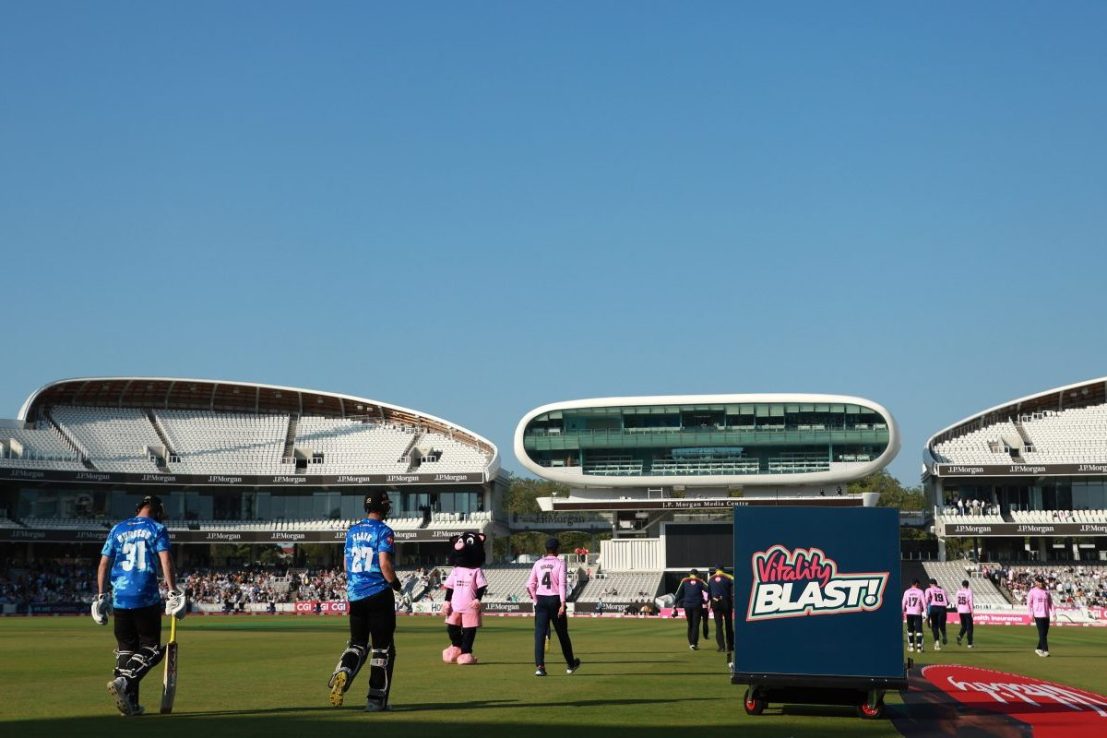
Middlesex will play just two Twenty20 Blast matches at Lord’s next year in a further indication of their declining foothold at the Home of Cricket.
The 13-time county champions have been tenants at Lord’s since 1864 and have a 12-month rental agreement with the Marylebone Cricket Club that is renewed on an annual basis, but increased demand for the ground following the creation of the Hundred and the growth of women’s cricket has led to the club increasingly being forced to play elsewhere.
While the county fixture schedule for 2026 has yet to be confirmed, City AM has learned that following talks between MCC and Middlesex it has been agreed that just two of their seven Blast home games will take place at Lord’s.
Middlesex played four Blast home games at Lord’s this year, with the other three taking place at Merchant Taylors’ School. Other out grounds at Radlett Cricket Club and Uxbridge have also been used in recent years.
In 2024, Middlesex caused controversy and upset some members by moving two home Blast fixtures to Chelmsford in Essex, but still played four matches at Lord’s. Despite the move being successful financially, the experiment was unpopular and is unlikely to be repeated, with the displaced Blast games set to be switched to other small grounds within the county such as Richmond Cricket Club.
Middlesex retain a good relationship with MCC, whose hand has been forced by the busy international calendar in 2026, which has been exacerbated by England hosting the women’s T20 World Cup, with Lord’s staging four matches including the final.
To compound matters, the Blast has been moved forward next year so finals day can take place before the start of the Hundred in August. It means the group stages clash with both the women’s World Cup and the men’s Test match between England and New Zealand at Lord’s.
Demand for the ground is growing generally, with the MCC understood to have had requests to stage 73 fixtures with only 60 match days available. Lord’s will also stage a women’s Test for the first time next summer between England and India, as well as two men’s Tests and a one-day international.
The MCC declined to comment, but club sources said that their priority remains maximising the amount of first-class cricket played at Lord’s, both for their members and those of Middlesex. It is anticipated that Middlesex’s Lord’s allocation of Blast games will return to normal in 2027.
Battle for brands
Chelsea’s search for a long-term shirt sponsorship deal could be further complicated by Tottenham Hotspur entering the market at the same time. Tottenham last week announced the end of their 10-year partnership with insurance company AIA Group Limited, who will move to become the club’s training kit sponsor at the end of next season, leaving the front of their shirt available from 2027 onwards.
Chelsea have not had a permanent shirt sponsor since the club opted not to extend a £40m-a-year deal with mobile phone company Three in 2023, with no companies willing to meet their £60m-a-year valuation.
The club have begun the last three seasons without any front-of-shirt branding, before doing short-term deals with Infinite Athlete and Dubai-based property developers Damac, but have not brought a partner on board this season.
Tottenham have endured a similarly fruitless search for a naming rights partner since moving to the Tottenham Hotspur Stadium six years ago, and their commercial team will be extremely busy in the coming months. In addition to naming rights and a shirt sponsor Tottenham will also soon be in the market for a new sleeve sponsor, with their existing deal with crypto platform Kraken expiring at the end of next season.
Tottenham have also begun selling individual sponsorship deals for each of the stands at their 62,500-seat ground. SI Tickets became the first new partner to come on board earlier this season, but sponsorship deals for the three other stands remain available.
Franchise time
English rugby’s seemingly inevitable move to a franchise model is set to be officially confirmed at a meeting of the Rugby Football Union Council in February. Prem Rugby have been advocating franchising for some time as a way of attracting more investment to the sport following the financial problems that led to insolvencies at Wasps, London Irish and Worcester Warriors, with Newcastle Falcons spared a similar fate after Red Bull’s takeover last summer.
The RFU Council last month offered “unanimous” support to proposals that have been developed by the Men’s Professional Game Partnership (PGP) to move to a licensing system which would offer Championship clubs the possibility of promotion based on meeting strictly defined criteria, but a regulation change is required to make it a reality. A formal vote has been scheduled for the Council meeting in February with a view to moving to a franchise system for the 2026/27 season.
Wages blast into orbit
A handful of big-name players appear likely to be the major beneficiaries of the 45 per cent increase in budgets in the men’s Hundred next year, with the minimum salary for in the competition remaining at £31,000. A number of the new Hundred investors are understood to have wanted to reduce the minimum wage for the four-week competition to free up funds for star signings in their enhanced £2.05m budgets, but that was resisted by the Playing Working Group that introduced the changes, which were approved by the Hundred Board last week.
The minimum salary on offer in the women’s competition has been increased by 50 per cent to £15,000, which was the highest pay bracket when the Hundred launched four years ago, as the ECB and the franchise owners move closer towards gender parity. The overall budget for women’s teams will be £880,000, a huge increase on the figure of £120,000 in 2021.
Dent in Wolves’ pocket
Middlesbrough received an eyebrow-raising £3m this week in compensation from Wolves for manager Rob Edwards – more than double his annual salary – after raising the spectre of reporting the Midlands club to the Premier League for making an alleged illegal approach.
The Championship club are renowned as formidable negotiators, and succeeded in gaining compensation from Derby County over their 2018/19 Financial Fair Play breaches three years ago after filing a complaint to the EFL, on the grounds that their rival’s overspending had cost them a play-off place.
Securing £3m for releasing a manager is unheard of in the Championship, with Wolves agreeing to buy out almost all of the two-and-a-half years remaining on Edwards’ contract.