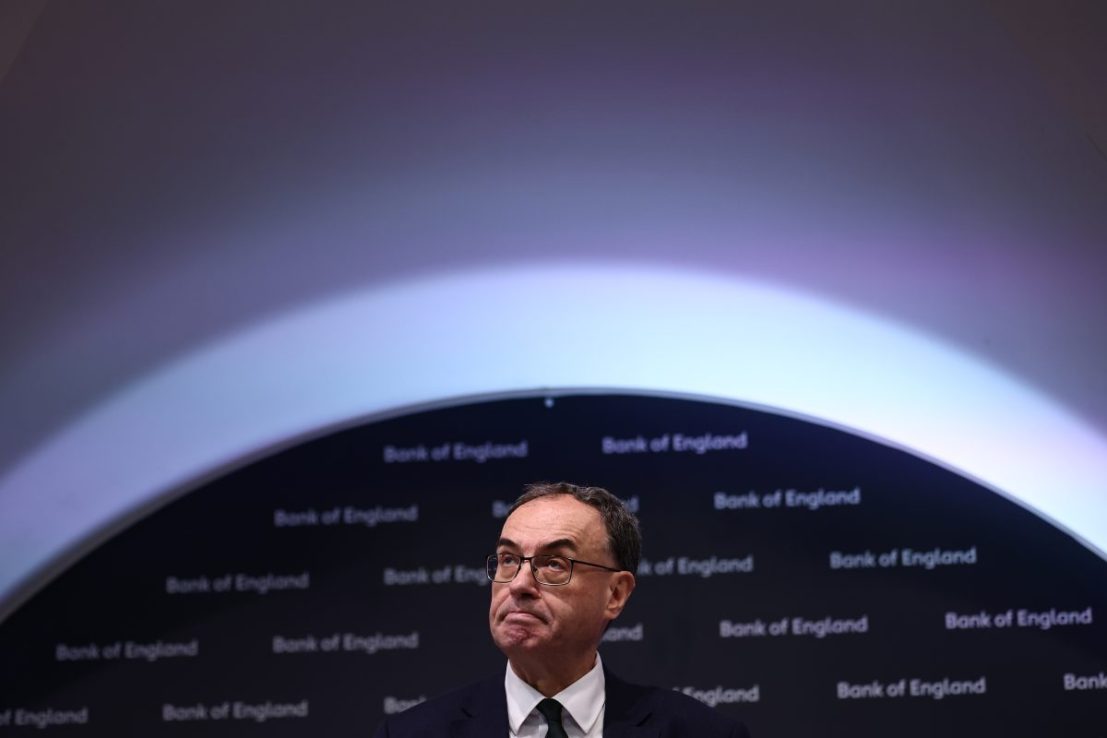
The Bank of England has held interest rates at four per cent amid caution around high inflation levels ahead of Chancellor Rachel Reeves’ crucial Budget in three weeks.
The Bank’s Monetary Policy Committee (MPC) voted 5-4 to hold interest rates as Governor Andrew Bailey, who made the deciding call at the latest meeting, said he would “prefer to wait” before backing further cuts.
Policymakers at the Bank said the crunch decision weighed up contractions in the jobs market, which could lower inflation levels, and high inflation expectations of around 4 per cent among households in recent months, which would have the adverse effect.
Inflation is only set to hit the Bank’s two per cent inflation target in the second quarter of 2027, gradually falling from its current level of 3.8 per cent. The Bank’s forecast made the same assumption in its last August report.
The UK economy is expected to grow by 1.4 per cent both this year and in 2026. It revised its estimate up slightly for the current year but lowered it for next year.
GDP growth is then expected to surge to 1.7 per cent in 2027 and 1.8 per cent in 2028.
Bank policymakers clash on interest rates
The Bank ditched “careful” from its policy guidance and said rates were on a “gradual path downwards”, with the minutes to the meeting highlighting that CPI inflation rate had “peaked” at a rate of 3.8 per cent.
In an explanation for his policy decision, Bailey left the door open to voting for policy to be loosened in the coming months.
“Upside risks to inflation have become less pressing since August, and I see further policy easing if disinflation becomes more clearly established in the period ahead,” Bailey said.
“Rather than cutting Bank Rate now, I would prefer to wait and see if the durability in disinflation is confirmed in upcoming economic developments this year.”
Some Bank officials were worried about elevated wage growth, with pay excluding bonuses rising 4.9 per cent in the three months to August.
Others, however, were more fearful about further drops in vacancies and further damage to the UK jobs market.
The Bank’s central projection slightly revised up its peak unemployment rate to 5.1 per cent in the second quarter of next year.
Rising levels of savings among the Britons, keeping consumption growth “relatively weak”, could also lessen demand for goods as fears are brewing that lower interest rates are not incentivising people to spend more.
Doves voting for interest rates cutExplanationSarah BreedenWhile the upside risks to inflation have diminished somewhat since the August Report, downside risks from the outlook for demand have become more prominent.
Combined with my view that policy remains restrictive and slack continue to build, this gives me enough confidence to cut now. Swati DhingraLabour market slack should lean against potential upside risks from inflation expectations. Vacancies have fallen further, while slack may be larger than estimated.
Weak demand should continue to constrain firms’ ability to raise prices.Dave RamsdenActivity is subdued, the labour market is loosening materially, and the inflation hump has played out largely as expected.
I judge that our policy stance continue to be restrictive and, based on my outlook, expect that a gradual removal of policy restraint will remain appropriate.Alan TaylorI disagree with the central projection and my own outlook is weaker. I judge that the current level of slack is larger, implying that the current stance is more restrictive than intended.
Peak unemployment is yet to come, may endure for some time, our projections for it have drifted higher over successive forecasts.
I place weight on our other models that suggest inflation may not stop falling in the second half of next year and could undershoot.
Hakws voting for interest rates holdExplanationAndrew BaileyI would prefer to wait and see if the durability in disinflation is confirmed in upcoming economic developments this year. Megan GreeneI am not convinced the monetary policy stance is meaningfully restrictive. There is huge uncertainty around the neutral rate.
As we approached it the risk of cutting too far or too fast rises and it becomes more difficult to discern whether inflation is driven by the monetary policy stance. Clare LombardelliHigher inflation expectations… may have changed wage and price-setting behaviour.
In such a scenario, we would need a longer period of restrictive monetary policy to bring inflation sustainably back to target. Catherine MannMonetary policy needs to rein in both inflation and expectations drift so as to reinforce commitment to our two per cent target.
Because the high saving ratio reflects inflation’s erosion of real wealth, and buffers against purchasing power uncertainty, holding a firm stance against inflation is needed.Huw PillI continue to prefer a slower pace for the withdrawal of monetary policy restriction than delivered over the past 18 months, reflecting my longstanding concern that structural changes in price and wage-setting behaviour have generated stronger intrinsic inflation persistence in the UK.
Bank officials unmoved by Reeves
The latest Bank decision on interest rates suggests policymakers were unfazed by public statements made by Reeves that she would use the upcoming Budget to curb the cost of living.
The Chancellor has said she would aim to lower borrowing costs as she made strong hints she would break a Labour manifesto commitment not to raise income taxes given comments that “all” would have to contribute more.
A hike to income taxes may be disinflationary given Britons’ spending powers would be hit. City analysts and business leaders have said raising income taxes would be the most effective method towards filling an estimated £30bn fiscal hole and building a larger headroom.
Accelerating the push towards lower inflation levels across the UK could prompt the Bank to cut interest rates at a faster pace in the next year.
Bank officials refused to pre-empt Budget policies given last year’s £25bn on employers’ national insurance contributions (NICs) forced firms to raise prices.
The Bank’s latest report said the rise in NICs had “disproportionately” hit supermarkets, feeding into higher grocery prices. Food price inflation could hit 5.3 per cent by the end of the year, according to Bank estimates.
Officials said the rise in NICs had already been passed through to consumers, with changes in the coming months likely to be less impactful.
The report also noted that President Trump’s tariffs have had a small effect pushing down on prices in the UK due to trade diversion from China and other countries.
Disruption in international trade did not play a large role in influencing MPC members’ votes.
However, policymakers said tax rumours in the lead-up to the Budget had taken its toll on growth. The cyber attack on Jaguar Land Rover also held the UK economy back in the third quarter of the year.