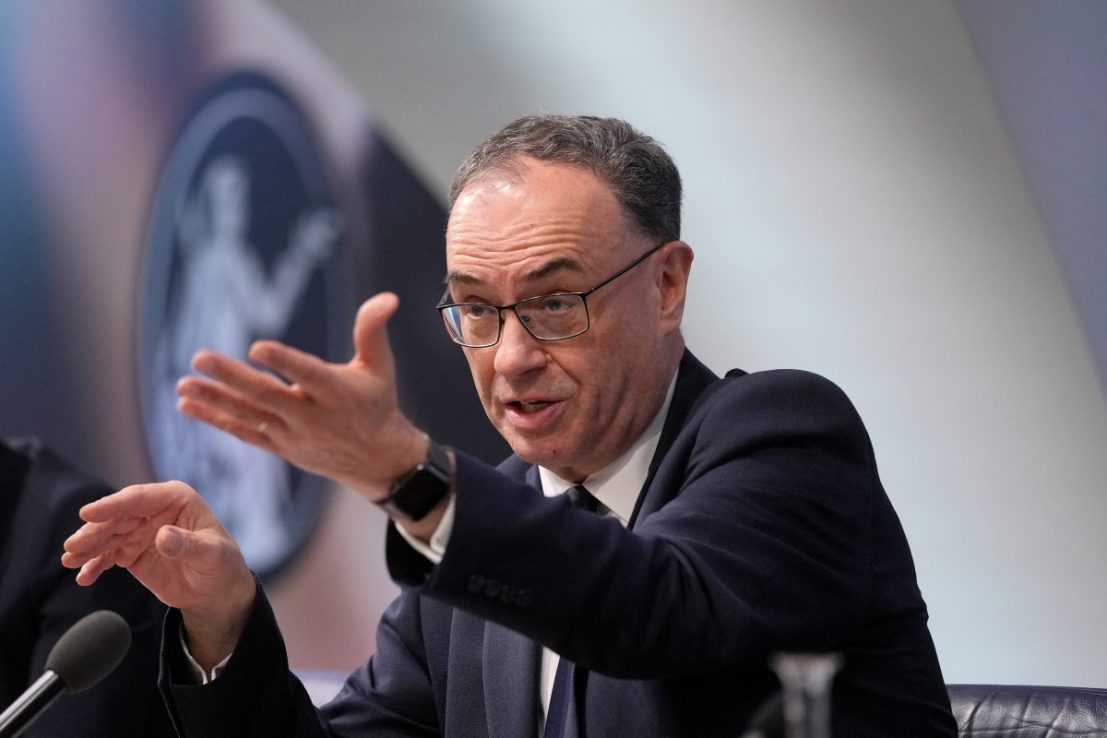
The Bank of England is expected to hold interest rates at four per cent despite some City forecasters suggesting that the votes of the Monetary Policy Committee (MPC) could tilt towards a 25 basis point cut.
City traders believe the Bank will keep interest rates on hold to curb high inflation, which is nearly double the Bank’s two per cent rate.
Market data appears to suggest that there is still an open possibility of an interest rate cut, with around a quarter chance of borrowing costs being lowered.
Inflation held steady at 3.8 per cent in the last official publication by the Office for National Statistics (ONS), which was 0.2 percentage points lower than expected.
Core inflation fell compared to data for the month before while wage growth slowed in the three months to August.
Expected split decision on interest rates
Some influential forecasters at Goldman Sachs and Barclays believe a 25 basis point cut could come this Thursday.
Analysts at Goldman said Governor Andrew Bailey would make the deciding vote while deputy governor Sarah Breeden’s position was also difficult to predict.
“The decision will be close, as there are still also arguments to look for a hold,” said Goldman economists James Moberly and Sven Jari Stehn.
“MPC commentary since the September meeting has remained cautious with respect to near-term rate cuts. Governor Bailey—who likely holds the key vote—hinted at a pause after the September meeting.
“But Bailey has not repeated this cautious stance since then and recently acknowledged the weaker employment data.”
Hawks to Doves scaleViewsHuw Pill Pill is railing against the doves as he called for interest rates to be cut at a more “cautious” pace.Catherine MannMann has made it clear that she believes higher interest rates will lower inflation pressures.Megan GreeneGreene has previously advocated for a “wait-and-see” approach and raised concerns about high food price inflation. Clare LombardelliLombardelli voted against consensus for the first time at the August meeting as she called for interest rates to be held. She is expected to take a more cautious view again at the November meeting. Andrew BaileyBailey has both spoken about a weakened jobs market and fears that inflation has remained high. It is unclear if he will be swayed by arguments made by the Bank chief economist Huw Pill or or by the deputy governor for banking Dave Ramsden. Sarah BreedenBreeden said the UK’s inflation “hump” was transitory and is expected to expand on her views around interest rates in an event on Wednesday.Dave RamsdenRamsden has struck a more dovish tone than his colleagues at the Bank, calling for interest rate cuts due to weak employment data. Swati DhingraDhingra is seen as one of the MPC’s most dovish members and is widely expected to vote for a cut. Alan TaylorTaylor’s vote for a 50 basis point cut forced Bailey into calling a second vote in August and he has raised alarm bells on the UK’s recession risks. Taylor could ruffle feathers again by voting for a larger cut.
Forecasters at the Wall Street bank also pointed to lower food inflation than expected as well as services inflation coming 35 basis points below the Bank’s forecasts from August.
WPI Strategy economist Martin Beck said it expected a narrow 5-4 vote for interest rates to be held as Bank policymakers would wait to find out about the Chancellor’s final decisions on tax and spending policies at the Budget.
“We expect the majority to hold rates steady, choosing to wait for confirmation that the recent disinflationary trend is durable and to assess how the November Budget reshapes the near-term inflation outlook,” Beck said.
Rachel Reeves has insisted that a primary focus of the Budget will be to lower the cost of living, with stripping VAT from energy bills and an income tax hike among the policies that could weigh down on price growth.
While the pledges to lower inflation may reassure Bank policymakers, they will not be able to comment on the Chancellor’s Budget plans and may wish to ignore Reeves’ recent public statements.
City analysts also believe inflation expectations and wage growth pressure remain high, a view that could be reflected by some of the Bank’s more hawkish policymakers.
“Recent signs of stickier wage growth and elevated pay expectations underline ongoing domestic inflation risks,” said St. James’s Place chief economist Hetal Mehta.
“Although a softer labour market has eased some pressure, policymakers are likely to remain cautious about easing aggressively.”
“As a result, the upcoming decision is expected to be finely balanced and reinforce a ‘wait-and-see’ approach, with the central bank likely to signal patience until there is firmer evidence that inflationary pressures have truly subsided.”