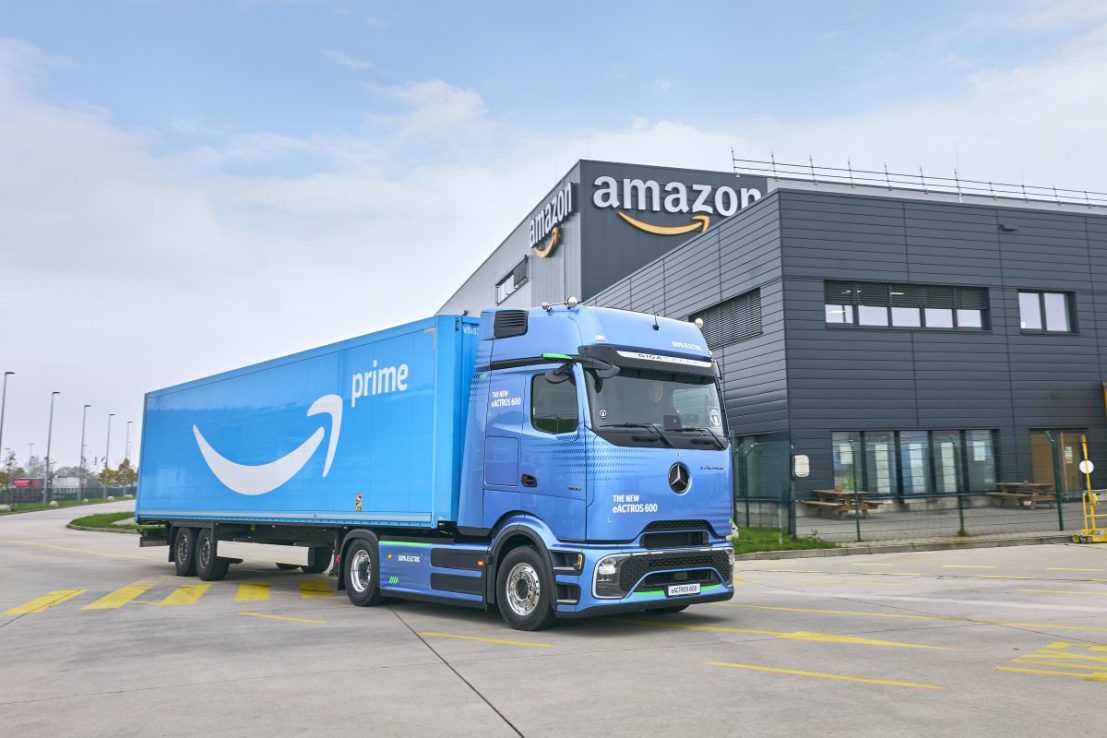
Amazon has begun rolling out the first of its largest-ever UK electric heavy-goods vehicles (eHGVs), with 160 trucks set to join its British fleet over the coming months.
The first of the new 40-tonne Mercedes-Benz eActros 600s is set to hit the road this week, delivering parcels between Amazon’s logistics hubs nationwide.
The fleet is expected to transport approximately 300m products once fully operational, with zero tailpipe emissions.
The move comes just a day after the government unveiled a £10m fund to help expand England’s electric vehicle (EV) charging network, targeting motorway and A-road sites where limited grid access has slowed charger rollout.
Transport minister Keir Mather claimed the new scheme would “power up the future of driving”, using renewable energy and battery storage to “future-proof England’s EV supply”.
This public investment will be essential if large-scale commercial fleets, such as Amazon’s, are to transition smoothly to electric vehicles.
“The first vehicles from our record-breaking eHGV order are now on Britain’s roads,” said Nicola Fyfe, Amazon’s vice president of EU logistics. “This marks a major milestone in our journey to decarbonise our UK transportation network.”
“We’ve invested heavily in charging facilities at our own sites, but we’ll need continued collaboration with government and industry to build the national network required for widespread EV adoption.”
From the warehouse to homes
Amazon’s eHGVs will operate between fulfilment centres, sort hubs and delivery stations, each with a range of around 310 miles per charge and the capacity to transport up to 22 tonnes of goods.
To support the rollout, the company has installed 360kW fast chargers at key UK depots capable of charging the trucks from 20 to 80 per cent in just over an hour.
The vehicles form part of a wider sustainability drive that includes 800 new electric delivery vans and the expansion of on-foot delivery routes in London.
Couriers in Hackney, Westminster, Islington, and now Camden collect packages from parked electric vans acting as mobile depots and deliver on foot, a model Amazon claims has already brought more than one million parcels to customers this year without adding to local congestion.
Councillor Adam Harrison, Camden’s cabinet member for planning and sustainable transport, said the partnership could “reduce van miles and improve air quality” and will inform the borough’s future freight policies.
As both government and industry accelerate their investments, Britain’s roads are fast becoming a test drive for the next era of electric logistics and low-carbon delivery.