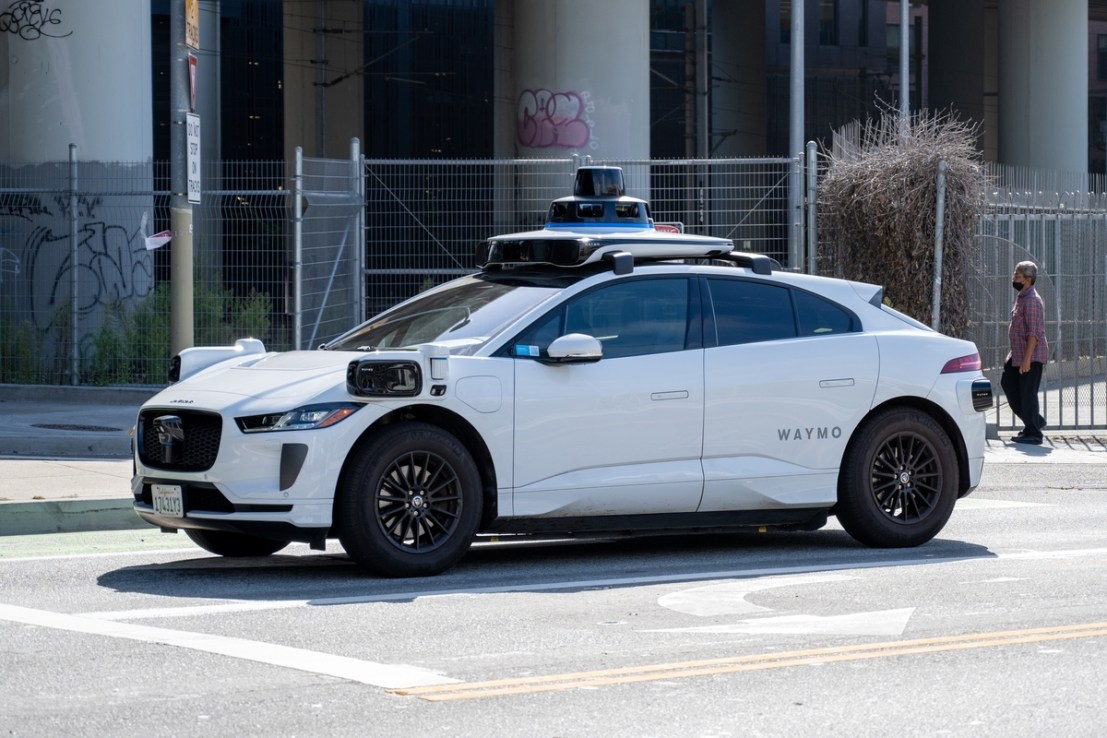
As Waymo prepares for its UK launch, founder Sebastian Thrun admitted he “never envisioned” London being home to autonomous cars.
The driverless taxis have taken the US by storm, and the company will soon enter Europe, hitting the streets of the capital before the end of the year.
The company, owned by Google parent Alphabet, logs approximately 300,000 rides worth at least $6m (£4m) every week in the five US cities it operates in.
However, Thrun who made the leap towards creating a self-driving car 20 years ago at Stanford University, did not originally have London on his agenda.
In an interview with City AM at London’s Blockchain Conference, he said: “I never envisioned a London rollout.
“I’m super excited about it, I think London is the best place in Europe because it is so forward looking and entrepreneurial.”
The UK is slowly becoming home to an increasing number of autonomous vehicle tech start ups and companies, due to the city being home to a strong network of global talent and funding opportunities, both from the government and venture capital firms.
This includes Oxford based Oxa which provides software for self-driving vehicles and Eatron, which develops AI-enabled motion control systems.
The driverless car industry has also attracted a large amount of investment over the past decade securing $58m, with Waymo alone raising $5.6bn of funding earlier this year.
The UK launch will start with a small fleet of human-supervised Jaguar I-PACE vehicles in the coming weeks before moving to fully autonomous in 2026.
Waymo’s Ethan Teicher previously confirmed to City AM that they will “start small and gradually expand”, working closely with the Department for Transport and Transport for London throughout the process.
How will London react?
The self-driving tech is set to align with London’s transport priorities, aiming to reduce road accidents and injuries as well as expand mobility options for commuters.
The decision to place Waymo on the capital’s streets is also expected to have a number of economic benefits, with Teicher noting it could create jobs in fleet operations and depot management.
The UK government also predicts that the autonomous vehicles sector could create 38,000 jobs by 2025.
But, others are forecast to lose out, in particular taxi and delivery drivers if Waymo continues to enter other cities across the UK.
However, not all Londoners are open to ordering a taxi that comes without a driver in the front seat.
A survey by the RAC foundation discovered that while 45 per cent of people are open to hitching a ride in a driverless car, with many believing it removes the risk of human errors, 38 per cent felt sceptical, primarily due to safety concerns and a lack of confidence in the software.
Legal concerns
UK lawyers have also noted issues surrounding Waymo’s rollout, arguing the UK legal system is not ready for driverless cars due to laws standing on the principle of human agency.
However, autonomous vehicles are legal in the UK after the Autonomous Vehicles Act was passed in May 2024, regulating their use on roads.
Despite concerns, Thrun is hopeful that the “the people of London will love Waymo as much as San Francisco” where the cars are already a familiar sight.
While London will be the first city in Europe able to order a Waymo, they are not the only one preparing to introduce driverless tech.
Autonomous technology group We Ride and Renault chose Barcelona as the home for a trial of self-driving buses in March, while transit operator Hochbahn is testing driverless vehicles for public transport in Hamburg.
Meanwhile, rivals are also brainstorming ways to break into London, including Tesla who successfully tested self-driving software in July.
Will cars fly?
Away from emptying driving seats, Thrun has long set his sights on getting cars off the ground, leading him to become the chief executive of electric aircraft company, Kitty Hawk.
The company focuses on creating autonomous flying cars, officially known as electric vertical take off and landing aircrafts, and made some progress through prototypes, such as the Cora and the Flyer.
However, Kitty Hawk shut down in October 2022, due to the high cost of investments and difficulty of bringing the tech to the market.
While Thrun has pivoted to other work, including the creation of a stealth start up and founding online education provider Udacity, he has not given up on his ambition.
He said: “Flying cars are still a bit of science fiction, but the technology has proven to work.
“We’re still a decade away from having products in the space.”
But, like his optimism for Waymo’s future in London, he sees cars in the air as a large part of the city’s future.
He concluded: “When they come, London will be better off.
“Trust me.”