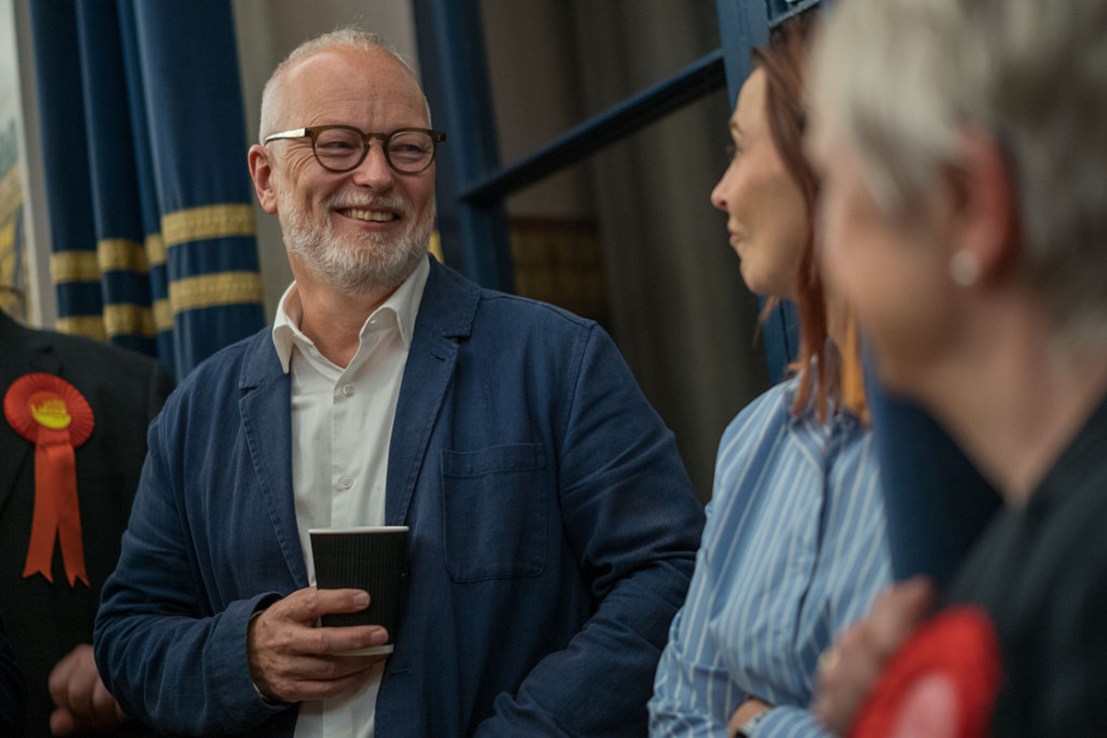
Jason Stockwood insists he hadn’t been angling for a plumb ministerial job before the call from Keir Starmer asking for him to be investment minister came six weeks ago.
The serial entrepreneur – and Grimsby Town Football Club co-owner – had, instead, been “moaning” about the paucity of politicians with genuine business experience, when the Prime Minister and his officials devised what they thought could be a nimble solution.
“They basically called my bluff and offered me a job,” he says, in what is his first set-piece interview since taking up his seat in the House of Lords and making his first formal foray into the public sector. “I got the call and was asked, ‘Do I want a couple of days to think about it?’ and I said, ‘Absolutely not. The answer’s yes. Of course it is.’”
Stockwood’s elevation to the second chamber – and new brief to spearhead the country’s efforts to unlock investment across the country – is the most prestigious role yet in a career that has seen him go from a council estate on the north east coast to a minister in one of the country’s most important government departments.
He certainly has big shoes to fill. The abrupt resignation of Poppy Gustafsson – the co-founder and former chief executive of cyber darling Darktrace – left an outsized hole in a government front bench devoid of first hand business cachet. Neither Jonathan Reynolds nor Peter Kyle’s CVs – the two business secretaries of this administration – boast any substantial private sector experience.
But take a cursory glance at his backstory, and the reasons why Labour – a party that has made its defining mission ‘growth people can feel in their pockets across the country’ – chose Stockwood as Gustafsson’s replacement become immediately clear.
Stockwood’s predecessor, Poppy Gustafsson
Stockwood’s journey from the Humber to the House
Brought up in Grimsby, the businessman – whose official title is now the Baron Stockwood of Great Grimsby and Cleethorpes – is a veritable poster child of social mobility. Having notched up several high-profile jobs – and investments in “over 100 start-ups” – he defied the geographical and socioeconomic hand he was dealt to forge a successful career, almost all of which was built beyond the confines of the M25.
He graduated from the University of Bolton before going through several prestigious roles in the travel industry, becoming managing director of Expedia-owned Travelocity and a board member at Skyscanner.
He then spent three years heading up the online dating juggernaut Match.com, before taking on his most prominent private sector roles to date – as the chief executive of business insurance provider Simply Business, and chairman of his much-loved local football club, Grimsby Town.
“I was a council estate kid,” he says. “Welfare state, free school meals, free university – I had the full kit and caboodle. So I’ve always had Labour values.”
Those Labour values notwithstanding, and despite his upbringing being a quintessential depiction of what he thinks a Labour government can – and should – offer the country’s poorest, he wants to leave the Punch and Judy element of SW1 to his parliamentary colleagues and the Westminster commenteriat.
“I’m trying to stay away from the politics,” he says. “I just want to bring my skillset in terms of understanding investment, understanding business and as an entrepreneur into business.”
Rhetorically, at least, it’s a gambit on which he is following through. In a striking departure from the kind of interviews given by his fellow ministers, Stockwood doesn’t mention the Conservative or Reform parties by name once, opting instead to talk vaguely of “the alternatives” or the past.
And when conversation turns to his priorities for change – there is also a refreshing absence of any talk of ‘13 years of Tory failure‘ or Liz Truss having ‘crashed the economy’, favouring a business analogy to describe where the country is, and what the government’s plans are to fix it.
‘The UK is one big turnaround project’
“You have to acknowledge the problem and situation that you’re in, which is the turnaround,” he says. “We’ve done that as a government. You need a plan. There’s a 10 year industrial strategy, and now we’re in execution mode, where we match the capital to the strategy and get going.”
One of the first set-piece moments at which Stockwood hopes to begin that turnaround is this week’s Regional Investment Summit in Birmingham, where over £10bn of investment into towns and cities outside London has been unveiled.
“The regions are really where the growth opportunity is,” he says. “Everyone in that room has either the plan for growth, or the capital to put towards it. And it’s about matching that together.”
It is perhaps unsurprising, given his personal backstory, that it is this element of his new brief that is the one about which he appears most passionate. And his native Grimsby also happens to be one of the few post-industrial town regeneration success stories, as it evolves from a fishing town in decline to one with a thriving, rewable energy-driven local economy .
“I think it’s a good example of a place on the move,” he says of his home town. “It’s definitely not a done deal, but there’s momentum, there’s energy, there’s capital. But we need to make sure that it works for the whole community.”
The Autumn Budget looms large
Not everyone would leap at the opportunity to tackle the turnaround project that Stockwood’s party – and the country – faces, one which Starmer himself has equated to “turning an oil tanker“. The investment minister may wish to avoid naked politics, but Labour’s position in the polls is dire. Of more direct relevance to his brief, business confidence is nearing all-time lows, and with the country is bracing for yet another tax-raising Budget next month, mood among UK plc is bleak.
Bosses are still dealing with the fallout from the one-two combination of a £25bn payroll tax raid and above-inflation hikes to the living wage. The kind of entrepreneurs and family businesses with to which Stockwood’s own career has been most redolent, were also dealt raises to capital gains tax and inheritance tax, via the changes to business asset disposal relief.
Despite his own private sector calibre, though, Stockwood ducks the opportunity to acknowledge any role that the Labour government may have played in contributing to the gravity of the ‘turnaround’ he feels the country needs.
In his view there are two major factors preventing faster progress, the first is a combination of industrial energy prices and an uncertain global macroeconomic picture.
Despite these headwinds, he feels the UK – which has avoided the worst of Donald Trump’s tariffs and inked major trade deals with India, the EU and the US in the space of a few months – is now “the best place to invest in in globally at the moment”.
“We’ve got a stable legal system, we have a high-skills base, we have a technological innovation base like nowhere else in the world, we have access to capital.”.. got”
And the second issue?
“We need, quite frankly, a bit of optimism. What we need to start doing, is rolling up our sleeves, and saying, ‘Look, we acknowledge that it’s a challenge. We acknowledge it’s a turnaround, and now we’ve got to crack on.’”