Niels van Roij looks every inch the English gentleman. The Dutch-born designer is wearing an immaculately cut tweed suit with leather-lined pockets, topped off with a green woolen tie. Only later do I realise that identical fabrics were used to trim the Rolls-Royce waiting outside. “I have a suit created to celebrate each car, using the same cloth fabric and leather,” explains van Roij. “Like a bespoke car, a bespoke suit fits its owner perfectly.”
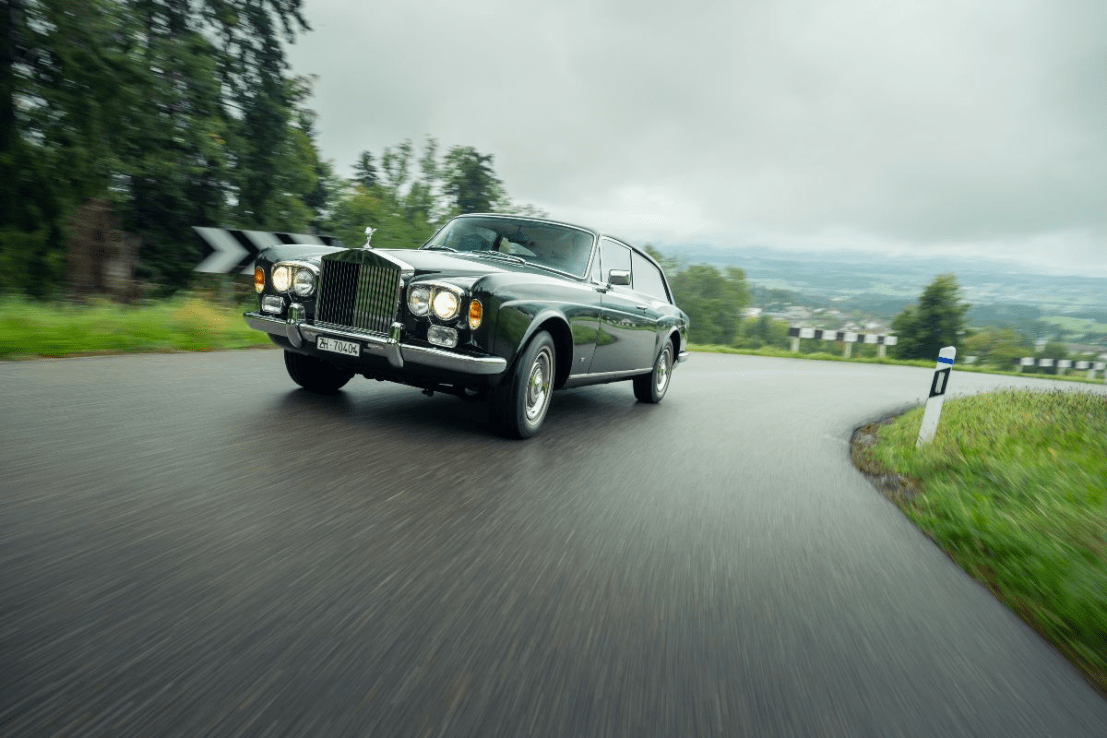
What began life as a 1981 Rolls-Royce Corniche called Henry is now ‘Henry II’ – the latest custom creation from Niels van Roij Design. With an entirely new body from the B-pillars backwards, it has gone from a stately coupe to a sleek shooting brake.
The transformation took two-and-a-half years and 7,000 hours of work, but the result is a piece of automotive art. And the cost? If you have to ask…
From a Fiat to a Ferrari
Niel van Roij learned his craft in London, studying car design at the Royal College of Art. “One of my favourite assignments was a concept for the next London taxi,” he explains. “I loved talking to the drivers, who often spent 10 hours a day inside their cabs, to find out exactly what they wanted.” The experience stood him in good stead when it came to creating highly personal, bespoke vehicles such as Henry II.
After a decade working for major car companies – mostly on designs that remain wrapped in non-disclosure agreements – van Roij decided to go it alone. His first project was a Tesla Model S shooting brake, revealed in 2018 outside the Dutch embassy in South Kensington. Back then, Teslas seemed quite exotic (how times have changed) and the unique ‘Model SB’ led to more requests for coachbuilt cars.
In the seven years since, Niels van Roij Design has ‘reimagined’ an eclectic mix of vehicles, from a plush Fiat Panda (the Piccolo Lusso) to a targa-topped Ferrari Testarossa (the Guida Touring Sport). Indeed, this isn’t even the company’s first Rolls-Royce estate; the Silver Spectre of 2020 was based on a Wraith coupe, with an elongated roof made of carbon fibre. It’s now owned by motorsport commentator and former racing driver, Dario Franchitti. “Most of our clients don’t want a showpiece for their garage,” says van Roij. “They want a car that can be driven every day.”
A roomier Rolls-Royce
Pleasingly, that is the plan for Henry II, which has been in the same Swiss family for more than 40 years. The owner and his wife compete in road rallies and are keen triathletes, so the car needed to be practical and capable of carrying two racing bikes. The ingenious solution is part-bicycle rack, part-Bond gadget – but we’ll come to that shortly.
Step one in rebuilding a rather careworn Corniche was a 3D measurement scan, which revealed its body was 7mm longer on one side than the other. The team also discovered up to 8mm of tin in places, applied by Mulliner Park Ward, the car’s original coachbuilder in London, to smooth out the surfaces. Eventually, with the shell back to bare metal, van Roij began making “hundreds of sketches” to determine its new look. “Even a sporting Rolls-Royce has a certain formality about it,” he explains, “so striking a good balance was crucial.”
Seeing Henry II for the first time, it’s clear van Roij got the balance right. Elegant and understated, with just a dash of raffish charm, the Corniche looks like it could have emerged from a vault of secret factory prototypes, rather than being a third-party conversion. Its long roof sweeps downwards into a recessed tailgate framed by subtle buttresses, with a bustle back inspired by Rolls-Royce saloons. At the sides, bespoke flat glass stretches across kicked-up haunches, while the broad C-pillars intersect with small tail fins.
Suits you, sir
There are delightful details when you look more closely, too: the hand-painted coachlines, delicate headlamp wipers, whitewall tyres and flawless British Racing Green paint. The pièce de résistance, though, is the bicycle rack concealed behind the chrome rear bumper, which glides out electrically when a button is pushed.
“The only way to make the bicycles fit inside would have been to create a very high roofline,” says van Roij. “But it could have ended up looking like a postman’s van, and we certainly weren’t going to do that.” The rack slots into the middle of a new, horseshoe-shaped fuel tank beneath the boot floor. “We managed to retain the same tank capacity,” adds van Roij. “This isn’t a very efficient car.” With a 6.75-litre V8, three-speed automatic transmission and kerb weight in excess of two tonnes, he is not wrong.
Niels van Roij Design also reworked the Corniche’s cabin, using that tasteful mix of materials: beige leather, green-flecked tweed (used to trim inside the glovebox, storage trays and seat-back pockets) and dark green carpets made of deep-pile lambswool. The rear bench now folds electrically and lies flat, while the load bay is trimmed with textured green carpet. Bespoke, Henry II-branded luggage, also in leather and tweed, provides a finishing touch.
Driving the Corniche shooting brake
I slide behind the thin-rimmed Bakelite wheel and settle into a re-stuffed, more supportive seat. Despite the Corniche’s coupe roots, its driving position is up at almost SUV height. There’s a majestic view of the Spirit of Ecstasy bonnet mascot ahead, plus excellent all-round visibility thanks to the slim roof pillars.
The original walnut dashboard has been carefully restored, with a set of Brantz rally instruments hidden inside a storage cubby. Glaring touchscreens, befuddling drive modes and bonging ‘driver aids’ are all notable by their absence. How refreshing.
Rolls-Royce famously described its cars’ power outputs as ‘adequate’ – and so it proves. The Corniche’s 240hp fuel-injected engine is certainly no firecracker, but release the foot-operated parking brake, click the column shifter into ‘D’ and it will gather speed gracefully, cresting a wave of brawny V8 torque. You steer with your fingertips, turning the wheel several inches before anything seems to happen. This ‘motor car’ (to use official R-R parlance) refuses to be rushed.
Designs on the Daytona
As we climb into the Swiss mountains, carving from one steep hairpin to the next, the Rolls-Royce feels somewhat out of its comfort zone. Still, it would doubtless be fun on a road rally and I can’t think of many lovelier ways to travel home after an exhausting triathlon. The old-school automatic gearbox is buttery smooth and ride comfort is as sumptuous as you’d hope. Above all, Henry II offers an imperious sense of occasion, only heightened by being a coachbuilt one-of-one.
The next vehicle from Niels van Roij Design will be a homage to the Ferrari Daytona, based on a 599 GTB. We have only seen sketches and a disguised prototype so far, but expect a supercar that is very stylish and utterly unique. With a tailored suit to match it, of course.
Tim Pitt writes for Motoring Research