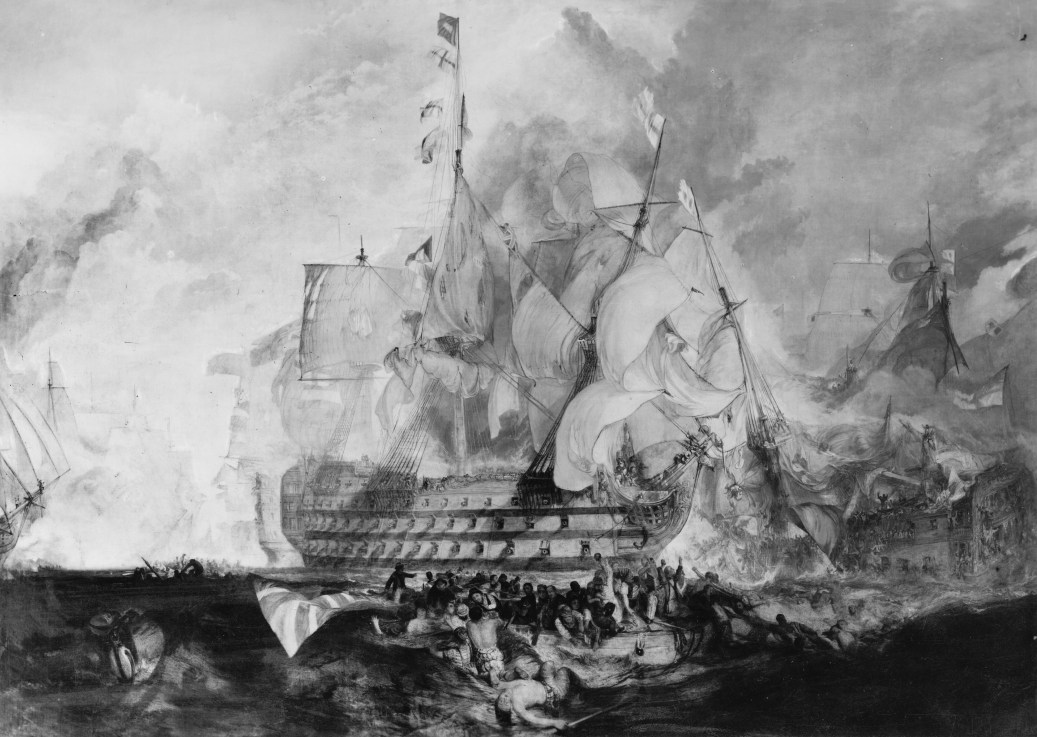
On This Day, 21 October 1805, Britain’s greatest ever naval hero proved conclusively that Britannia rules the waves… and died in the process, writes Eliot Wilson
Today, 21 October, in 1805. It is a Monday, shortly after 5.30am, 25 miles off the coast of southern Spain. As dawn breaks, the skies are mostly clear, the wind very light, with a heavy sea swell from the west. There are 33 ships of the Royal Navy under the command of Vice-Admiral Viscount Nelson on board his flagship, HMS Victory; between them and the coast is a fleet of 40 vessels, 25 French and 15 Spanish, under Vice-Admiral Pierre-Charles Villeneuve.
Europe was six months into the War of the Third Coalition. The 1802 Treaty of Amiens, having created a fragile peace, had unravelled within a year. Britain, fearing French expansion, had refused to withdraw troops from Malta and Egypt as agreed, and, on 13 May 1803, declared war on France.
The First Consul of the French Republic, Napoleon Bonaparte, was unprepared for war but his strategy was clear. He meant to invade Britain, something no-one had done successfully for nearly 750 years, and began to assemble an army at Boulogne. A successful invasion, however, required mastery of the English Channel.
In 1805, the Royal Navy was by far the largest in the world, with nearly 1,000 ships; France could muster fewer than 150. Napoleon initially intended Villeneuve’s fleet to sail from Cadiz to join a smaller force at Brest and then make for the Channel, but Villeneuve, short of supplies, his sailors inexperienced and his officers reluctant, temporised.
Napoleon then ordered Villeneuve to sail into the Mediterranean. After weeks of inaction, the Franco-Spanish fleet put to sea on 20 October, heading for the Straits of Gibraltar. Around 6.00pm that evening, lookouts on the Achille first sighted the British in pursuit. It was now only a matter of time.
At 6.00am on 21 October, Nelson ordered his fleet to prepare for battle. He wanted to pull the enemy’s vessels into a melee which would favour his better trained sailors and more effective gunnery. Accordingly he formed two columns to slice the enemy line of battle into three and disrupt Villeneuve’s control of his forces.
The winds were so light that manoeuvring ships reliant on sail required expert seamanship. At 8.00am, Villeneuve abruptly ordered his fleet to put about and return to Cadiz. Easy to decide, but his crews lacked that seamanship, and by 9.30am the last ships were still turning around, his line of battle now a ragged arc five miles long.
Outnumbered and outgunned
By 11.00 am, Nelson had sight of the entire enemy fleet. With 17,000 sailors and 2,148 guns to Villeneuve’s 30,000 men and 2,568 guns, he was on paper outnumbered and outgunned, but that exaggerated the French advantage. At 11.45am, after some judicious editing with his signal officer, Lieutenant John Pasco, Nelson ordered a signal hoisted on Victory’s mizzenmast and relayed across the fleet: “England expects that every man will do his duty.”
Aboard HMS Royal Sovereign, his second-in-command, Vice-Admiral Cuthbert Collingwood, an imperturbable 57-year-old Geordie, sighed.
“I wish Nelson would make no more signals; we all understand what we have to do.” Turning to his officers, he said, “Now, gentlemen, let us do something today which the world may talk of hereafter.”
Nelson and Collingwood led the two columns east into Villeneuve’s line, Victory jinking at the last minute so they converged. Royal Sovereign, her hull recently re-covered in copper, outpaced the other ships, breaking the line astern of the Santa Ana and firing a devastating broadside into the Spanish flagship.
Nelson’s ships piled in one after another, engaging at the closest of quarters. Victory came so close to the Redoutable that their masts locked and French naval infantry prepared to attempt a boarding, but HMS Temeraire, a ship of the line later immortalised by JMW Turner, raked the French ship with a carronade, scything down those on deck.
The British were prevailing. Better command, better gunnery, better seamanship and sheer fighting spirit gave them mastery over their opponents and by 5.00pm it was over. Of Villeneuve’s warships, 20 were captured as was the French admiral himself, while not a single British ship was lost.
There was one immeasurable loss. At 1.15pm, a French marksman at the mizzen-top of the Redoubtable had fired at Nelson on Victory’s quarterdeck. The bullet entered his left shoulder, passed through his lung and between his sixth and seventh vertebrae, lodging in his back muscles. Nelson knew it was a grievous wound, and when the ship’s surgeon William Beatty arrived, he told him, “You can do nothing for me. I have but a short time to live. My back is shot through.”
The Battle of Trafalgar, like the Battle of Britain 135 years later, ended any possibility of invasion across the Channel. But it did more than that. After 1805, the Royal Navy was never seriously challenged by Napoleon
At 2.30pm, Victory’s captain, Robert Hardy, came below to tell Nelson 14 or 15 enemy ships had surrendered. “I had hoped for 20,” he replied. Hardy kissed the admiral’s cheek but his life was fading: Horatio Nelson, incomparably Britain’s finest naval commander, died at 4.30pm. He was 47.
The Battle of Trafalgar, like the Battle of Britain 135 years later, ended any possibility of invasion across the Channel. But it did more than that. After 1805, the Royal Navy was never seriously challenged by Napoleon and indeed it maintained a tight blockade of Continental ports. Britannia would rule the waves for more than a century, and in 1918 she still possessed the world’s most powerful navy.
As for Nelson, he became a legend. That single word, “Nelson”, still conjures up British naval dominance and daring. It is summed up by his advice to his commanders a few days before Trafalgar: “no Captain can do very wrong if he places his Ship alongside that of an Enemy”.