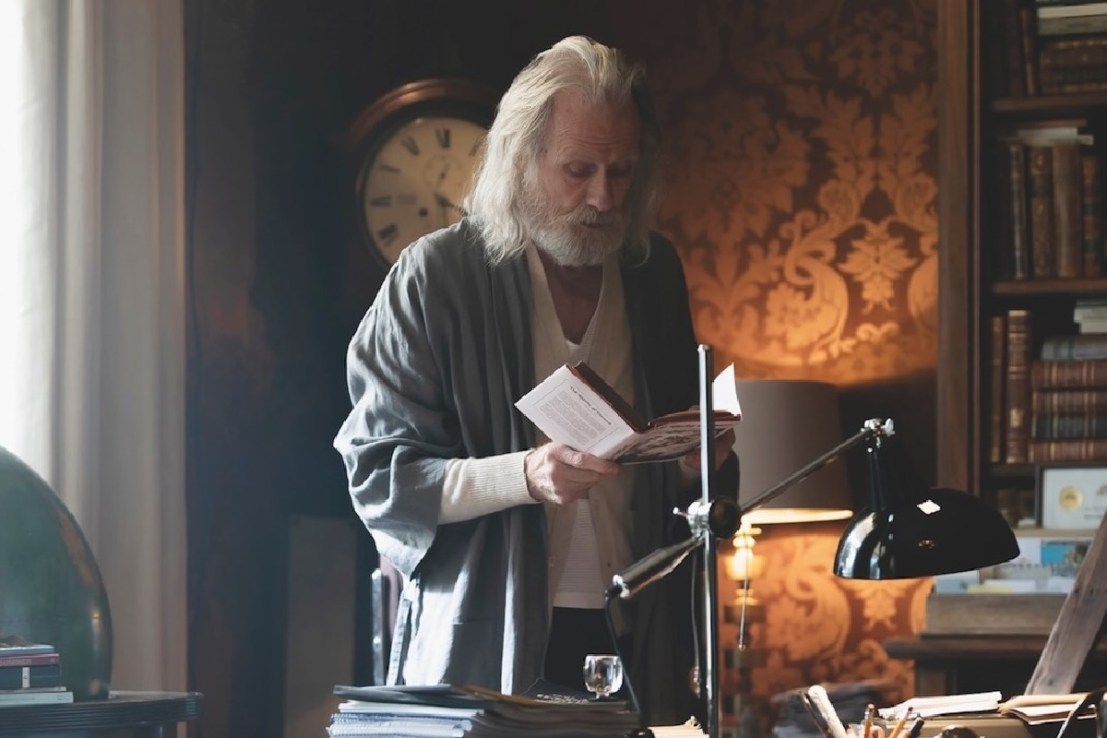
In 2022’s Living, Bill Nighy played a dapper old gent grappling with his mortality amid the realisation life has largely passed him by. In many ways, Argentinian director Pablo Trapero’s English language debut & Sons is the equal and opposite of that film, following a broken, decrepit husk of a man who has long-since achieved everything he ever wanted.
Nighy plays AN Dyer – the world-renowned author of novels including Saturn’s Salute – as an exaggerated cross between Kingsley Amis and Alasdair Gray. He’s a grotesque figure, shambling through his days in a drunken, bad-tempered haze, his towering intellect matched only by his endless self pity. Essentially a toddler with a beard, he’s grudgingly looked after by his European housekeeper and his youngest son Andrew (Noah Jupe), who dreams of escaping their sprawling mansion.
Sensing the end is nigh, Dyer summons his two eldest sons, the recovering addict Richard (Johnny Flynn) and the creepy videographer Jamie (George MacKay), to make a terrible confession he says will recontextualise not only their relationship but the entirety of western ontology.
You could make a strong case for going into & Sons entirely cold, so proceed with caution if you’re sensitive to mild spoilers: Dyer’s outlandish claim is that Andy isn’t his son but his clone (actually, he prefers the term “autonomous reflection”). He insists a covert, Illuminati-style group of scientists are duplicating men of substance for the betterment of mankind; there’s even talk of a Shakespeare clone! Of course, he’s either making it up or he’s completely lost it, his sozzled mind taking up residence in one of his novels. Right?
The film, based upon David Gilbert’s eponymous novel, uses this premise to explore the great questions of humanity: do our genes make us who we are or our environment? How much can we blame our genetic inheritance for our worldly troubles? What makes us distinct? The irony of the set-up is, of the three sons, alcoholic Richard seems to have the most in common with his father.
It’s an effective set-up, a little reminiscent of Caryl Churchill’s excellent play A Number, which similarly introduces sci-fi elements into a thoroughly grounded, contemporary story. Nightly is immense in the lead, offsetting Dyer’s shambolic, rage-filled moments with a quiet pathos. Both Flynn and Imelda Staunton (as his ex-wife) are excellent, bringing some much-needed humanity and warmth to the proceedings. MacKay’s character, however, feels underwritten, floating through scenes with his camcorder like a member of the crew who accidentally stepped into shot, while Andrew is too much of a blank slate, a decision that’s surely deliberate but isn’t much fun to watch.
Still, & Sons is rarely less than gripping, especially when Nighy is around. It is, perhaps, not one that demands to be seen on the Biggest Screen Possible but, with its tight direction, strong cast and a concept that keeps you guessing until the final reel, it’s ideal lazy Sunday fodder.