In 2008, I was a 23-year-old uni student on an Erasmus programme in Amsterdam. I know what you’re thinking and yes, I may have held a few herbal cigarettes, stumbled around the red light district and generally been that Brit abroad. My recollections of those 12 months are somewhat fuzzy.
What I have never forgotten, however, is my deep love for the city. In the intervening years, I became a writer and, in the words of Suella Braverman, a member of the tofu-eating wokerati. Then, I returned to Amsterdam.
I took the train, obviously. The Eurostar leaves from central London and drops you off in the middle of Amsterdam. And you always know exactly where your luggage is. Yes, the Eurostar check-in entails airport-style queuing, security checks, and passport control, but it’s simpler and less stressful because the distances you have to cover are negligible in comparison to most airports. Plus it’s just a much (much) nicer experience.
In February, Eurostar opened a new cross-channel terminal in Amsterdam that allows for more trains and passengers to and from London. The project will be fully realised from mid-December when five direct trains will run back and forth daily, able to hold 650 passengers each – up from 275 each in 2024.
How to visit Amsterdam and live like a local
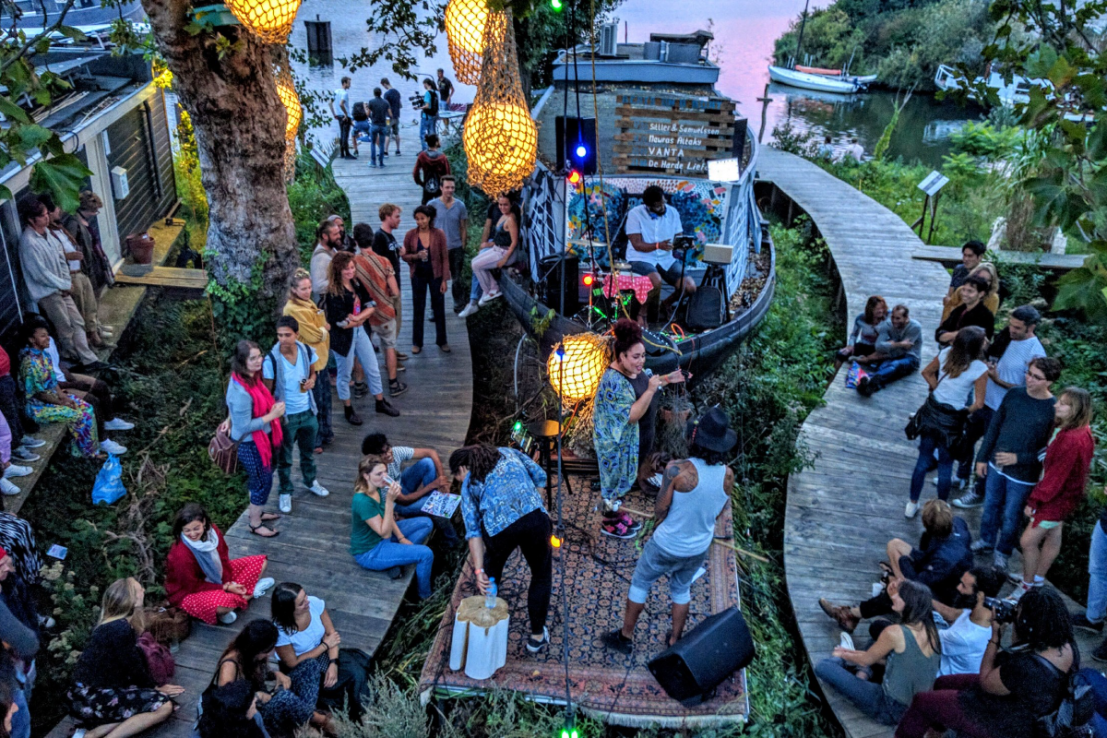
The waterside venues at De Ceuvel
Speaking of new rail developments, in my 2008 student daze the Amsterdam Metro’s North-South Line was a monstrous crack spewing traffic cones and JCBs along the middle of the city’s central traffic artery, the Damrak. The line opened 10 years later, morphing from an annoying traffic obstacle into the first Metro line to serve Amsterdam North. This district lies just across the waterfront that Amsterdam Centraal (where I disembarked the Eurostar) overlooks.
It’s no coincidence that some of Amsterdam’s freshest and most forward-thinking developments are found in its now-more-accessible northern suburbs. The most revelatory of these developments is De Ceuvel, which takes about 40 minutes to reach on the Metro from the city centre. A former shipyard near the new Noorderpark Metro stop, the development is reached via a grey, traffic-clogged main road that filled me with dread. But at the end of an unassuming, workshop-peppered lane, De Ceuvel reveals itself like a romantic summer fling flashback: alfresco diners chat and clink beneath a swooping canvas spotted with fairy lights; wooden decks for casual drinking extend out over the water; a burgeoning copse softens man-made edges; all ages splosh about in the surrounding waters.
Like a flower fighting its way out of a tarmac crack, De Ceuvel is an oasis sprung from an industrial graveyard. My absolute favourite thing about De Ceuvel is Hotel Asile Flottant, a huddle of six renovated boats anchored around a private jetty. There’s a cute, blue-hulled boat for two built in 1942, a 1911 herring fishing ship large enough for six. My boat for the night was a handsome burgundy ‘Botter’ named UK85 that spent its past life fishing in the North Sea. Of course, staying on a boat necessitates a certain amount of climbing, clambering, and stooping, but Asile Flottant’s collection has been fitted out to a very comfortable standard. The six-berth De La Soul has a bloody cinema room. And personally, there is nothing like laying out on the deck of your hotel room, or curling up beneath a pothole for a cosy night in a timber-clad cabin.
Hotel Jakarta is an impressive moment to progress
If climb, clamber, and stoop are very much not your holiday verbs, however, but you’re still keen to experience Amsterdam’s forward-thinking side, you’ll be needing Hotel Jakarta. Residing on the corner of Java Island in the watery throughfare between north and south Amsterdam, the hotel is an impressive monument to progress. Opened in 2018, it immediately dominated the Netherlands’ green hotel scene, becoming a sophisticated lesson in how the solutions to environmental problems usually improve our lives by default. For example, Jakarta’s rooms radiate out from a huge central atrium, which cuts down on artificial lighting. But it also creates an invigorating, bright interior – no twisting burrows of dark corridors in this hotel.
The more famous central parts of Amsterdam
Meanwhile, the cosseting, bamboo-clad rooms are more tranquil than you might expect from a hotel in a major European city, thanks to its island location. Between Hotel Jakarta and Amsterdam Central station is Mediamatic, an eclectic art hub. This unassuming collection of buildings and gardens hosts a variety of free exhibitions and art installations. There’s also a plant-based restaurant named TestTafel, which overlooks the Dijksgracht canal and the dramatic sea-green wedge of the NEMO Science Museum beyond. TestTafel’s weekly tasting menu is a thoughtful and beautiful procession of culinary experiments with in-season ingredients that launches every Wednesday, evolving across the week based on diner feedback.
So, the northern reaches now cultivate innovation. But Amsterdam’s central web of picturesque canals, wobbly houses and strange-smelling coffee shops gave the city its identity and tenderised my own soft spot for Rembrandt’s home town. Central Amsterdam’s sustainable hotel game is dominated by Conscious Hotels, so I checked into its Museum Square location. It’s a modern, smart option with airy, understated rooms and a curved dining conservatory with a garden that’s fantastic for sunny breakfasts. Marco Lemmers and Sam Cohen founded Conscious Hotels after Lemmers became a parent, and his concern for the future peaked. Therefore, much thought goes into being as easy as possible on the planet: organic food and drink only (no herbicides, pesticides etc); the carpets, sofa coverings and curtains are made from recycled materials; solar power is used throughout.
Read more: Visit arty Amsterdam, beyond the sex shows and cannabis cafes
I borrowed one of Conscious Hotels’ guest bicycles and headed west to Rembrandtpark for lunch at Bolenius, an accomplished spot founded by chef Luc Kusters. In 2021, the restaurant became the Netherlands’ first to win a Michelin’s new sustainability accolade, a Green Star. This August, the whole operation moved from its original patch in the commercial business district of Zuidas to this more central location, within Rembrandtpark itself and incorporating a terrace overlooking a lake.
It is quite the upgrade. The menus, which include a six-course all-vegetable option, are stuffed with superior Dutch ingredients. As you would expect from a Michelin-starred kitchen, plate after plate of thoughtful and exhilarating food arrives – startling delicious blood-red tomato sorbet here, a flurry of mushroom dust there. The whole team is well-versed on the machinations of their menu and the broader Dutch Cuisine movement, too, in case you’d like to amuse your brain as well as your bouche.
This is where I concluded my trip, lounging about in a Michelin-starred restaurant, prattling on about four preparations of parsnip and why it’s important to eat less beef. Would my 23-year-old student self even recognise this monster I have become? No. But then again, he normally couldn’t even remember what he’d done in Amsterdam last night anyway.
Visit Amsterdam yourself
Eurostar from £78; eurostar.com. Hotel Asile Flottant from £168; asileflottant.com. Hotel Jakarta from £170; hoteljakarta.com; Conscious Hotels from 85 per night; conscioushotels.com