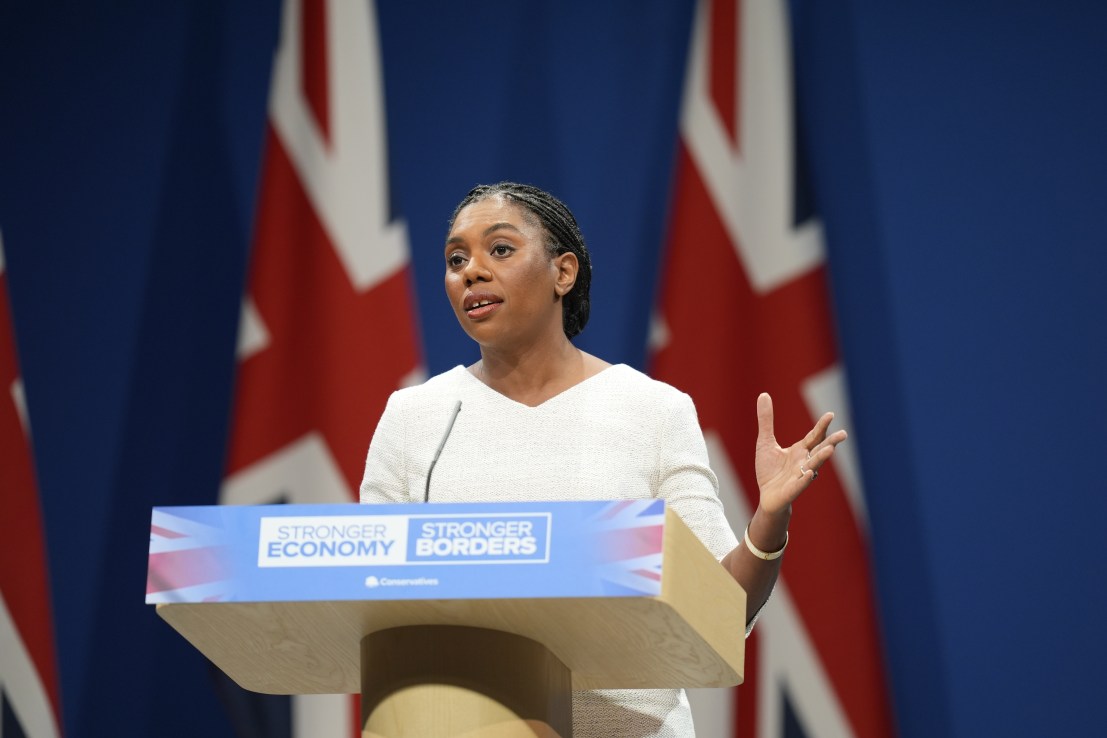
Tory leader Kemi Badenoch has pledged to abolish stamp duty on primary residences to help support people moving into their first home as she centred her speech on backing people wishing to “get ahead in life”.
In a speech delivered to Conservative Party members at its Manchester conference, Badenoch said the Tories would cut stamp duty to free up the housing market and break down barriers for young people looking to become home owners.
Taking on a greater focus on the UK economy in an attempt to set the Tories apart from opposition parties, Badenoch said all tax cuts would be funded by a £47bn savings package.
Tory policies announced this week on offering new hires a National Insurance rebate and an end to business rates for most high street stores together cost around £9bn, with a further cut to the stamp duty projected to cost some £9bn.
The projections were largely based on calculations made by the Institute for Fiscal Studies (IFS) for the end of this parliament as Tory officials said its abolition was seen as “unambiguously good” by economists across the political spectrum.
Badenoch’s speech outlined the “chain reaction of activity” from an abolition on stamp duty, with the labour market and high street shops set to benefit.
The Tory leader also talked up the Tories’ “golden rule” to use half of government savings to cut the public deficit, which has risen again to 96.4 per cent of GDP since Labour came into office.
In a raft of proposals, she said she would reverse Labour policies including tax hikes on private schools and farms, adding that the Employment Rights Bill – which she said would cost the UK economy £5bn – would also be scrapped.
The Conservative Party shared a “scorecard” of how their costings and savings stack up.
It believes sizeable savings to the welfare bill will help to fund most costs to the government.
SavingsProjected total for 2029Welfare reform£23bn Civil service £8bnOverseas aid£6.9bn Asylum and affordable housing programme£7.4bnNet zero subsidies and targets£1.6bn
Costs Projected totalReversal to business property and farm tax reliefs£500mReversal to VAT on private schools£1.7bnRemovals force and policing expenditure£1.5bnEnd to carbon tax £1.6bnBusiness rates relief to high street stores£4bnNational insurance rebate on first job£2.8bnAbolition of stamp duty on primary residence£9bn
She also took digs at several Labour frontbenchers including Chancellor Rachel Reeves and former housing secretary Angela Rayner.
But she made fewer references to Nigel Farage’s party despite more councillor defections in recent days, praising “Reform-slayer Paul Bristow”, the mayor of Cambridgeshire and Peterborough.
Tories to face more scrutiny
The costing and savings will also face intense scrutiny over the timings at which savings can be made, with welfare reforms and civil service cuts likely to take years to come to pass.
Tory officials said abolishing the stamp duty was a “top priority” but it is unclear which costs they would be willing to incur at an earlier stage in a five-year tenure.
Opposition officials will also likely face industry criticism over plans to cut subsidies for clean energy producers while the benefits of giving the green light to further exploration in the North Sea could also have a time lag.
The questions will test Badenoch’s claim to building back the public’s trust in the party’s economic credentials while Labour are also expected to introduce sweeping reforms to the stamp duty system in this year’s Budget.
The speech marks Badenoch’s determination to breathe life back into the Conservative Party, which is trailing in the polling far behind Reform and the Labour government.
Polling by City AM/Freshwater Strategy showed the Tories gaining just 18 per cent of the voter share compared to 20 per cent for Labour and 35 per cent for Reform.
But in head-to-head polling against Farage when voters are asked who they would prefer to be prime minister, Badenoch only trails by four points.
Badenoch also marginally beats Starmer, a sign that the Tories could bounce back in an election where dividing lines are drawn between Reform and mainstream parties.
Badenoch vows to reverse Labour policies
In her speech, Badenoch also announced that the party would ban doctor strikes, limit access to the Motability scheme and unveil an overhaul of the education system.
She said she would double the number of apprenticeships on offer and reduce the number of “debt trap” degrees that offer poor value for students.
A Conservative government would add controls on the university sector and the only allocate places within each subject area based on the quality of degrees and graduate outcomes.
Tory officials believe it would reduce the loan of repayment losses and reduce the loan repayment losses for the government, allowing it to invest in an “apprenticeship revolution”.
“Every year thousands of young people go off to university but leave with crippling loans and no real prospects”, Badenoch said.
“Nearly one in three graduates see no economic return, and every year taxpayers are writing off over £7bn in unpaid student loans.
“We will shut down these rip-off courses and use the money to double the apprenticeship budget.”
The plans add to efforts for the Tories to persuade younger generations to vote for them after Shadow Chancellor Mel Stride said he would offer young people a £5,000 rebate to be used for savings.
He also said earlier this week that the Tories would apply a tax exemption to firms across the retail and hospitality sectors that pay £110,000 or less a year in business rates.
The new plans were widely welcomed by business groups though some have raised eyebrows over plans to scrap net zero targets and end subsidies for renewable energy producers.