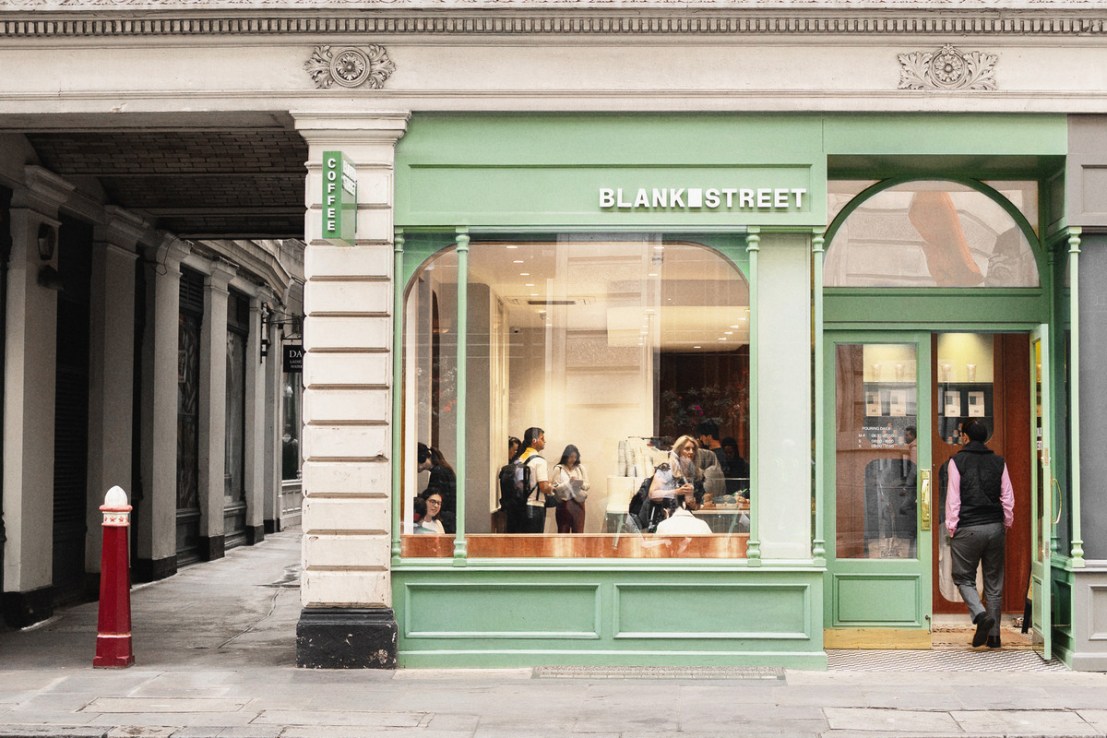
Given the ubiquity of Blank Street’s pastel green branding across the capital, it is almost surprising to think the New York-based company only opened its first London shop in the summer of 2022.
In fact, it only opened its very first shop in Williamsburg in 2021, after spending nearly a year housed in a Brooklyn coffee cart.
Just four years later, the company has announced its first-ever, company-wide profitability, tripling turnover to £36m over the last two years.
Managing director Ignacio Lladó describes 2025 as a “landmark year” for Blank Street. “We’ve really hit visibility… and showed the success of the business,” he said.
Blank Street’s success sits alongside a difficult time for older coffee chains like Costa Coffee, Pret A Manger and Starbucks, which are all struggling with a cost-of-living crisis as well as higher wage taxes and an uncertain global macroeconomic environment.
So, what is Blank Street doing differently?
A matcha made in heaven
There are a few key drivers of Blank Street’s success. The first, unsurprisingly, is some hefty venture capital backing from funds like General Catalyst and Tiger Global.
The two founders, Issam Freiha and Vinay Menda, raised over $67m (£49m) in 2021, super-charging the brand’s expansion in the US and further afield.
The second is something a little more difficult to quantify, and ends up coming down somewhere between luck and foresight.
Blank Street came along at the right time, with the right aesthetic, for a generation eager to enjoy ‘Instagrammable’ treats.
Everything from the shops to the drinks and the counter is sleek, simple, and – however intentionally or not – looks brilliant on camera.
It is also more affordable than your average pint or social, placing it in the right bracket for a mid-afternoon social visit.
Crucially, Blank street nailed its timing on the post-pandemic matcha boom. The chain’s blueberry matcha, launched in 2024, became a social media trend and briefly made Google tag the company as the ‘home of the blueberry matcha’.
“[We] pioneered a full matcha menu in a way that had, realistically, never been done before in the high street… we were the first at this scale to really go out with a matcha menu of this quality,” Lladó said.
“We saw the spark of matcha in 2023,” he explains. “We decided to launch our blueberry matcha into our spring menus, and it started to take off small circles.”
Blank Street staying on-trend
While rivals wrestle with a shaky consumer backdrop, Blank Street has leaned into collaborations and experiences, which are designed to resonate with younger customers.
Customer experience is designed to push past the boundaries of ordering a drink, and tips into the Gen Z-centric trend of experiencing and consuming a brand as an aesthetic – both online and in real life.
Events range from a surprise in-store event with pop star Sabrina Carpenter to a month-long padel pop-up at Battersea Power Station, while last year concluded with a drink collaboration with influencer and stylist, Melissa’s Wardrobe
A Mel’s Maple Matcha secret menu exclusive generated a significant amount of social media buzz, and sits alongside countless other menu collaborations with brands like Supergoop! and Haley Bieber.
The company has not escaped criticism however, with detractors questioning its VC-fuelled model and consistency across outlets – but Lladó insists expansion has not come at the cost of standards.
“[The question] is actually, how do we increase the quality of what we do as we scale?” he said. “And a big part of that is not just [quality of the drink] but store design and customer experience.”
“We’re incredibly ambitious, and we’re improving, evolving every day. But that’s our mindset for growth: With every new store, are we able to up the Blank Street experience one notch higher?”
“People are coming from blank street experience,” Lladó said. “That’s what makes us stand out and makes us special.”
For a coffee chain that started in a Brooklyn cart just a few years ago, its rapid rise – and first taste of profitability – suggests that strategy may be paying off.