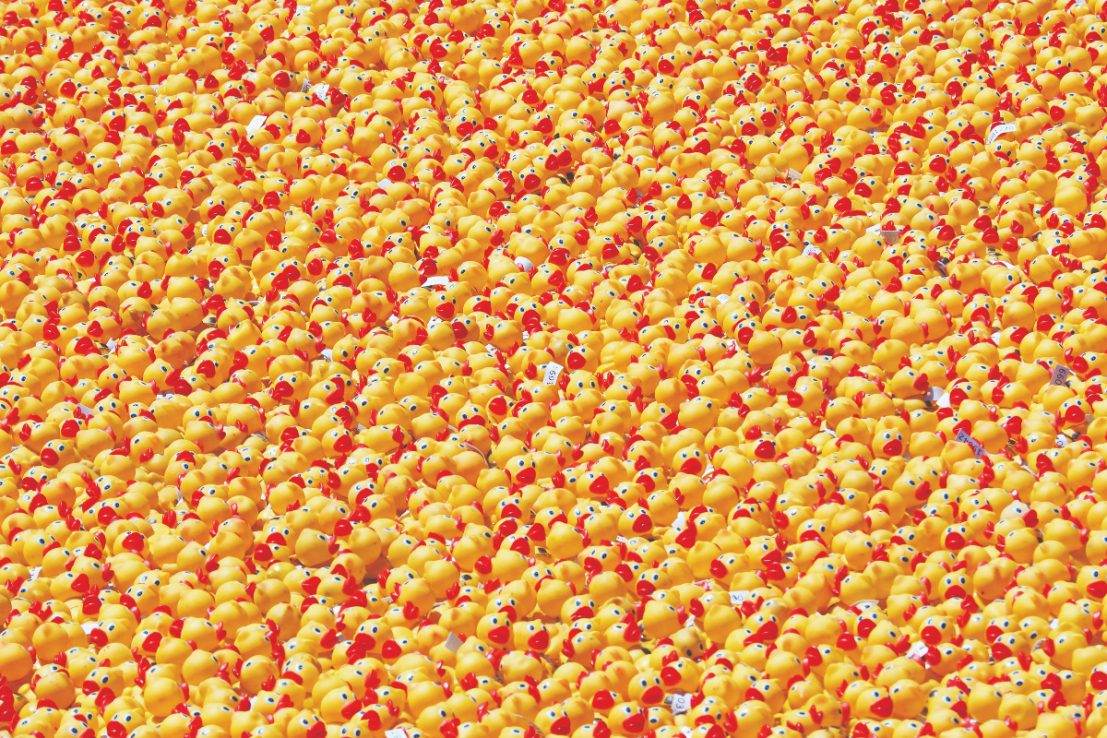
From City AM The Magazine, Autumn edition, Adam Bloodworth meets the people exploring ‘radical connection’ by handing one another tiny little rubber ducks
We were at a festival when two girls I’d never met tapped me on the shoulder and handed me something,” says Aggie Morris, who lives in east London. “They asked me if I wanted some quack. Then they dropped a duck in my hand and carried on dancing.”
Aggie is one of thousands who’ve been handed tiny yellow ducks by complete strangers this summer. Instagram feeds and Tiktoks of people looking delighted with their bright yellow toy animals have been plastered over social media. ‘Quack teams’ have been handing out the ornaments, and stray ducks, no bigger than an inch long, have been found strewn across regional towns.
Whimsical waterfowl have been placed in belly buttons, matted into hair and lined up on the countertops of food vendors. This summer’s strange but joyous new trend is taking hold at music festivals – luminous yellow birds were a common sight on DJ decks this year – and there have been reports of ‘duckers’ at concerts too.
Smudge McIntosh, who set up The Joy of Ducks Instagram page in April 2024, is a DJ and events runner. He has posted photos of himself covered in duck mascots, wearing duck outfits and handing them out to strangers. The Duck Diggory Instagram account is another example of the secret underground world of duck giving.
Smudge is one of the leading figures in the ‘ducking’ game. He hands out tiny rubber ducks to connect with strangers
A month after Aggie was given a duck, her sister had been handed a silver metal one by a stranger at another festival in another part of the country. Who is Smudge McIntosh? And, more importantly, why are so many people handing out little ducks?
“The angriest of people can crack a smile,” Smudge DMs me. “It’s very rare that it goes badly, but it’s a subtle art to do it well.” Smudge lives in Liverpool but travels the country to attend festivals alone. He’s into absurdism, sending me a link to a video entitled How to Party at the End of Meaning. “I don’t know really,” he says when I ask him why he hands ducks to strangers. “Geese are silly, but ducks are cute. I think that’s what people like. Having a big suitcase full of ducks, that’s when it becomes ridiculous.” Then he gets serious: “It’s about bringing joy into the world.”
Smudge got into ducking after wearing a yellow hat to a festival last summer and receiving loads of compliments. To one-up his look he placed a rubber duck on his hat, which drew even more flattery. As a DJ, Smudge has played at Glastonbury and Pikes in Ibiza, but he views ducking as his most successful project. “It’s radical connection,” he says. “It’s laughing in the face of what’s going on. It puts the other person at ease. When you’re extroverted and talking to somebody it can come across as intrusive.”
Curtis, who also lives in London, met Smudge at Lost Village festival. He had been working there
when he was confronted by a man wielding a shoebox. “A pile of tiny yellow ducks were just smiling up at me,” he says. It was a similar experience for Matt, a tech worker from Liverpool. “He just sort of appeared and started to change the dynamic of the dancefloor,” he said. “I was really impressed by how quickly he brought something different.”
Festivalgoers have been wearing rubber ducks gifted from strangers
Like festival wristbands that people keep on throughout the year, Matt, Curtis and Aggie took their ducks home. Aggie has hers in the living room to remind her of the fun she had at the festival, and another festival-goer, Tamsin, tells me she keeps hers in her handbag when she goes to raves. “They’re like a good omen,” she says.
Naturally, The Duck Truck, a mainstay at music festivals, has become a Mecca for duckers. Founder Ed Farrell has lined the ducks he’s been gifted along the front of his truck. “You do get the occasional bad reaction to them, mainly from vegans who hate the fact you are linking a cute rubber ducky with the fact you are eating duck!” says Farrell. “You can’t please everyone. I have also had people suggest I am making my brand less classy by displaying rubber duckies. But I don’t give much of a duck about the haters, they are far outweighed by the joy it brings people.”
The trend for passing out gifts at raves has been around in America for some time, particularly on the EDM scene, where ‘PLUR’ culture (peace, love, unity and respect) is about connecting with new people. Kandi bracelets are commonly given as gifts, similar to the way Taylor Swift fans exchange friendship bracelets.
In the UK this summer, the trend appears to have taken on a more whimsical form. Smudge admits he’s “upped the game a bit,” but suspects dozens of duckers are now at large. Ducker Clare from Manchester had been attending Lost Village when one of her group graduated from duck receiver to duck hander-outer. “One friend was very excited about the ducks and ‘with permission’ grabbed a handful and popped them in her handbag,” she says. “By the end of the festival she gave them out to festival goers to spread more joy!”
Ducker Arman, a videographer based in London, takes a more targeted approach than Smudge, spotting specific people in crowds he’d like to gift. “We’d see a certain unique characteristic about someone and we’d look at each other and be like ‘I wanna duck them,’” he says. “We’d look at each other and be like, ‘We need to duck them hard.’” He is particularly keen on passing ducks to people wearing peculiar outfits, and likes to place them in random locations around the house to surprise his girlfriend. “I place them inside her boots, on her desk, in the kitchen cabinet.”
All duckers have different methods. “I don’t like that line,” Smudge tells me when I bring up the ‘quack dealer’ joke. He sounds genuinely exasperated at the thought of it. “Everyone makes that joke.” He says he takes his “silliness very seriously,” helping him reach the higher echelons of the festival hierarchy: even Gilles Peterson has played sets with ducks on his mixing decks.
Punters have been finding interesting ways to wear their rubber ducks
Altogether, Smudge reckons he gave out north of two thousand of them at festivals this summer. He has since seen people handing out mini brussels sprouts and little pigs. “The best I got was when someone gave me a little bottletop man with googly eyes made out of upcycled trash,” he says. “It does make me uncomfortable that I am handing out little bits of plastic in a field. I have considered how I can make it more eco-friendly. Origami is the obvious one but it doesn’t have the same effect. So now I’m researching using recycled plastic.”
As autumn hits, duckers have turned to making mallards memeable while everyone’s stuck inside, sharing ducklings digitally, instead. “I want to start a campaign to get the rubber duck emoji!” Smudge says. “It’s been rejected twice. The ordinary duck and chick ones aren’t good enough.”
There is science behind the silliness, too. Humans require these encounters with strangers “as much as they require food and shelter,” according to counsellor Debbie Keenan. Without them, “feelings of isolation and alienation tend to grow.” The act speaks “to a part of our desire as humans to connect,” says psychologist Lianne Terry, who says duck-giving “fits into a larger cultural moment of people actively seeking offline connections.” It’s a tonic to the loneliness epidemic and our messy digital lives, where doom scrolling so often takes precedence over IRL social connections.
As a social glue, ducks are a canny choice. Their luminous yellow is a colour widely understood to evoke feelings of happiness, optimism and energy. But there’s more to it than just that. Specialist shops have been thriving across London in recent years, selling ducks dressed as beefeaters, navy seals and pirates. New Square Mile arcade Fairgame has a ten-metre-wide spinning duck that greets you as you enter, and inside you can play the classic village fete game of hook-a-duck. The duck is a nostalgic symbol of childhood and care-free play.
So next time someone makes eye contact with you at a festival or gig, don’t look away – you might end up with new friends, both human and squidgy-form.