From social media influencers to top chefs, artisan knives are slicing across the UK’s culinary scene. Carys Sharkey meets the makers behind the metal
Translucent wafers of sea bass are topped with diaphanous slivers of grape; chives are chopped into oblivion; and steak is sliced bloody.
If you’ve spent any time watching social media chefs, you’ll have seen this all before. You will know that knives and knife skills are a conspicuously Big Deal. Like squirty olive oil and vintage Arsenal shirts, chef knives are a staple of the boyish online realm. Even OG butter fiend and foodie love-hate thing Thomas Straker has his own brand of blades.
Like social media chefs, knives really exploded in the UK during lockdown, when obsessions were given time to fester. It happened to me, too. Navel gazing turns to bevel gazing as one makes the inevitable lurch from amateur cook to knife enthusiast. As lockdown dragged on, I bought a waxy canvas roll bag to carry my knives in like some Medieval itinerant chef, which was especially ridiculous considering I literally couldn’t leave the house.
A recent trip to Japan got me thinking about knives again. In Tokyo’s Kappabashi district you can spend an entire day walking around knife shops, where walls are burnished with razor-sharp yanagiba, gyuto and santoku knives. Sit at any omakase counter and you’ll be hypnotised by blades see-sawing through pale, fatty tuna, iridescent horse mackerel and custardy steamed eggs.
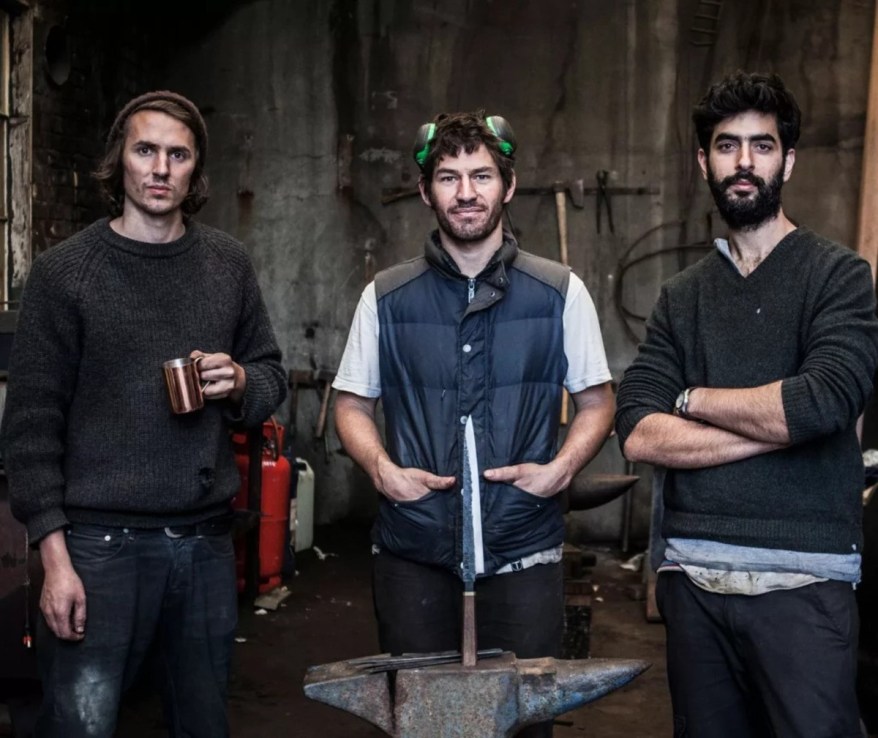
The UK knife scene is dynamic but one company has been a trailblazer, frequently topping lists of chefs’ favourites: Blenheim Forge. It started – in what seems to be a recurring theme with knife companies – as two guys messing around with fire and metal in their garden. While still at university, James Ross-Harris and Jon Warshawsky turned their backyard into an alfresco workshop, complete with DIY forge powered by a leaf blower. A decade later, the set up has come a long way. Jon and James were joined by Richard Warner, and after setting up in a workshop in Peckham’s arches, the group are now turning out some of the best knives on the market.
I visited Jon in the workshop one blisteringly hot summer morning. Blenheim’s Japanese-style knives are made from their own steel blend, forged with a dark dappled patina that blurs into an undulating seashore effect from walnut handle to precise tip. Jon tells me they do most of the forging at another site and finish the knives here in Peckham.
“We produce them consistently, and they’re all basically the same knife with small variations. They’re handmade but they should function the same,” Jon says.
They also make limited edition knives, which Jon describes as a “passion project”. When I visit, he is working on a pasta knife, a flat-edged blade for slicing perfect strands of eggy noodles. Previous special projects have included a jamon slicer and a hunting knife. They might be niche, but these releases will often sell out in minutes. “People really do like to have something a bit specialised,” Jon says.
But Blenheim doesn’t just make knives that look pretty. They are rigorously tested in professional kitchens, which explains why they are so popular with both chefs and amateur cooks.
“If someone who’s used the knife for 10 hours finds it comfortable, then so will someone who uses it a couple of hours a week. They might not even know why, but it just sits right in your hand,” Jon explains.
Credit: Blenheim Forge
Jon says being in the heart of Peckham is integral to the process, with little pieces of the community hammered and folded into each knife. It would, however, be remiss not to point out that these knives are expensive. Most people do not have the money to drop a couple of hundred quid to facilitate a marginal improvement in the chopping of onions. Jon doesn’t deny this but says that, despite rising rent and skyrocketing steel costs, Blenheim has not put up its prices. A big part of his job is now making the same high-quality knives more efficiently.
But he is facing increasing competition from companies importing or buying steel-cut blades for cheap and sticking a fancy handle on them, then claiming to be ‘handmade in the UK’. “There’s more competition from people who don’t really make their knives… there’s no one to complain to. No one cares, apart from the customer, who gets an inferior product.”
If well-established forges like Blenheim are feeling the squeeze, then spare a thought for individual knife makers. I spoke to both Dan Prendergast of Prendergast Knives and Tim Westley AKA Clement Knives: both are acutely aware of being undercut. The issue, they tell me, is compounded by the fact that they can no longer reach new audiences on social media due restrictions implemented in response to soaring knife crime. It leaves them fighting an uphill battle against companies with impressive PR machines for hypey-collabs and releases, which are able to crank out a higher volume of lower-quality but similar-looking knives.
Dan, a blacksmith since 2004, makes his knives from a “wonky shed” in the Cotswolds. Speaking to me from Gloucestershire, Dan is direct, both about the knives he makes and the issues he faces as an independent manufacturer. He describes his design as “very straightforward”, but these are not the kind of knives you find crammed into utensil holders in suburban kitchens. They are expertly forged and without any affectation. The steel on his blades appears almost brushed, like heavy rain streaming off a window pane.
Dan often makes knives out of reclaimed materials: iron from a railway cart dragged out of a hedgerow by “Farmer Dave”, or beams that have been stripped from an 18th century cottage. He might then blacken handles with “a potion made from vinegar and old horseshoe nails”.
He collapses hundreds of years of history into each knife but function must always come before form. His ethos is to do “as little as possible to get it from being a piece of metal into being a knife.”
Credit Dan Prendergast
“There’s not a single part of my knives that I can’t defend from a functional point of view,” he says. “I forge the steel, grind it, glaze it, heat-treat it, sharpen and handle the blade – all myself.”
Tim, who goes by Clement Knives, is also a one-man show weathering the pinches and punches from the industry. But far from the bucolic surroundings of the Cotswolds, Tim started out bobbing up and down on the Thames in a canoe. After collecting rubbish from the murky river, Tim taught himself not only how to forge blades, but how to melt down discarded plastic to make the handles.
“I could only find one video of someone actually making something out of bottle tops, a young boy making a slingshot. I just applied that same concept.” Ten years on from those Thames trips, Tim is based in the Scottish Highlands. But the knives he makes are still all about recycling materials in surprising ways. “The interesting part is doing it within the confines of working with rubbish. And then trying not to produce any rubbish as well,” he tells me.
Credit Clement Knives
He takes trips to Glasgow or London to collect NOS canisters, which you will have seen scattered on streets outside pubs and clubs come Sunday morning. These are then melted down and forged into beautifully patinated blades printed with his trademark laughing skull logo. He visits Scottish beaches to pick through washed up commercial fishing rubbish, which is turned into kaleidoscopic handles of swirling blues, pinks and greens. He rails against waste in commercial manufacturing, pointing out that for every knife made, there are two or three that go to landfill – unless he can get his hands on it first.
This summer, Tim started working an ice cream series, with handles designed to look like Fabs and Fruit Pastille ice lollies. One with a watermelon design is straight out of The Very Hungry Caterpillar. When I ask him about it, he tells me that he’s still trying to master the Twister. “It’s been a bit tough lately, but I just started trying to have a little bit of fun with it. I’m trying to do different things.”
Given the immense pressures on hand-forged knives, 27-year-old Sean Warmington-Wan decided to go in a different direction when he launched Fragrant Knives in 2024. Sean worked in kitchens in the capital before moving back to Hong Kong. He was struck by the way chefs would use a single knife for everything: chopping, mincing, dicing, slicing, scooping and deboning – the ubiquitous and utilitarian cleaver is the culinary Swiss-army knife.
“After my grandmother gave me an old Chinese knife of hers, I would use it both at home and in the restaurant. I just found it so much easier,” Sean tells me. He saw a gap in the market for introducing high-quality, small-batch Chinese-style cleavers to western cooks. Having lived in house shares throughout his time in London, he knew that having really sharp and expensive knives that demand a high-level of care is simply not practical for most people. “I’ve seen enough beautiful Japanese knives rusted, chipped or unused in knife drawers.”
Sean goes on to point out that, for the majority of western home cooks, you’re more likely to be “cutting carrots for a stew” than slicing yellowtail for sashimi. And while Japan might be held in the highest regard for knife manufacturing, he says that China’s craft scene is often unfairly maligned.
Credit Fragrant Knives
“We’re proud to be made in China. I wouldn’t ever try to elude where the knives are made. I’m really proud to be a part of this long tradition of craftsmanship. For too long, there’s been a widely held, quite lazy assumption that equates Chinese manufacturing with low quality, knock off consumer goods”.
Fragrant Knives partners with a small workshop in Yangjiang in the south of China, which has been the centre of Chinese knife production for thousands of years. The workshop is run by a third-generation knifemaker, who relishes taking Sean out to show him the city and drink heroic quantities of baijiu whenever he is down to visit.
Credit Sean Warmington-Wan
It’s a small-batch company still in its early stages, but Sean is looking for ways to engage with the British-Chinese community, from chefs and restaurants to authors and influencers. Undaunted by the twin titans of Japan and Germany that loom large in the western steel psyche, Sean says it’s high time that Chinese-made cleavers got their dues. “If you are willing to pay a fair price and deal with a workshop you trust, you’ll get some of the most economical high performance knives of anywhere in the world in China”.
It might just be time to add to that canvas roll bag of mine…