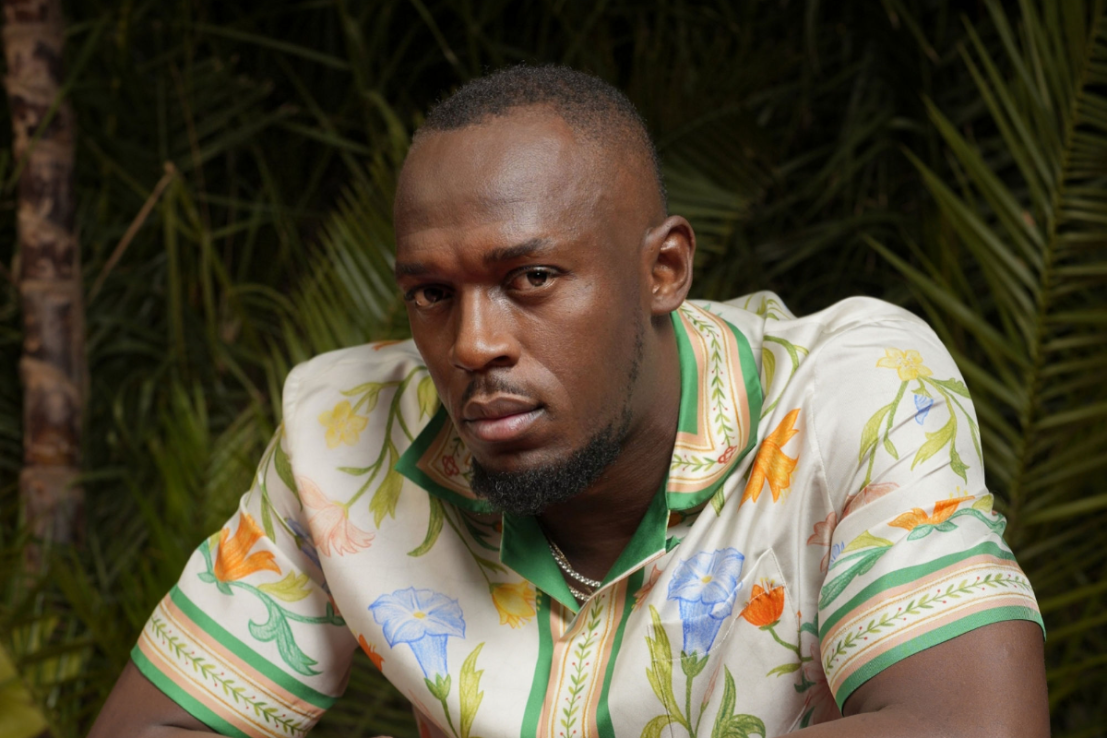
What does the fastest man in the world do when he slows down? For the cover of City AM Magazine, Autumn edition, Usain Bolt talks to Sam Kessler about his unrecognisable new life
On 16 August 2009, the world record for the 100m sprint was set at 9.58 seconds at the World Championships in Berlin. Sixteen years later, it’s a record that has yet to be beaten. The man who set that record needs no introduction. Millions of people across the globe instantly recognise the fastest man in the world’s signature lightning bolt pose. Everyone knows the name Usain Bolt.
The only sprinter to win gold medals in both the 100m and 200m sprints at three consecutive Olympics, at Beijing 2008 he also became the only person in the world to hold the records for both distances. Calling him a legend is an understatement bordering on an insult. And yet far from the split-second timing and iconic showboating of the track, Usain Bolt might just be the most relaxed former athlete around.
Now that running is behind him, there’s no more regimented training sessions, no more pushing himself to the limits of human performance. I mean, if he doesn’t deserve a rest, who does?
“Life on the track, it’s fast, obviously. We’re here to run the fastest time possible. But away from the track I try to take things as slow as possible, to take it easy. If I don’t have to work, I’m always just chilling with friends, hanging out with my kids.
Usain Bolt: there’s a lot going on in the world – making music that is positive, energetic: that helps
Usain Bolt talks to City AM The Magazine
“Most of your life when you’re competing it is just on the go, making sure everything’s together. You’re so focused. So, when you’re not competing you can take a breath, take a week off, relax. It’s a beautiful time.”
All that spare time has given Usain Bolt, now 39, a chance to experiment with alternative careers. He tried football, hoping to convert his speed on the track to the pitch. But now his focus has changed to music. His debut album, Country Yutes, is a combination of reggae, afrobeats and dancehall, underpinned by something very important to the older Bolt – positivity.
“It’s Jamaican music, but we try to keep it as positive as possible. You know, as youths are coming up you want to try and push the positive. In these times there’s a lot going on. If you can make sure that the music is positive, energetic, different from the negative, it helps.”
Fortunately, Bolt has positivity to spare. Thinking back on that record-breaking sprint in Berlin is still a lifelong highlight: “It was a great feeling. It was one of the times I was actually running for a record and it meant a lot to see all that effort pay off. Every time you win a championship it’s kind of a relief, know what I mean? You kind of blow out, like ‘ahh’. Because you know the work you go through, whether you’ve been injured throughout the season. It’s always tough. I just tried to focus on making sure I got it right. That time I did.”
And yet, while you might assume that looking up and seeing that clock read 9.58 would be the highlight of Bolt’s career, he thinks of it as more of a job well done. It makes sense: he aimed for a time and he got it. But if he could go back to any moment in his career, it wouldn’t be 2009, but much, much earlier.
You have to believe in yourself, believe in your time, because it’s going to be a tough road
“World juniors when I was 15 in Jamaica. That atmosphere, the feeling I got from being at home and winning, I’d go back to that feeling, definitely. At the time I was still trying to properly get into running. I was enjoying it because I was winning all the time. But the older I get the more I understand just how big that moment was, actually winning in front of your own crowd. A lot of people never get that opportunity, you know? It was the one time we actually hosted a championship. It was a small championship, sure, but we’ve not really hosted much since and the fact that I could win at home was a big deal.”
That championship was a metaphorical lightning strike for Bolt. Prior to that championship, he was widely considered to be coasting, enjoying the sport without putting his all into it. After that 2002 World Junior Championship in Kingston, he began his ascendency.
As we’re talking, it’s hard not to spot what Bolt was rocking on his wrist: a solid gold Hublot Big Bang. It’s not a shy, retiring watch: on the contrary, it contains 45mm of industrial planes, skeletonised dial and precious metal. It’s one that Bolt had a hand in creating.
“It’s one of my own watches!” he says excitedly. “The Big Bang. It’s our second collaboration and my second favourite watch. My favourite is the first collab we did to commemorate the Beijing Olympics, where Hublot used my actual spikes from the race in the watch. That was one of my favourite spikes, too.
“We tried to just capture me, you know what I mean? That first watch was mainly focused on Jamaican colours, my pose in general. But this second one is a bit different. It’s bold, it stands out… I wanted something that I’d wear on a night out.”
It’s not hard to see why a brand like Hublot would appeal to someone like Bolt. The bombast, the boldness and more gold than Bolt’s eight Olympic medals, it’s punchy. It’s almost enough to make you forget there’s a serious Unico movement underpinning some equally serious watchmaking. It’s also no surprise that Bolt has plenty of other watches in reserve.
“Last time I checked, I have something like 34 maybe? When I started getting watches they were all big, but now I try to mix it up, different colours, different vibes.” Usain is in good company at Hublot, who these days have a sporting hall of fame when it comes to their ambassadors. He sits alongside tennis legend Novak Djokovic, football icon Kylian Mbappe and the entire Premier League. But it’s not the flash of wrist candy or ambassadorial pedigree that got Bolt on board. It was charity.
“One thing I’ve noticed when I was growing up,” says Bolt of the eponymous Usain Bolt Foundation, “kids didn’t have the necessary means to get to school, didn’t have books or the basic necessities of education. You know what? If you miss this part, it’s harder when you get to the next level. So, I try as hard as possible to just get these kids pencils, computers in schools so they can research.
“For me, Hublot was making waves when we got together. They’d started to do a lot of collabs with different people over the years. But we found out that they did a lot of charity work and that meant a lot to me. When Hublot came on board they really supported by giving towards my charity every year. They helped in every way they could and earned a place in my heart.”
Of course, any good partnership needs some synergy and, while his collaborative limited editions prove Hublot matches Bolt’s personal style, according to the man himself there’s a deeper reason they work well together. “Hublot’s creativity, their strong will, the time and effort they’ve put into being the best… that’s how I started. They took their time to get there and so did I. It’s about thinking how can we change, how can we adjust, how can we be better? In that, we’re the same.”
It’s been a long road (and a short sprint) for Usain Bolt to get where he is. It’s taken dedication that few could rival and that’s defined both him and his sport for generations to come. But while Bolt pushes himself, that’s not something he necessarily wants for his own children (daughter Olympia and twin sons Saint and Thunder).
“Growing up, one thing I’ve always said is to just enjoy the process,” says Bolt. “I see so many kids being pushed so hard at a young age. They’re being pushed to mature so quickly. But sometimes it’s good to make mistakes when you’re young, it helps you refocus. I made mistakes when I was younger and I learned from those mistakes. Just believe: you have to believe in yourself, believe in your time, because it’s going to be a tough road.”
So, the big question. It’s been 16 years since that 9.58 time and unlike many, many other athletics records, nobody’s come close to breaking it. Does he think anyone ever will? “No,” he laughs, “I don’t think so. I’ve seen a few athletes nowadays… but I don’t think anybody’s going to break it.”