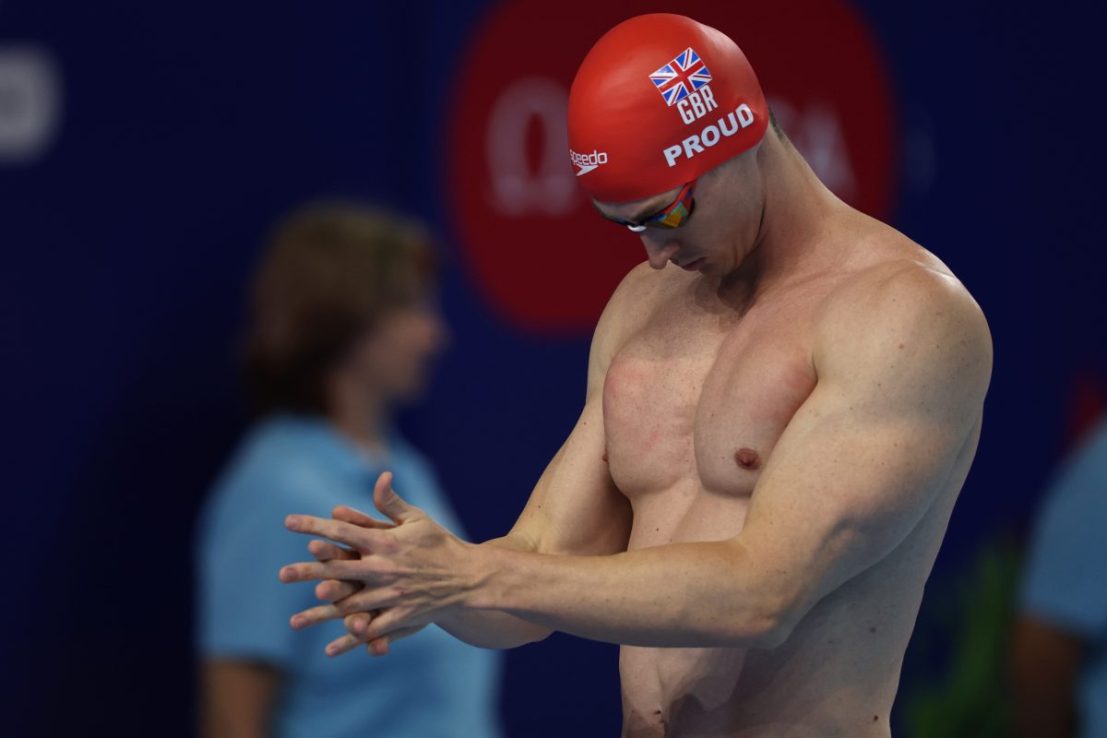
Rather than wondering why Ben Proud would sign up for the Enhanced Games, it is better to ask why he wouldn’t. The British swimmer’s commitment to the competition with an “anything goes” attitude to performance-enhancing drugs is a wake-up call for the Olympic movement. Money, as ever, lies at the heart of the matter.
Proud will be 31 years old on Sunday. He won silver medals in the 50m freestyle at both the Olympics and World Championships over the past 14 months. Los Angeles 2028 probably looks a long way off and age a key factor in his likely prospects there.
As retirement nears, as for any athlete, so his career and financial uncertainties will have been looming larger. Then in stepped the organisers of the Enhanced Games with their $1m reward for breaking world records, and who knows what other inducements to compete in their mission to test human boundaries?
The announcement of Proud’s change of swimming career path took the sport’s establishment by surprise. What was not surprising was its condemnation of his decision — a choice which will rule him out of aquatics’ mainstream. In springing a surprise the Enhanced Games gave itself, and its new recruit, a PR jump.
In interviews on the BBC and in a national newspaper, the swimmer had a starting block from which to launch his justifications, which were largely financial.
“It would have taken me 13 years of winning a World Championship title in order to win what I could win in one race at this games.” Ben Proud, talking to the BBC.
This, though, is not simply a tale about swimming, nor is it one only of British Olympic sport. After all, Proud is not the first swimmer to sign up to the Enhanced Games, merely the first Brit.
Expect similar spikes of alarm in other countries and other sports as the roster of ‘defecting’ athletes grows. And grow it will, for almost all Olympic sports struggle to provide financially for their stars while they are competing, and most entirely fail to enable them to prosper in retirement.
“I think it’s tragic that we may now never see Ben handing out medals at nationals, being introduced to the crowd as our greatest sprinter, speaking to kids at clubs and so on.”
This teammate of Proud’s, quoted in The Times, inadvertently gets to the nub of the issue. Handing out medals pays no bills. Turning on Christmas lights or cutting ribbons to open new call centres might earn an ex-athlete a few quid; an appearance on Strictly or in TV’s jungle a few more. But the public’s memory fades swiftly, even more so for sports stars with silver rather than gold Olympic medals.
That may seem harsh on both athlete and public – brutal even – but it is the reality of an Olympian’s long-term prospects. Perhaps competing at the Enhanced Games will enhance those prospects, though; a whiff of notoriety create greater value in the celebrity or corporate marketplace. Consider it the reality of retirement postponed.
As fans we revel in the Games, but each Summer or Winter edition only arrives every four years. In between times we largely fail to support the sports and athletes that we enjoy during their fleeting moments in the Olympic spotlight.
If we don’t pay to see them in the flesh or subscribe to watch them online, then we should not be surprised that it is a constant grind for those competing or promoting them.
It is a struggle too for those, such as UK Sport, who make the case to governments for more athlete funding. There are only so many times that they can argue the case for the inspirational effect of the Games on a nation’s wellbeing if the public doesn’t maintain its side of the bargain.
The Enhanced Games is, in business parlance, a disruptor. It is tapping into mankind’s enduring fascination with the outlandish and the extreme, from the often morally dubious attractions at Victorian travelling fairs to combat bouts between influencers today.
Indeed, modern technology and the social media it hosts have probably heightened appetite for excess (and commensurately dulled interest in the ‘normal’). I’d wager reactions to Ben Proud’s decision vary widely across the age spectrum, with younger generations least censorious.
Perhaps mainstream sport will learn from the performance experiments conducted under the banner of the Enhanced Games. It is hard, too, to envisage them proving anything other than a sideshow from a commercial perspective.
Cherry-picking a few athletes to take part, especially those approaching their career twilights, will not create a sporting mass that could rival the Olympics or the event structures of its constituent sports.
If the new venture does take root, however, there must be a risk that it becomes a late career pathway for a growing cohort of Olympians eager for a lucrative final payday before confronting the reality of decades as ex-athletes.
Every time they prove capable of going faster and being stronger than in their clean heydays – whatever the risks they might run to their health in the process – the lustre of Olympic sport will be dulled just a little more.
Ben Proud’s choice can be condemned. That is the easy response. For those like me who love clean sport, it can and should be lamented. It is not difficult to understand his choice, but accepting that understanding is harder for it forces one to confront the fundamental weaknesses in the financial structure of Olympic sports.
The International Olympic Committee (IOC) has almost $5bn of reserves and a new president, Kirsty Coventry, with the opportunity to reset the sports that underpin its enduring might. The IOC should invest much more heavily in those sports and their athletes, not abdicate responsibility for their financial health behind a smokescreen of outdated amateur ideals as it does today.
Prize money at the Games (following athletics’ recent lead) and investment in the constituent sports’ world and area championships would be a start.
Time then for Coventry, a former gold medal winning Olympic swimmer herself, to prove she is both a visionary and a realist — for all athletes’ sakes.
If you’ve not heard or read Proud’s comments already, it’s worth doing so. Some of them caused my eyebrows to shoot skyward. Take this, for example: “I do kind of feel I’m in the safest hands I have been in my career.”
Watch Proud on the BBC here and read him in The Times here.
The long and winding road
If you can bear to wade through the treacle that is LinkedIn, you’ll find ex-athletes with a wide range of post-competition careers – both inside and outwith sport –plus much evidence of the transition challenge that Ben Proud’s decision highlights.
Just this week a post popped up on my phone by a former GB track athlete, with a gold European medal the most glittering of their many achievements. Their tale of “endless job applications” and networking with “countless people” is telling:
“I loved every minute of my career as an athlete. I created incredible memories and it helped shaped the person I am today. But now I can’t help but think – was chasing a dream for 15 years worth starting over in your 30s?
“The search continues. Resilience is what sport teaches us… but this part of the journey is testing every bit of it.”
Ed Warner is chair of GB Wheelchair Rugby and writes his sport column at sportinc.substack.com