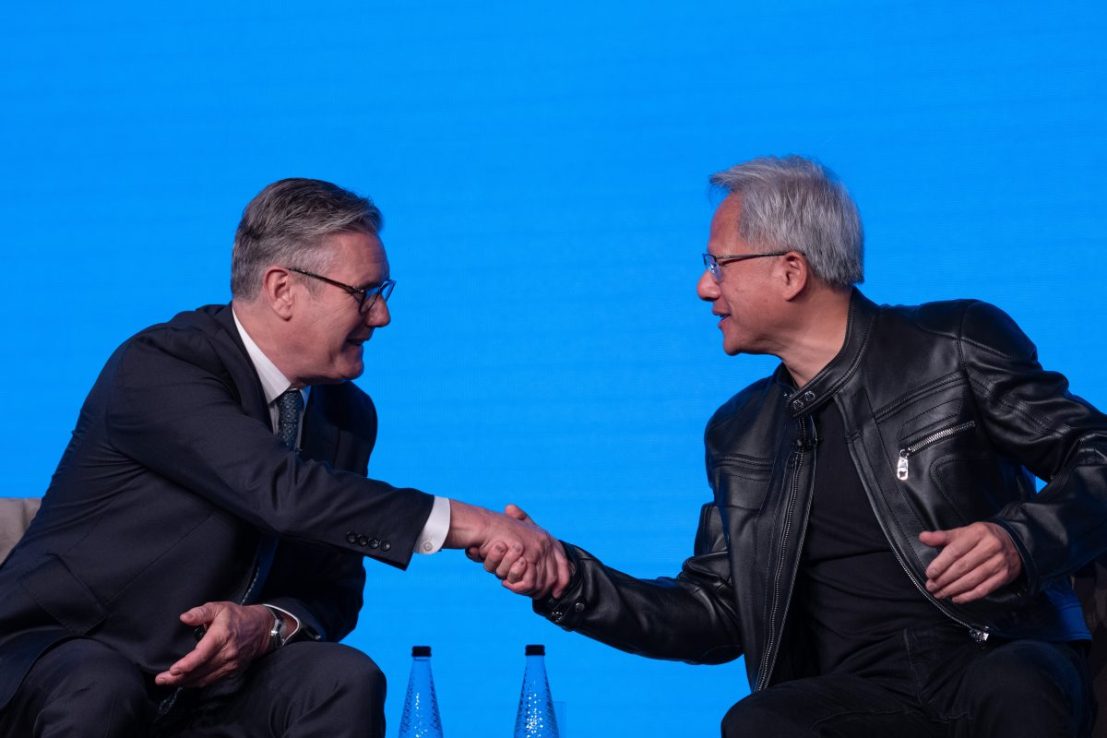
While investment numbers and GPU deals have made headlines, Jensen Huang’s recent comments on his £11bn UK investment reveal a far more ambitious vision than just building data centres.
Beyond the chips and infrastructure, the Nvidia chief has framed AI as the ultimate economic tool to fight inflation and boost national productivity, a message that speaks directly to the UK’s current political and economic challenges.
“AI has the capability to be the greatest deflationary force in history”, Huang told reporters on Wednesday, connecting his company’s technology directly to the cost of living crisis gripping the nation.
“And the reason for that is because we’re automating things, automating something that that is quite expensive to do today”.
While many have raised concerns about AI’s impact on jobs and society, Huang has pivoted to the core of the economic debate.
He claimed that the new ‘AI factories’ his company is building in the UK will not just create new companies but fundamentally change the way existing industries operate, making them more productive and efficient.
“I completely believe that’s going to happen. We’re going to improve productivity, we’re going to expand markets, we’re going to create new product lines”, he told City AM.
For Huang, this is a return to an industrial revolution model, a concept he explicitly links to the UK’s own history.
“The discovery of steam factories that produced electricity. All of that was happening right here, the Industrial Revolution”.
He positioned Nvidia as the modern-day steam engine, creating a “new type of generator… a token generator, an intelligence generator”.
Backing the UK
Huang’s confidence in the UK has been translated into his a half a billion pound equity investment in UK based tech titans.
“We convinced ourselves that that Nscale could be a national champion for the UK to build, to be the UK AI infrastructure technology company”, he said, revealing a strategic bet on a British firm.
This investment shows signs of a long-term strategy for building a self-sufficient ‘sovereign AI’ ecosystem.
Huang has acknowledged that a nation must own its intelligence, and build its own data, specific to its own culture.
“The data belongs to you”, he said. “It belongs to your people. It’s created by your people, your companies, and you should be able to use that data to turn into to trend, to transform that, that data into your national intelligence”.
While acknowledging the UK’s rich heritage of AI talent, telling City AM: “You’ve got superpowers. You just don’t appreciate it sometimes”, Huang claimed that this potential has been “turbocharged” by the new infrastructure.
The government has hailed the announcements as a vote of confidence, with prime minister Keir Starmer describing the deal as a “generational step change” in US-UK ties.
Dependence on US tech
But the surge in American investment raises sovereignty questions. Brent Hoberman, co-founder of lastminute.com, welcomed the deals as “much-needed”, but warned that Britain risked becoming “users, not makers” of AI.
“The next challenge is making sure UK startups and scaleups actually benefit from these deals”, he said, urging government and industry to prioritise domestic champions.
Professor Sebastian Weidt, from Universal Quantum, also cautioned that “alliances cannot substitute for sovereign capability” in fields like quantum computing.
Huang insists his UK investments are aligned with national sovereignty goals, pointing to Nvidia’s equity stake in Nscale.
He also stressed that nations must own their data: “The data belongs to you. It belongs to your people. It’s created by your companies, and you should be able to transform that into your national intelligence”.
Still, the lion’s share of investment is being driven by American giants, not homegrown firms.
Even as Microsoft’s Satya Nadella predicts AI could boost the UK economy by 10 per cent in the next decade, questions remain over whether Britain is laying the foundations for others’ success.
As Hoberman put it: “The real opportunity is in what we build next. Data centres yes, but also new national champions”.