A new format for its conference suggests Reform is thinking seriously about policy, not just personality, says Emma Revell
It’s not uncommon for me to spend a September day on a crowded train full of awkward-looking men in suits (and occasionally some women too). But last Friday’s journey was a little different. Instead of heading to Birmingham’s Escher-esque ICC for Conservative Party Conference, the journalists, lobbyists and policy wonks of Westminster were going to the capacious NEC, which was playing host to Reform UK.
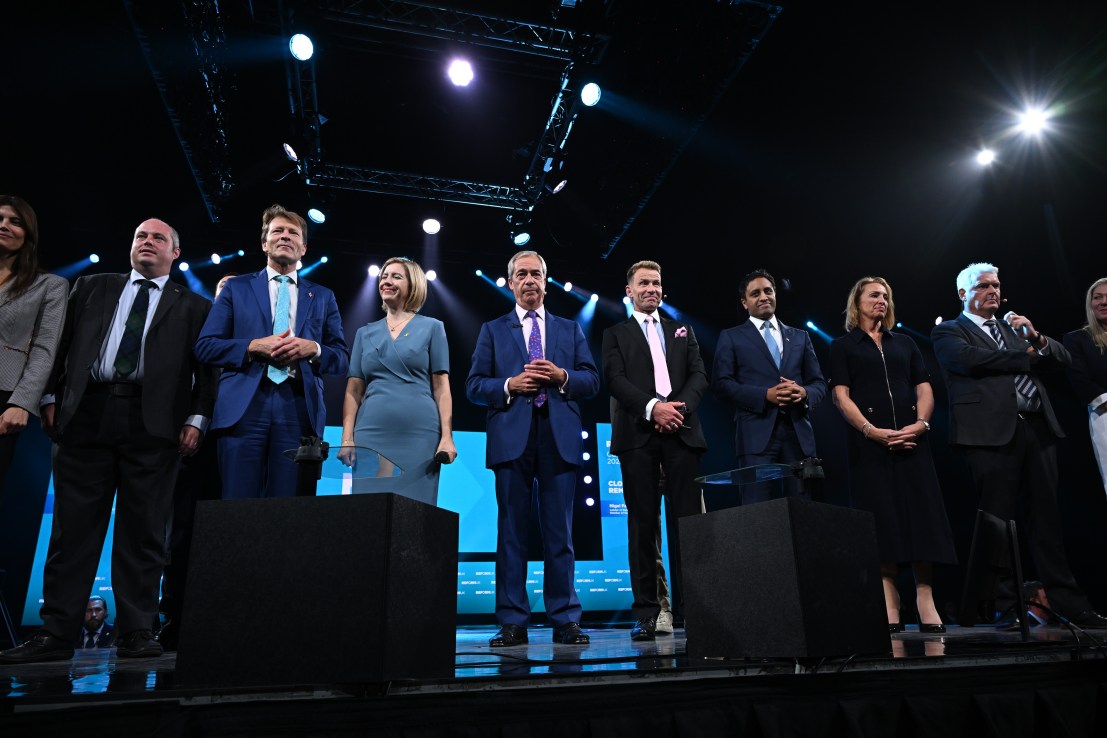
Traditionally, Reform’s conferences have been less actual conferences, and closer to US-style political rallies. Big speeches from big personalities – one big personality in particular – on a big stage designed to energise a cheering fanbase. Much of that was retained this year, from the fireworks and thumping bass that greeted Nigel Farage’s march to the stage to Dame Andrea Jenkyns’s performance of a self-penned ode to insomnia while wearing a sequinned jumpsuit. (I wasn’t a direct witness, but I’ve seen enough video footage to convince me my boss isn’t playing an elaborate prank on me.)
Farage focused-festivities
But the big difference between the weekend’s event and last year’s Farage-focused festivities were the fringes. Anyone who has been to a political party conference knows that the main stage activities can be a little staid – whether it’s junior government ministers given seven minutes of prominence to seem relevant or the Liberal Democrats’ inexplicable enthusiasm for amending the party’s constitution at 9am on a Sunday. The real meat tends to be found in the overcrowded spaces dotted around the edges.
This is where Reform had really upped its game. There were five large “theatres” dotted around the NEC, generally packed to the brim with activists, lobbyists and journalists joining in discussions on everything from good governance (the topic of the event I was there to organise) or Reform’s path to power to immigration, justice reform and energy abundance.
So is Reform starting to think clearly about policy, not just personality?
I think the early signs are there, and not just because of the change in format.
In his main stage speech, brought forward amid the excitement around Angela Rayner’s resignation, Nigel Farage announced a new head of policy role for erstwhile party chairman Zia Yusuf, along with the formation of a “Department for Preparing for Government”. The new party board will also discuss policy issues – some even voted on by the members.
Yusuf has always been considered the man capable of professionalising the party, even after his brief resignation and change of role to run the party’s “DOGE unit”. That, combined with a business background, could reassure some in the private sector that policy formulation is being taken seriously. Having the policy work anchored by one recognisable individual also helps provide a consistent point of contact for the merry band of lobbyists and public affairs professionals who packed out the commercial lounge in Birmingham.
Beyond the back of the fag packet
But there had already been signs the party’s attention was shifting towards more full-bodied policy announcements ahead of their conference.
A few weeks prior, Reform published ‘Operation Restoring Justice’, a pamphlet setting out how it would secure Britain’s borders and deal with illegal migration. It isn’t perfect. But it does draw heavily on existing work already done by think tanks, including my colleagues at the Centre for Policy Studies. A sharp contrast to some previous announcements from the party, which have had a strong “back of a fag packet” vibe.
Now one pamphlet on one policy area does not a manifesto make. There are large gaps in the costings for this immigration paper – and a willingness to host policy wonks en masse at conference isn’t a guarantee they will be listened to. There was a telling question from an audience member at our panel who asked what the party’s governing ideology was, suggesting there was an inconsistency when Reform spokespeople can go from channelling the Iron Lady one day to wanting to nationalise the steel industry the next. The answer from the panel was that the party’s ideology was “family, community, country”. But that’s not actually an ideology.
More weight was placed on new joiner Nadine Dorries’ status as a wise old hand who would steer Reform through the shoals of government than her idiosyncratic CV can bear
Nor was the conference entirely reassuring for those who want to see robust policy thinking from a party which has a real chance of governing the country in a few short years. A prominent and widely discredited vaccine-sceptic was given a speaking slot on the main stage, the cult of personality around Farage still dominated, and there was perhaps more weight placed on new joiner Nadine Dorries’ status as a wise old hand who would steer Reform through the shoals of government than her idiosyncratic CV can bear.
Of course, Reform is still – as Yusuf keeps saying – a start-up. It has only existed under its current name since 2021 and is still at times much closer to a campaign group than a political party. But with momentum strongly in its favour, there is a very real chance it could find itself the largest party in the Senedd in May next year – then who’s to say Downing Street isn’t within Farage’s grasp? Which means the deep thinking we’re told is happening needs to move from behind the scenes to front and centre before it’s too late.
Emma Revell is external affairs director at the Centre for Policy Studies