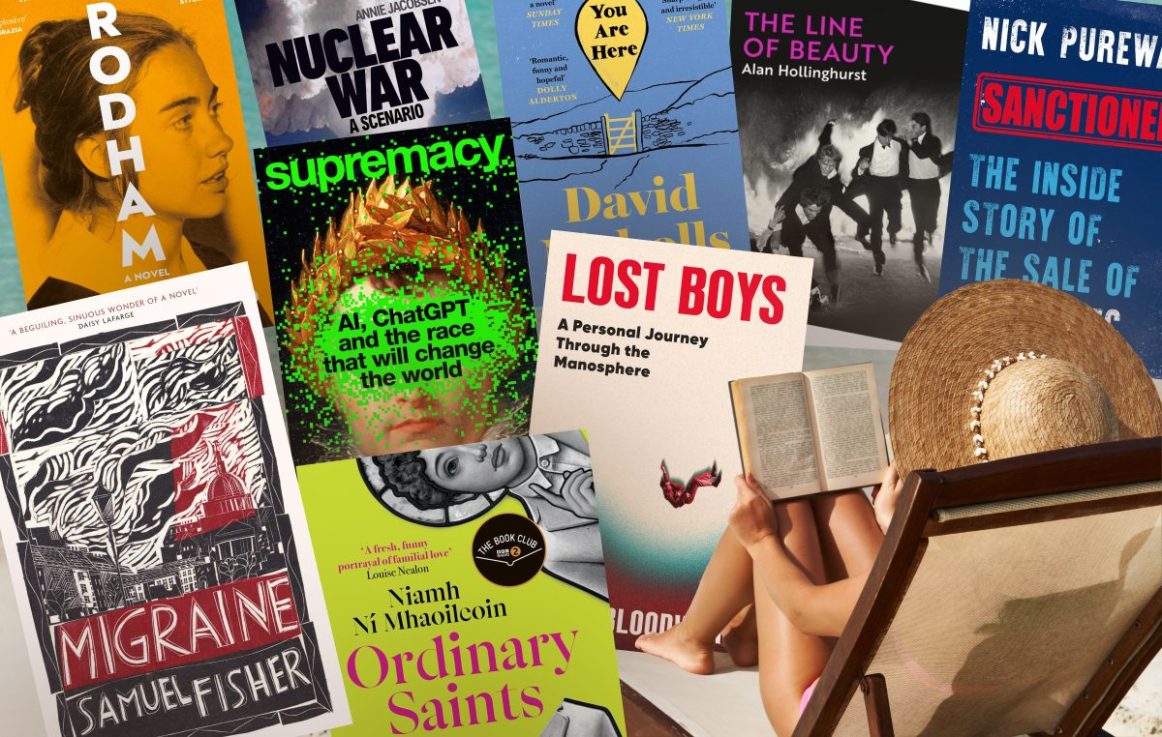
City AM can get you through the flight (pick us up at Gatwick) but we don’t quite have kiosks at the beach yet. To fill the void, we’ve put together a list of the best books we’ve read this summer, hand-picked by our editorial team, to keep you informed and entertained.
From romance to nuclear warfare, there’s something for everyone. Plus even a couple with scenes in the Square Mile, just in case you’re missing it.
Harry Owen, CEO: Supremacy by Parmy Olson
Supremacy is thankfully not an AI book predicting our dystopian future, nor an author cashing in with another workplace AI self-help guide. Instead, we get a behind-the-scenes history of the key players, companies and ideas that are now shaping AI in real time. It helps that the author, Parmy Olson, is a proper journalist, with stints at both Forbes magazine and the Wall Street Journal. That investigative, deep-dive skill-set is what makes this story so compelling. The book is ultimately centred around two people, Sam Altman (ChatGPT) and Demis Hassabis (Deepmind). I’d wager you’ve only ever heard of the former and that is why this book is so important.
With the advent of artificial general intelligence on the horizon, we are in a profound moment, the implications of which will affect everything in our lives. The people steering this ship, into either oblivion or utopia (depending on who you talk to), represent the cast of Supremacy. It’s a wonderfully foreboding title, Supremacy for whom? In the book context it’s Google v Microsoft – in the end it might be the Robots v Humanity. So I can’t stress enough – read this now, not next year. You may not be building AI agents yet, or ‘no-coding’ in your bedroom – but someone is. And the people building our brave new world are at the heart of Supremacy.
Alys Denby, comment editor: Lost Boys by James Bloodworth
Tariffs, tax, war – times are grim so do yourself a favour. Put down the chunky history book and cast aside the guide to optimising your performance at work. Go for escapism as it might be your last chance. You can’t go wrong with anything by PG Wodehouse, but perhaps, since the English countryside seems to be having a moment (thanks JD Vance), try a Blandings castle novel – Pigs Have Wings is great.
If you must read non-fiction, Lost Boys by James Bloodworth is part memoir, part undercover expose of the sinister world of the ‘manosphere’ – the online backlash against feminism. It’s replete with anecdotes and characters both tragicomic and deeply sinister. With the impact of the TV show Adolescence and the rise of figures like Andrew Tate, it’s an apt time to examine the way the emancipation of women has left a vacuum where traditional masculinity used to be – and the dark forces that are filling the gap.
Samuel Norman, City reporter: Rodham by Curtis Sittenfeld
In Rodham, author Curtis Sittenfeld imagines an alternative universe where political heavyweight Hillary Clinton never married her husband Bill – though his continued reappearances do spark some disappointment. While fictional Hillary can feel surprisingly meek compared to her real-life counterpart, the book reads as a fascinating – albeit sympathetic – autopsy of her media image.
The ‘behind the closed doors’ element is sometimes bizarre and often inappropriate, but it’s a compelling enough read to encourage you to keep turning the page. If you’re into your US politics and like to ponder on a ‘What if?’, it’ll make a decent poolside read.
Christian May, editor-in-chief: Nuclear War: A Scenario by Annie Jacobsen
If you want to emerge from your holiday riddled with anxiety and wrestling with the moral, geopolitical and civilisational implications of nuclear conflict, this is the book for you.
Pulitzer prize-winning journalist Annie Jacobsen delves deeper than anyone ever has into what a nuclear exchange would actually look like. What events could lead to such a cataclysmic outcome? What would key individuals actually do? What processes would kick in and how would leaders behave? Presented as a minute-by-minute (often second-by-second) account of a terrifying scenario, Jacobsen’s deep research, interviews and mastery of the details provide a chilling, gripping, fascinating and horrifying account of what earth’s final days could look like.
Matt Hardy, Deputy Sports Editor: Sanctioned by Nick Purewal
Ever wondered how to sell a £4.25bn football club inside 100 days? Well Nick Purewal’s Sanctioned explains just that. Following his sanctioning by the UK government after Russia’s illegal war with Ukraine, oligarch Roman Abramovich had to sit back and watch as his representatives sold the London club he had looked after for nearly 20 years. Purewal’s unprecedented access to those in and around the sale of Chelsea to a consortium fronted by American Todd Boehly provides a fascinating account of the events that led to the club changing hands.
Slightly too pro Blues, maybe, the book still manages to weave sport and politics together, describing the time Abramovich was suspectedly poisoned, and his subsequent efforts to end the war in Eastern Europe. A compelling read, Sanctioned lifts the lid on the very public events that unfolded across four months in 2022, but with detail previously left brushed under the carpet.
Anna Moloney, deputy comment editor: Ordinary Saints by Niamh Ni Mhaoileoin
Did you know St John Paul II canonised more saints than all his predecessors combined? And Pope Francis only accelerated the march. Inflation isn’t just a worldly affair, I disovered in Niamh Ni Mhaoileoin’s brilliant debut Ordinary Saints.
The novel follows Jay, a 20-something marketing executive, whose London yuppyhood would be nothing remarkable if it weren’t for her late brother, a former priest-in-training who is now the subject of a campaign for canonisation. It’s a setup that is intentionally jarring, wrestling the scale of the cosmos into the constraints of a kitchen in Ireland, where Jay and her devout parents navigate shared grief against conflicting faith. Sometimes comic, sometimes cosmic, this is a quietly moving novel about death, faith and everyday saintliness.
Steve Dinneen, life & style editor: Migraine by Sanuel Fisher
In Samuel Fisher’s post-apocalyptic London, climate change has ravaged not only the land but people’s brains. He imagines a world in which the Gulf Stream has packed in, triggering a mini ice age from which Europe is only just recovering. But as the ice melts, the headaches begin: strobing, debilitating migraines that plague most of the survivors.
We follow Ellis as he embarks upon a road trip through the tattered remains of Dalston, Old Street and the Square Mile en route to a lost love in Vauxhall. Despite the antediluvian state of affairs, people spend their time scrolling through hallucinatory “aura shows” – visual representations of other people’s migraines – uploaded to the web and accessed through microchips implanted in their heads. Like a mash-up of William Gibson and Cormac McCarthy, with a little bit of Don DeLillo thrown in for good measure, it’s unlike anything else you’re likely to read this summer.
Matt Kenyon, newsletter editor: The Line of Beauty by Alan Hollinghurst
If visions of crime-filled streets and graffiti-covered tube carriages are getting you down, Alan Hollinghurst’s sun-dappled satire on 1980s London could be the perfect City AM summer read. The Line of Beauty follows plucky gay grad student Nick Guest: a listless English Literature grad who finds himself at the coalface of the Square Mile’s Big Bang and Thatcher’s era of political dominance.
For more visions of Britain gone by, check out Kate Atkinson’s A God in Ruins, about a bomber pilot who survives the Second World War, with no idea quite how to spend the future he never thought he would see.
Amber Murray, retail reporter: You Are Here by David Nicholls
The newest novel by bestselling author David Nicholls (best known for One Day), You Are Here takes the reader on a charming coast-to-coast journey across the UK, following the path of Marnie and Michael, brought together by a mutual friend. Healing from separate heartbreaks with previous partners, both – one more grudgingly than the other – have decided a very long walk will help (they may or may not fall in love along the way). It’s a proper summer read, which flips very nicely between lighter, comic scenes to earn the heavier stuff. Funny, realistic and idiosyncratic characters, plus some excellent descriptions of the English countryside, too!