Whisky Business: City AM’s monthly look at the world of whisky.
The Orkney Islands have a special place in the world of whisky. The cool, damp, and often windy climate is considered ideal for a slow and steady maturation process, while pristine water sources permeate the rocky landscapes.
Orkney also has an abundance of unique heather-rich peat, which has been used as a fuel source for centuries. Records suggest distillation was taking place on Orkney as early as 1494, and illicit stills were common in the 17th century.
Throughout the 1800s and 1900s, production boomed, but a punitive excise tax imposed by the Scottish government in 1928 led to the closure of many distilleries across Scotland, including some on Orkney.
Today, there are only two distilleries left producing Scotch whisky on the island. Highland Park with its distinctive heather-peated smoke, sourced from the local Hobbister Moor and Scapa. The two couldn’t be more different.
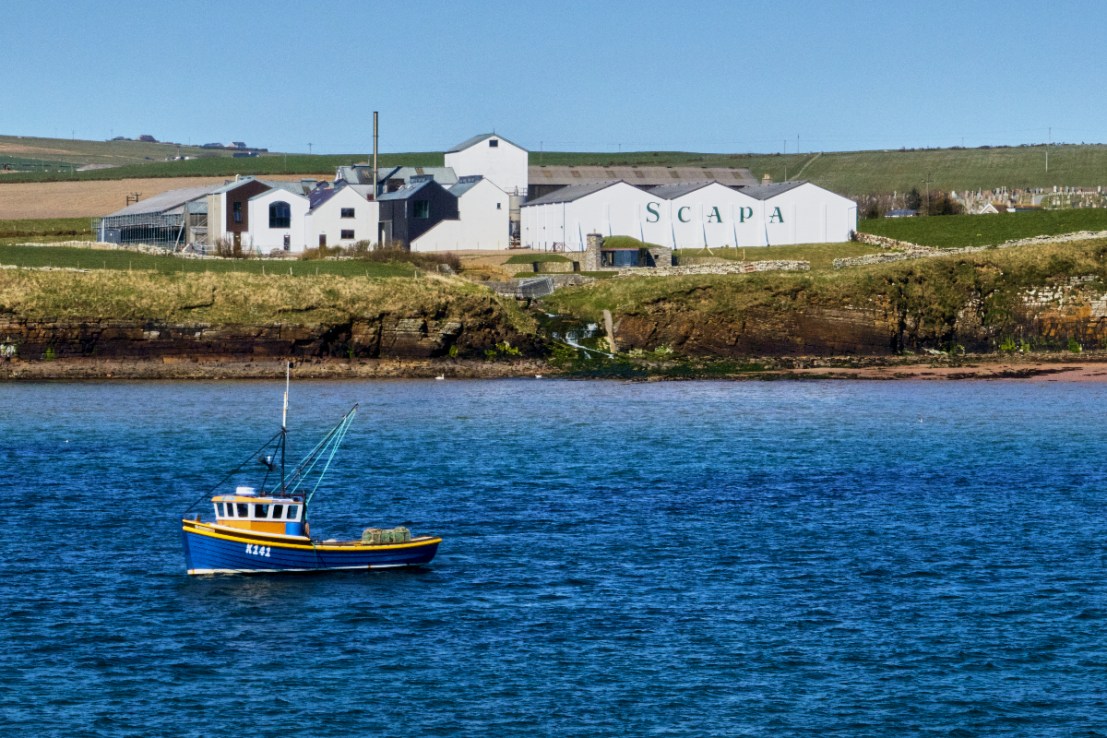
Scapa is located on the shores of Scapa Flow, one of the world’s largest natural harbours and a key base for the Royal Navy until 1956.
Founded around 100 years after (1885) its larger peer by Macfarlane & Townsend to make unpeated island malt for blends like Ballantine’s, Scapa has long been an anomaly for an island distillery.
After surviving two world wars, a major fire (in 1919, it was saved by the crew of a captured German destroyer anchored in Scapa Flow) and tax changes, the distillery was officially mothballed in 1994.
In what has now become known as the “silent decade”, distillers from Highland Park were brought over to Scapa for eight weeks each summer to do a few runs, creating some very rare casks from that period.
Then, in 2004, Scapa was reopened as a fully functioning operation.
Today, Scapa is owned by Pernod Ricard and it’s looked after by master distiller Mick Swanney and his small team, and it’s looking to make itself a major destination on the whisky map.
Unique whisky island blend
Scapa is the smallest distillery by volume owned by Chivas Brothers, with an annual output of around 1m bottles. It’s focused on high-quality, single malts that exhibit the distillery’s qualities and its surrounding environment.
Scapa whisky is typically matured in ex-American Oak casks and is known for its smooth, creamy sweetness with notes of tropical fruit, citrus, and coastal heather. It’s a lighter, more delicate style of island whisky.
Towards the end of last year, the brand unveiled its first-ever collection of age-statemented single malts.
Towards the end of last year, the brand unveiled its first-ever collection of age-statemented single malts. The 10, 16 and 21-year-old whiskies celebrate the distillery’s heritage and unique take on Scotch. The 21-year-old brings an impressive depth of tropical fruit flavours, with hints of aromatic oak and spices, and a sweet, syrupy finish.
At the same time, Scapa also unveiled a brand refresh, rolling out new packaging inspired by the “calm pace of life within the sanctuary of the Scapa Flow.”
Three qualities
Mick Swanney explains three qualities have helped the brand stand out from its peers over the decades. Firstly, the 160-hour fermentation is one of the longest fermentation periods in the industry.
Developed more out of necessity than anything else, the long fermentation period originally allowed the distillery’s small “skeleton crew” the time to perform other on-site duties. Today, Scapa has stuck with this method to maintain the flavour. “We tried to tweak the fermentation to get more production through, so shorten up the fermentation time, but I [could not] recreate the notes…So we have to stick to 160 altogether,” explains Mick.
The second unique quality is Scapa’s Lomond wash still, the only one still in use in a Scottish distillery. Swanney explains the shape of the still allows “a bit more copper contact and that makes the spirit lighter.”
Unlike many Scotch whiskies, Scapa has always been a light spirit. Light and sweet. Mick Swanney states the key flavour they always look for is “pineapple, every single time.”
The blending team describes the older single malts as tasting like “pineapple upside down cake.” That sweetness comes from the casks, first-fill American oak casks, adding notes of caramel, vanilla, and coconut, which complement the tropical fruit profile.
However, the biggest problem with running an island distillery, especially an island distillery in a place as unforgiving as Orkney, surrounded by the North Sea, is logistics.
Scapa keeps a 10-day supply of malted barley as a buffer in case ferries are cancelled due to bad weather. A team of just five people run the entire distillery 24/7, and there is staff accommodation on site for external employees who need to travel to the island. Scapa’s history and desire to keep its traditional equipment running add an element of complexity.
It uses a second-hand red Porteous mill in the milling process from the 1970s, which can only be fixed by two specific men in Scotland (Ronnie Lee & his son), meaning the team always needs to be thinking and planning ahead to prepare for issues that might arise in this island world.
The Scapa distillery destination
Scapa has been through multiple evolutions throughout its history, and its owners are now looking to build on its unique location, history and quality of the whisky to turn the distillery into a destination.
In addition to last year’s rebrand, tours and a revamped visitor centre are both on the menu and in 2023, the distillery opened its new tasting room called the ‘Scapa Noust’, harking back to the island’s traditional boat shelters.
Visitors can now book an exclusive whisky tasting paired with Asian inspired food in the Noust, overlooking the rugged and impressive terrain of Scapa Flow.
In June, Scapa launched the ‘Scapa Sanctuary trails’ with the leading hiking and outdoor activity app, Outdooractive.
The Scapa Sanctuary trails are designed to showcase the artistry of local Orcadian craftspeople, as well as the untouched beauty of the island’s natural landscapes. Walkers can enjoy short leg stretches or longer coastal hikes, all based around Orkney’s rich history and, of course, Scapa’s place on the islands.
Scapa’s reinvention as a destination distillery is well underway. From its refreshed branding and age-statemented whiskies to the inviting Scapa Noust and the innovative Sanctuary trails, it’s an experience waiting to be discovered on the shores of Orkney.