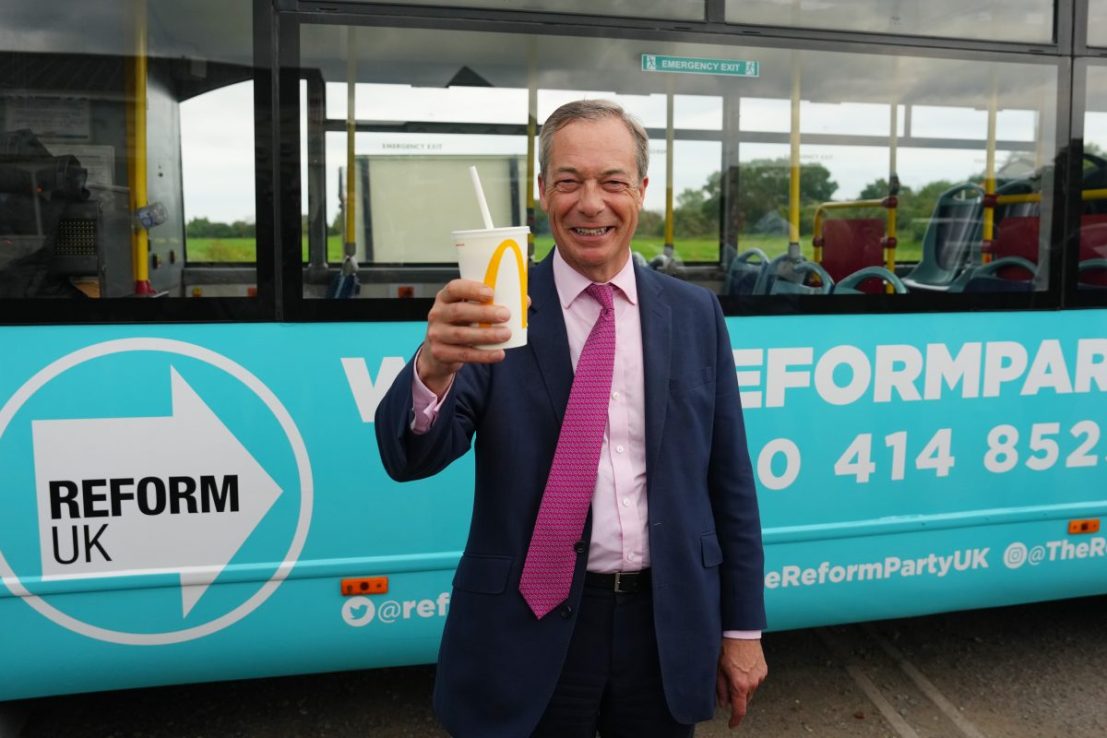
Reform UK is now seen as the most pro-business party in Westminster, fresh polling produced for City AM has found, in one of the first major signs the public is warming to Nigel Farage’s economic policies.
Political parties have long battled to present themselves as a pro-business party, with Labour’s Chancellor Rachel Reeves wooing company bosses and City firms in the lead-up to last year’s elections, promising to be “the most pro-business government” the country has ever had.
But the latest City AM/Freshwater Strategy poll of UK voters shows that Reform UK is deemed to be the party most likely to support UK businesses’ needs.
On a scale of zero to 10, Reform was rated at an average of 4.8 while Labour came in lower than all other parties at 3.8.
Kemi Badenoch’s Conservative Party was rated at 4.4 while Ed Davey and the Liberal Democrats were given an average score of 4.2.
Younger voters saw Labour as being best placed to support the needs of businesses while over 55 year olds saw the party in government to be the worst for business.
The new polling represents a significant improvement in voter attitudes towards Reform UK’s ability to revive the UK economy.
Nine in ten voters saw government support for businesses as an important issue, with over half of respondents to the City AM/Freshwater Strategy poll of 1,250 eligible voters claiming it was very important.
Reform UK pledges sweeping tax cuts
Richard Tice, Reform’s deputy leader who leads on economic issues, said the party’s overall message on cutting taxes, tackling bureaucracy and ending net zero was “filtering through” to industry.
“Small and medium-sized entrepreneurs and business owners are the ones very often who can set a tone with their staff and, ultimately, each individual,” Tice said.
“We’ve got two simple slogans: you’ve got to make work pay for employees, and you’ve got to make risk-taking pay for entrepreneurs and business owners.”
Tice indicated Reform would stick by many of its economic proposals made last year.
He said commitments to scrap inheritance tax for estates under £2m, ending off-payroll working rules that make intermediaries pay the same taxes as company employees and lifting the VAT threshold to £150,000 had attracted business owners’ support.
All of these proposals were included in Reform’s manifesto last year, which was widely criticised by economists at the Institute for Fiscal Studies (IFS) and opposition groups for failing to make the sums add up.
Panmure Liberum’s Simon French suggested in May this year that Reform’s plans could lead to an “immediate and violent” Sterling crisis due to fears of a black hole being blown in the public finances. Tice branded the comments “juvenile claptrap” at the time.
But business groups and public affairs giants are now forging relationships with Reform in a sign it is being taken seriously as a party, with party leaders getting into the routine of hosting business breakfasts.
Businesses ‘taking Reform seriously’
Business associations including the British Chambers of Commerce (BCC) and Confederation of British Industry (CBI) are expected to send delegates to Reform’s party conference later this year.
It has also been suggested Farage would install business leaders in ministerial roles across government departments including the Treasury if Reform wins the next general election.
Nick Faith, founding director of public affairs advisory WPI said Reform UK was positioning itself as the party for “smaller businesses”, taking care not to forge closer links with larger companies over the electorate’s scepticism of “big business”.
“Given the party is consistently leading the polls, it would be remiss of the business community to ignore Reform UK,” Faith said.
“They are serious players on the UK political landscape and an ostrich-like approach of burying your head in the sand would be extremely short sighted.”
Another City public affairs veteran suggested links between business leaders and Reform UK was “more fascination than engagement”, adding that executives felt it was “too early to go all in” on Farage.
Slump in business confidence
Reform UK may be hoping to capitalise on Labour’s failures as multiple business surveys suggest top bosses across the country are losing confidence in the UK government after employers suffered a £20bn tax raid at last year’s Autumn Budget.
The Institute of Directors (IoD) last week suggested confidence in the UK economy fell to a record nine-year low in July.
Keir Starmer and other ministers may be keen to point to the Lloyds Bank surveys showing confidence edging up, though economists point to its data as an outlier among several surveys provided by the likes of S&P Global and the Confederation of British Industry (CBI).
Method note: Freshwater Strategy interviewed n=1,259 eligible voters in the UK, aged 18+ online, between 1-3 August 2025. Margin of Error +/- 2.8%. Data are weighted to be representative of UK voters. Freshwater Strategy are members of the British Polling Council and abide by their rules.