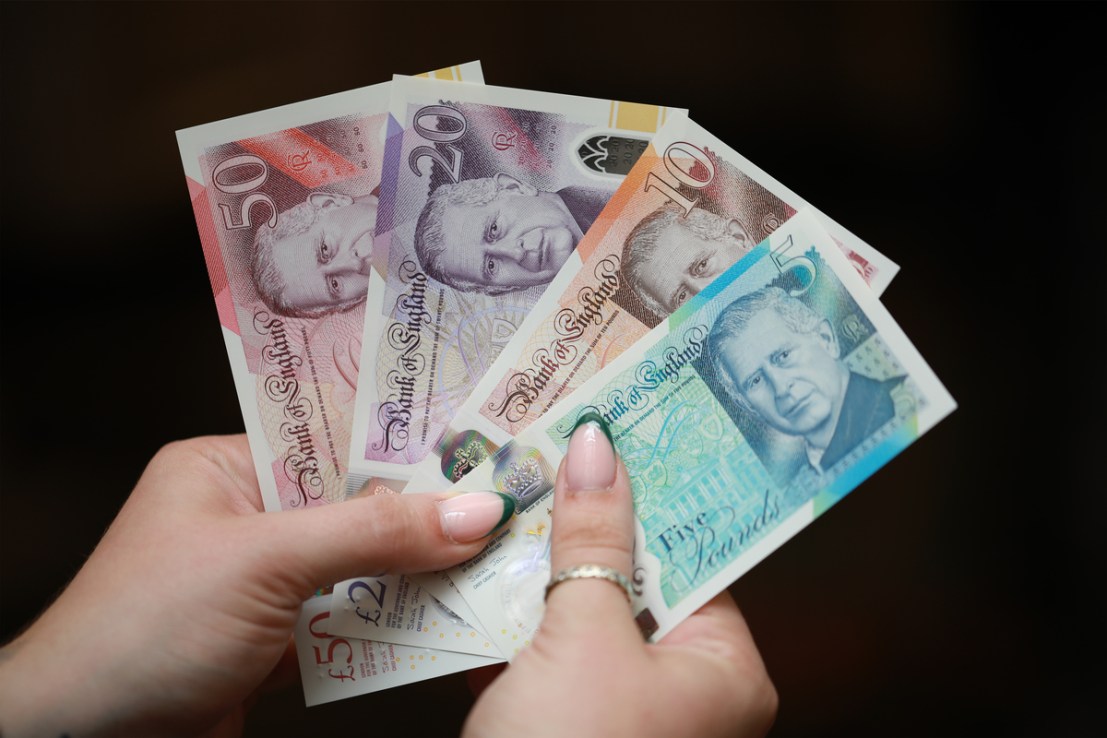
The Bank of England first began issuing banknotes in 1694, and today there are 4.7bn sterling banknotes in circulation, worth a combined total of £86bn.
And while the use of cash as a method of payment has dropped from around one in two transactions to one in four over the past decade, cash remains a vital part of the UK’s payment ecosystem.
Banknotes, £5, £10, £20, and £50 notes, are essential for most cash-based transactions. The designs of these have undergone several evolutions, with a new ‘Series’ being introduced and retired every couple of decades.
The latest series of notes currently in circulation, followed ‘Series F’ and was introduced in stages throughout the 2010s with designs incorporating historical figures such as Sir Winston Churchill, Jane Austen and Alan Turing. These bank notes were reissued in 2024 with the new King Charles portrait on one side, replacing that of the late Queen.
At the beginning of July, the Bank of England launched a new consultation on the future design of banknotes.
Open to the public, the consultation asks whether the next series of banknotes (Series H) should break with tradition by featuring a historical figure on one side or replacing it with a nationally significant theme.
The new banknotes
The Bank of England has identified six themes, including staying with the tradition of notable historical figures. Other themes include architectural landmarks, images related to the arts and sports, British world-changing innovations, and images from the natural world.
“We’ve got thousands of responses coming into the Bank of England,” Victoria Cleland, the Bank of England’s chief cashier and executive director of payments, tells City AM.
“School children have been loving it…it’s really capturing people’s imagination, and they’re not just thinking ‘oh well, let’s send in a nice picture,’” she adds. The public can express their views on the six themes outlined by the Bank via the online form or suggest other themes they think the Bank should consider.
Some have been posting their responses directly to the Bank, including one proposal “absolutely covered in glitter.” The consultation on themes is just the first stage of what will be a multi-year process of designing the next series of notes.
Once the themes have been decided, the next step will be finding the images, and this goes hand-in-hand with the creation of the in-built security features on the notes.
As Cleland explains, the new security features will be designed around the overall theme of the notes. “The key reason we’re making the change is around new security features, to make the banknotes more difficult to counterfeit, something that we’re having to get embedded in the notes with accessibility.”
“All of the notes would be the first that we have that introduced a tactile feature for people who are sight and vision impaired,” she adds. Accessibility and security features will be incorporated into the design, which also needs to take into account how notes will be used and whether the features are robust. “A glitter banknote would probably have a short life,” Cleland says.
The current series of banknotes features a key security element: the key hologram foils, which are shaped around the design theme.
“We’ve got Margate’s Tower, we’ve got the young Queen, we’ve got Jane Austen’s quill. We can turn the security features into different shapes so we’ll decide what the features are, and we can merge that with the imagery,” Cleland explains.
The move from paper to polymer notes starting in 2016 ushered in this new age of security. “That was one of the great things that polymer brought us, that you can put the windows in it and you can hold it up, and there’s a clear space in the polymer. That was something you could never do with paper, which makes polymer more difficult to counterfeit.”
The whole process, from beginning to end, blends design, the latest in banknote security, accessibility features and history. The Bank also needs to make sure the security features are easy for the general public to understand. “If we’ve got something so complex… there’s no point in doing that…you need to be able to explain it so the public can understand and sort of test themselves,” says Cleland.
Some security features won’t work with this approach. “Some countries look at geometric shapes. They don’t work very well in security features because it’s hard to know what they’re supposed to be,” she adds.
Complex process
When the Bank has a provisional design, the next stage is testing. Testing with ATM and other cash-dependent machine providers to understand if the “machine-readable [security] features” are robust enough (Cleland points out this is another area where a glitter note would fail to pass muster).
While it’s unlikely we’ll learn the outcome of the consultation for some time, Cleland does provide some insight into the responses the Bank has seen.
Stonehenge has been a common, unexpected favourite. “It’s partly nature, it’s partly landmark, but I think it’s something that’s really stuck in people’s minds, and so that was an unexpected one to come through.”
The consultation closes at 11:59 pm on July 31, 2025.