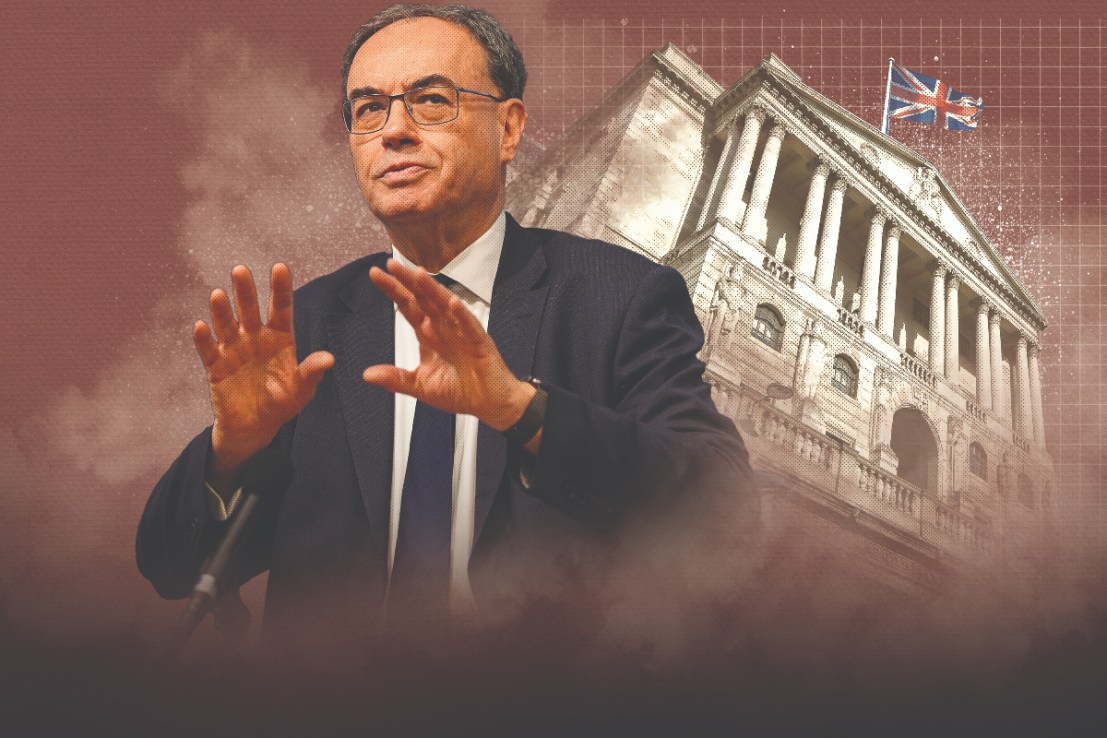
The Bank of England has sounded the alarm on international hedge funds snapping up record levels of UK government debt, warning that their highly leveraged bets leave Britain increasingly exposed to a bond market meltdown.
In its biannual Financial Stability Report, the central bank said the large share of UK government debt held by risk-seeking asset management firms means the economy is more vulnerable to a sudden sell-off of British bonds – known as gilts.
The UK government has become more reliant on a small number of little-known hedge funds to buy up its debt, after a shake-up in capital market regulation allowed pension funds and insurance firms to diversify away from the longer term bonds the government relies on selling.
Pension funds and insurers had tended to keep their bond holdings until they matured, and given their risk-averse mandates were not as likely to rack up debt to help fund investing elsewhere. But hedge funds, which largely operate on much shorter time frames, have increasingly taken out enormous bets on small price fluctuations in the UK bond market, which they then borrow against and reinvest to boost returns.
Bank of England officials warned the amount of debt taken out against gilts has reached its highest level since the central bank started monitoring the trend in 2017. Hedge funds used their gilt portfolios to borrow some £100bn of extra cash in November, a pattern of behaviour the Bank said “increase[s] the risk of sharp moves” in the UK government bond market.
Bank of England explores limiting hedge fund leverage
The leverage has left regulators concerned about the strength of the bond market’s foundations during a downturn in financial conditions, as the mostly foreign hedge funds would be forced to extricate themselves from the risky trades to pay off debts, compounding a rout. Any sharp sell-off would immediately send government borrowing costs skyward, posing an acute threat to the public finances and a major systemic risk to the financial system.
“Forced or widespread deleveraging would have the result of amplifying initial moves and potentially triggering a feedback loop of further forced selling,” the Bank of England’s Financial Regulation Committee wrote, “especially if funding conditions tightened to the extent that refinancing became unavailable or prohibitively expensive.”
Andrew Bailey, the Bank of England governor who chairs the regulation committee, said officials were exploring plans to limit the size of hedge fund bets on gilts in a bid to avoid the worst of any market fallout.
Elsewhere in Bank’s report, officials highlighted the rapid escalation of debt issuance for artificial intelligence infrastructure, the “materially stretched” tech valuations and “opaque” shadow banking sector as all raising the likelihood of a market meltdown in 2026.
“Risks to financial stability have increased during 2025,” the Bank’s Financial Policy Committee wrote. “Global risks remain elevated and material uncertainty in the global macroeconomic outlook persists.”
Investor speculation over the transformative potential of AI has driven shares in tech firms to historically high valuations through 2025, and meant capital in global stock markets is increasingly concentrated in a few large stocks.
The development has compounded fears that equity markets are ‘priced to perfection’, meaning they could sell off sharply should AI fail to meet investors’ financial or technological expectations. Bank of England officials warned the spectre of a “sharp correction” in equity markets was more likely next year, saying US stock market valuations were the “most stretched they have been since the dot-com bubble”. UK equities are also enjoying their highest valuations relative to earnings since the global financial crisis.
Private credit and major bond issuance raise concerns
The committee also drew attention to the rapid escalation of riskier lending practices being carried out in corporate debt markets, saying the expansion of AI-related credit posed “financial stability risks”.
Much of the initial ramp up in artificial intelligence investment was driven by public and private equity markets. Shareholders were largely happy to fund enormous purchases of AI chips and the data centre projects to allow a company to keep up with intense competition.
Recently, however, many of the AI industry’s largest players have also turned to enormous issuance of corporate bonds and private credit – also known as ‘shadow banking’ – to help fund their expansion, a development Bank officials said posed a greater risk to UK financial stability.
“Deeper links between AI firms and credit markets… mean that, should an asset price correction occur, losses on lending could increase financial stability risks,” they wrote.