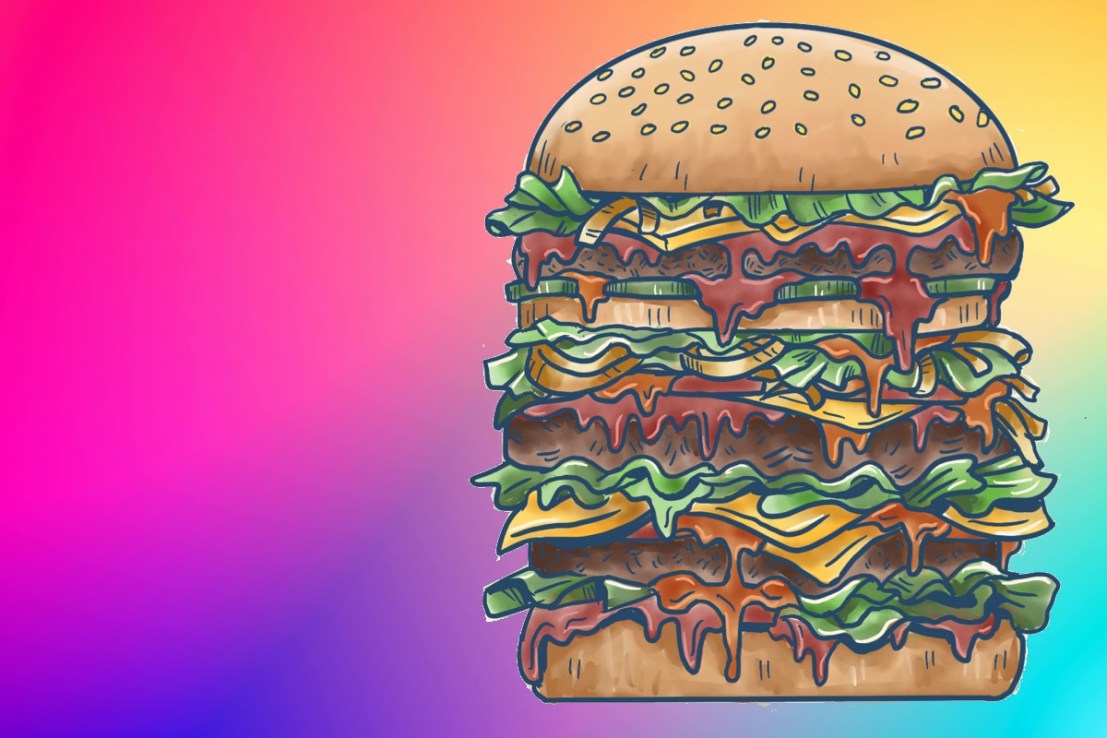
Fifteen years ago, we didn’t seem to think of our food as leading a life of sexual promiscuity. Today, casting your eye over a burger menu can feel like you’re browsing Pornhub.
It all seems to have started in the mid-2000s, when foodies began calling anyone who served an egg on top of something an “egg slut”. In 2011, chef Alvin Cailan turned this jovial term into a food truck specialising in egg sandwiches.
This was the opening of Pandora’s box, so to speak. Since Eggslut, it has become commonplace to call food – often but not exclusively burgers – by the filthiest names imaginable. ‘Dirty Bitch’. ‘Dirty Motherclucker’. ‘Salty Bitch’. ‘The Slut’.
Meat Liquor, which began operating in 2008, describes its ‘Dirty Chicken’ burger as “juicy, crispy and unapologetically thicc”. Slutty Vegan, which opened in Atlanta in 2018 to much hype, serves burgers with names like ‘Fussy Hussy’. There’s a British chain called Slutty Buns that delivers sloppy burgers across the land. In 2020, the actor and comedian Jack Whitehall helped launch a pop-up called Foodslut. “We love slutty food,” declared the website. There is a Burgerslut in Salford. None of them wanted to speak to me for this column.
It is perhaps no coincidence that this type of language is applied to a food that is extremely male-coded. “The burger stands as supremely masculine,” says Emily Contois, the author of Diners, Dudes and Diets: How Gender and Power Collide in Food Media and Culture. (You could quibble that steak is even more stereotypically male, but, by virtue of being cheaper, burgers are a more dominant cultural force.)
In the book The Sexual Politics of Meat, Carol Adams argues that the patriarchy treats both women and animals as flesh to be consumed
Google ‘man food’ and you are assaulted by photos of massive burgers; google ‘woman food’ and the first photo is a lady eating a salad. In the UK there are twice as many female vegans as male vegans. When marketing red meat, advertisers know their demographic is more likely to be male.
But is calling food items ‘sluts’ a misogynistic and macho throwback, or a fun – even feminist – addition to our culinary lexicon? When food is described as slutty it tends to mean it’s extremely indulgent – succumb to it and you may as well be succumbing to a sexual urge. A slutty burger would never be a petite, low-calorie option, rather something enormous and dripping with fat.
There’s certainly an argument that this is problematic. In the book The Sexual Politics of Meat, Carol Adams argues that the patriarchy treats both women and animals as flesh to be consumed. Is it a coincidence that slutty burgers have risen alongside the proliferation of widely available hardcore pornography? Probably not.
Or maybe we’re overthinking it. “I never felt ostracised at Eggslut,” says Contois. In our digital culture, she suggests, ‘slut’ has a range of definitions that can be inclusive or funny. “I don’t know that I’d ever call a friend a slut,” Contois says, “but women younger than me definitely do.”
I tell Contois that I can’t imagine a range of slutty yoghurts, given that the food is targeted so directly at women. “I don’t know,” she says. “These higher-fat ones are coming back. I can actually see the slut concept working really well with Greek yoghurt now.”
You heard it here first. We can’t close Pandora’s box, so to speak, but perhaps we can shake some more out of it. Brace yourself for a range of Slut Yoghurts, coming to a supermarket near you.
• Ralph is a freelance writer and stand-up comedian