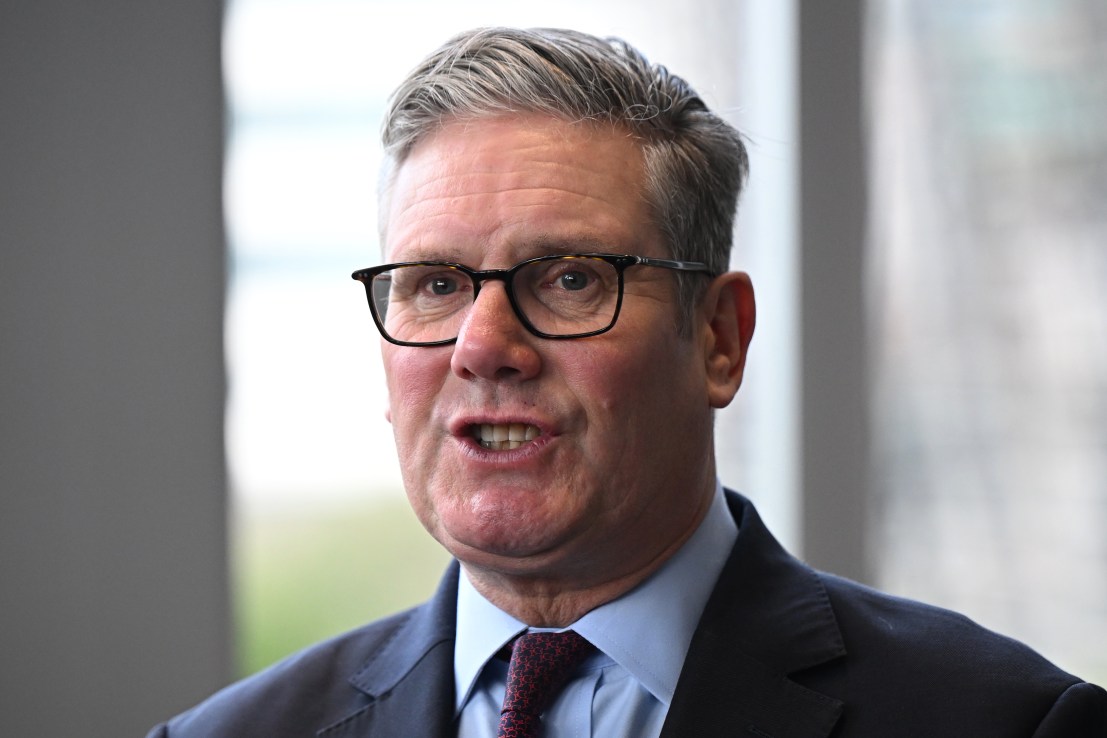
Starmer’s cringe-making video address to his son for International Men’s Day only served to underline how odd and lifeless a politician he really is, says Eliot Wilson
Last Wednesday was International Men’s Day. To mark the occasion – and, because he is a politician, and self-promotion is an intrinsic part of the role – Sir Keir Starmer released a video of himself reading a letter to his son. (Starmer Minor was not pictured and we can assume was not actually present.) It was a distinctly odd and unsettling experience.
I confess that I am instinctively sceptical of the concept of “International Men’s Day”. I am very aware that, now more than ever, there are many particular challenges faced by men of all ages. We are in the midst of a societal, perhaps global conversation about what it means to be a man in the contemporary world, the phrase “toxic masculinity” soon marches on stage. That then provokes the noxious bravado of inadequate misogynists like the Tate brothers, Nick Fuentes and Myron Gaines, obscuring real issues like mental illness, a staggeringly high incidence of suicide and declining educational attainment and professional success.
For all that, “International Men’s Day” sounds like a demand of the saloon bar bore, who thinks feminism has “gone too far” and protests that “you can’t say anything these days”. That reliably translates as a culture no longer willing to listen politely to loud, reflexive prejudice.
It is worth noting the physical absence of the Prime Minister’s son. He and Lady Starmer have two children, a 17-year-old son and a daughter aged 15, but they have been commendably determined to shield them from public scrutiny and not even their names are widely known. This cannot have been easy and they should be applauded for attempting to allow the children to grow up as “normally” as possible; after all, they did not choose for their father to have a public career.
Part of me does think that fierce protectiveness sits slightly uneasily with Starmer’s conceit, even if he believes he is acting to promote a worthy cause, of a letter addressed to his son. The missive touches lightly on their father-son relationship and the relationships the Prime Minister had with his own parents. His mother was chronically ill with Still’s disease and his father, famously a toolmaker, was “difficult” and “complicated”, his wife’s caring needs leaving him with little emotional energy for his sons.
There are some bland vapidities about “the pressures on young men that are difficult to talk about”, and how Starmer’s political career entails “huge sacrifices for you, for your sister and your mum” He adds that he wants “the world for tomorrow’s generation to be better” so that “your generation has the future it deserves”.
Desperate
This is desperately thin stuff, a creative meeting at Hallmark Cards on a darkening Friday afternoon with everyone eager to wrap up and go home. It put me in mind of Winston Churchill’s acid feedback on a draft speech by Anthony Eden: “As far as I can see you have used every cliché except ‘God is Love’ and ‘Please adjust your dress before leaving’.”
But it is also the undisguised use of family, even if only as a reference point for saggy verbiage, to promote the Prime Minister’s political message. The subtext is obvious, that he and his wife and children have made sacrifices so that he can serve as the King’s chief minister, and that he holds that office, not because of ambition or a longing for esteem and reputation, but solely because he is driven by a desire to make the world better. It seems to me that politicians should be entitled to more privacy than we are often willing to afford them, but they cannot then have it both ways. They cannot in good conscience use their families as political props while also demanding there is no intrusion into their “private” lives.
Having become Prime Minister, Starmer has been revealed, not as pedestrian or enigmatic, but blank and bewilderingly hollow
There is something more profound underlying this. It has always been accepted as an immutable fact that Starmer lacks charisma, articulacy and sparkle. He has a humdrum manner which in opposition was adapted to present him as safe, responsible and serious, a character suited to the strains of high office. It is possible to serve in senior political roles without being charming or magnetic: Denis Healey famously described crossing swords with Sir Geoffrey Howe as like “being savaged by a dead sheep”, while Labour’s greatest Prime Minister, Clement Attlee, was undemonstrative and almost gnomically laconic.
Having become Prime Minister, Starmer has been revealed, not as pedestrian or enigmatic, but blank and bewilderingly hollow. Colleagues complain he lacks a coherent vision, while voters see an awkward, often tetchy leader with no ideological moorings at all. Yet Starmer seems determined to present his “human” side: his references to football and his passion for “the Arsenal”, agonising pleasantries with other leaders over half-pints of lager.
Last week’s video, suffused with rehearsed spontaneity, served only to underline how odd and lifeless a man the Prime Minister really is. Its manipulation is mildly irritating, its philosophical emptiness depressing. He spoke of how, as a young man, he heard a voice in his head telling him he wasn’t good enough. The voice is back; and increasingly it sounds like it is right.
Eliot Wilson is a writer and historian; Senior Fellow for National Security, Coalition for Global Prosperity; Contributing Editor, Defence on the Brink