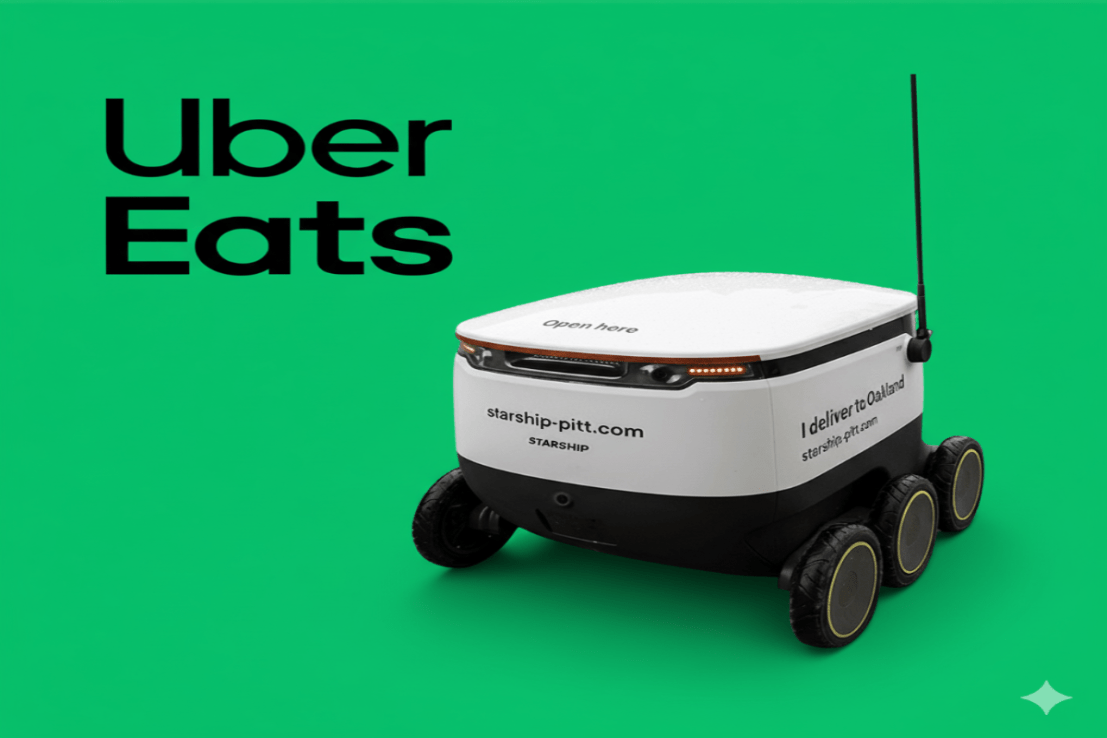
Uber Eats and Starship Technologies have announced a partnership to deploy autonomous delivery robots across the UK, Europe, and the US, starting in Leeds this December.
While the pair have argued the move promises faster, cheaper, AI-powered deliveries, it may also reignite fears over the future of human couriers.
Starship, which operates the world’s largest fleet of autonomous delivery robots with more than 2,700 units, has completed over 9m deliveries to date. And by 2027, the fleet is expected to exceed 12,000 robots, handling short-range deliveries in under 30 minutes.
The robots operate at what is labelled ‘level four’ autonomy, which means they can navigate pavements and roads without human supervision, using cameras, radars, and AI systems honed over hundreds of millions of crossings.
Ahti Heinla, Starship co-founder and former Skype creator, argued the partnership “builds the infrastructure for the next generation of urban logistics” and stressed that the robots operate profitably even in small towns.
He also claimed that automating delivery could “touch everybody’s lives” by reducing costs and improving access to food and groceries, particularly in underserved areas.
Job cuts loom large
This drive towards automation, whilst labelled as efficiency-enhancing, comes with a myriad of drawbacks.
The rise of robot-led deliveries may lead to a loss of income and labour protections for many delivery drivers across the country.
Yaseen Aslam, president of the UK-based App Drivers and Couriers Union, said: “They’re making autonomous vehicles because they want to get rid of the workers. What will happen to all these workers? Where do they go?”
While Starship has argued robots will supplement human couriers rather than replace them, the scale of the rollout, potentially thousands of deliveries per city, has raised concerns.
A recent report from Prysm Global suggested autonomous delivery could add £1.3bn to the UK economy over the next decade, but has also acknowledged that automation could displace significant numbers of low-paid delivery jobs, even as new tech roles are created.
Heinla emphasised that Starship’s robots have allowed the company to operate at a small profit with only 200 employees, compared to traditional delivery firms that rely on large fleets of human drivers.
It has also faced regulatory hurdles in the UK, negotiating with local councils to expand robot access to pavements, a challenge Starship claims to have broadly solved in markets like Finland, where nationwide legislation governs autonomous delivery devices.
Its new partnership with Uber Eats, a food delivery platform with global reach across 10,000 cities, proves that fully robotic deliveries are no longer a distant reality. But, as ever, the human cost could be high.