Remember, remember… on this day in 1605 Guy Fawkes and his fellow conspirators plan to blow up the Houses of Parliament was foiled
Today 420 years ago was supposed to see the State Opening of the Parliament for its second session. The 100-day first session had been frustrating and fruitless: a new king from a new dynasty, the Stuart ruler James I, had succeeded the childless Elizabeth I in 1603, but he was also James VI, King of Scots, and he wanted to unite his two kingdoms.
The Union of England and Scotland Act 1603 provided for a commission to negotiate a political union, but the English Parliament had no enthusiasm for anything short of absorption of its Scottish counterpart. It lacked support in Edinburgh too, since the Privy Council of Scotland could maintain its control with a largely absentee monarch.
There were more urgent matters. James was instinctively more tolerant of Catholicism than Elizabeth had been: the mother he barely knew, Mary Queen of Scots, had lost her throne and her head for her adherence to Rome and he had been baptised a Catholic. There were also rumours that his Queen, Anne of Denmark, had secretly converted to Catholicism in the 1590s.
This raised hopes among England’s 40,000 remaining Roman Catholics that James might lift some of the restrictions on them: the Religion Act 1592 determined prison sentences for those who failed to attend church, while the Popish Recusants Act 1592, branding Catholics as “spies and intelligencers”, forbade them from travelling more than five miles from their homes.
James had no wish to “persecute any that will be quiet and give an outward obedience to the law”, but his English counsellors argued against any meaningful relief. Pope Pius V’s bull of 1570, Regnans in Excelsis, by stating that oaths of allegiance to Elizabeth were void, had irreversibly identified Catholicism with treason and turned a private matter of conscience into a public issue of loyalty.
In February 1604, Robert Catesby, a 31-year-old recusant Catholic landowner from Warwickshire, had endured enough. Some contemporary thinkers – Protestants like Ponet and Knox, ironically – had argued in justification of tyrannicide, and Catesby took it a step further. In order to free his co-religionists from sectarian repression, he planned to blow up the State Opening of Parliament, killing not only the King but also all the members of the Houses of Lords and Commons who were present. This was to be a decapitation strike, a coup d’état.
Gradually Catesby assembled a group of conspirators: Thomas Wintour, John Wright, Thomas Percy and a tall, burly, 34-year-old former officer in the Spanish army, a Yorkshireman named Guy Fawkes, known during his military service as Guido. He was skilled with explosives, so inevitably became the conspiracy’s operational leader.
The State Opening, originally scheduled for February 1605, was delayed until the autumn because of worries about plague. On Lady Day, 25 March, the conspirators purchased the lease to a ground-floor undercroft directly underneath the Painted Chamber in the old Palace of Westminster, where major ceremonial events were staged.
Over the summer, Fawkes placed 36 barrels of gunpowder in the undercroft, and by October, the plan was finalised: Fawkes would light the fuse and escape across the River Thames, while a Catholic uprising in the Midlands would seize the plotters’ chosen puppet ruler, the King’s eldest daughter, nine-year-old Princess Elizabeth, from Coombe Abbey in Warwickshire. The conspirators intended to install themselves as protectors and Elizabeth would be married to a Catholic husband.
What if it had worked?
Pause for a moment to appreciate the scale of this. Monarchs had been assassinated before, from the judicial murder of the King’s own mother, Mary Queen of Scots, to his ancestor James I, stabbed to death in Perth in 1437. This was wholly different.
If the plan had worked, a cataclysmic explosion would have killed everyone present: the King and Queen; 11-year-old Henry, Prince of Wales; as many of the 26 Lords Spiritual and 85 Lords Temporal as attended; and a good number of the 543 MPs. Most of the Privy Council and judiciary would have died. Afterwards, King James estimated the death toll would have been 30,000, a sectarian atrocity on the scale of France’s St Bartholomew’s Day Massacre.
But the plan did not work. Lord Monteagle, a Catholic peer, received an anonymous letter on 26 October warning him to stay away from State Opening, because “they shall receive a terrible blow this parliament and yet they shall not seie who hurts them”.
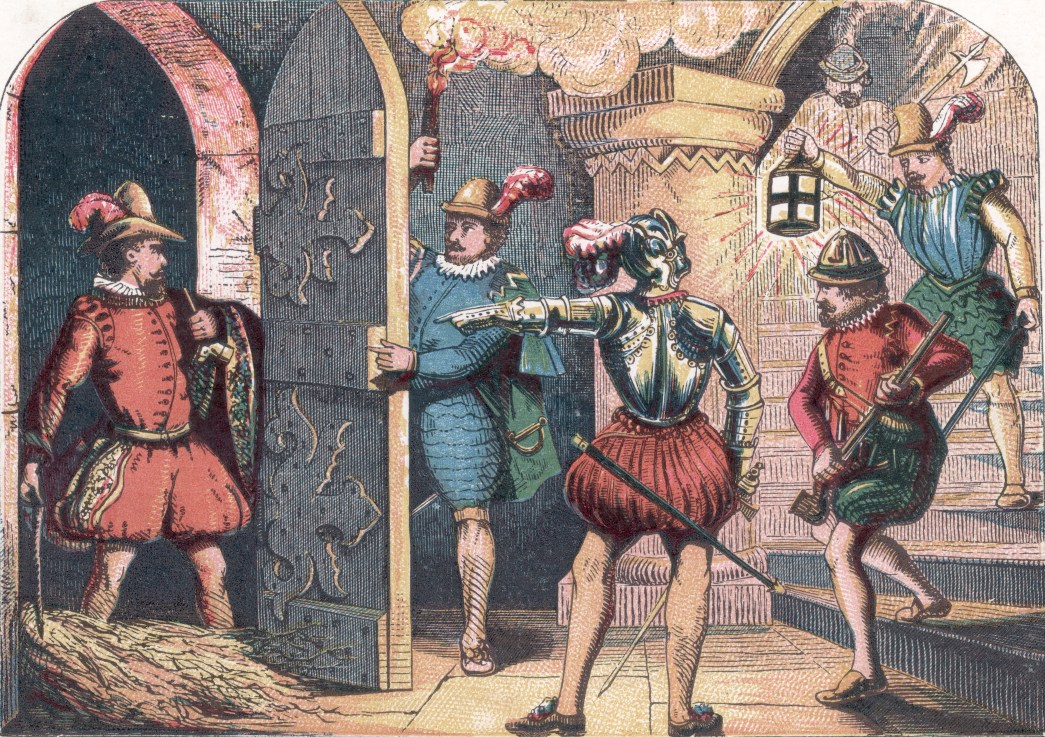
Monteagle passed the letter on to the Secretary of State, the Earl of Salisbury, who consulted his colleagues then informed the King. In the early hours of 5 November a search of the rooms underneath the Painted Chamber revealed Fawkes with several slow matches and a watch, with 36 barrels of gunpowder hidden under firewood and coal.
Retribution was swift and brutal. Catesby and Percy died resisting arrest, and eight of the conspirators, including Fawkes, were tortured, charged with and convicted of treason, then hanged, drawn and quartered.
A desperate gambit
The Gunpowder Plot was a desperate gambit. 40,000 Catholics, represented by what Hugh Trevor-Roper called “the idiot fringe of the indebted gentry”, in a country of over 4m could not sustain a revolution alone. The gunpowder, having been in place for months, had begun to decay, though a 2005 documentary showed it could still have caused a devastating explosion. Even if Fawkes had been successful and decapitated the political establishment, a likely outcome would have been an outraged anti-Catholic pogrom. Only foreign intervention at that stage could conceivably have tipped the balance.
Did the government know about the plot? The anonymous authorship of the Monteagle letter is tantalising, and some believe that Salisbury had discovered the conspiracy but allowed it to continue for propaganda purposes. The allegation that it was a false-flag operation is probably exaggerated, though Salisbury possessed brilliant statecraft and a formidable intelligence network refined from that of his predecessor Sir Francis Walsingham. Certainly it was convenient, and was the last nail in the coffin of a Catholic revival.
Yet it could perhaps have worked, and changed the course of British history, and that is worth commemoration.
Remember, remember, the Fifth of November, gunpowder treason and plot; for I see no reason why gunpowder treason should ever be forgot.
Eliot Wilson is a writer and historian; Senior Fellow for National Security, Coalition for Global Prosperity; Contributing Editor, Defence on the Brink