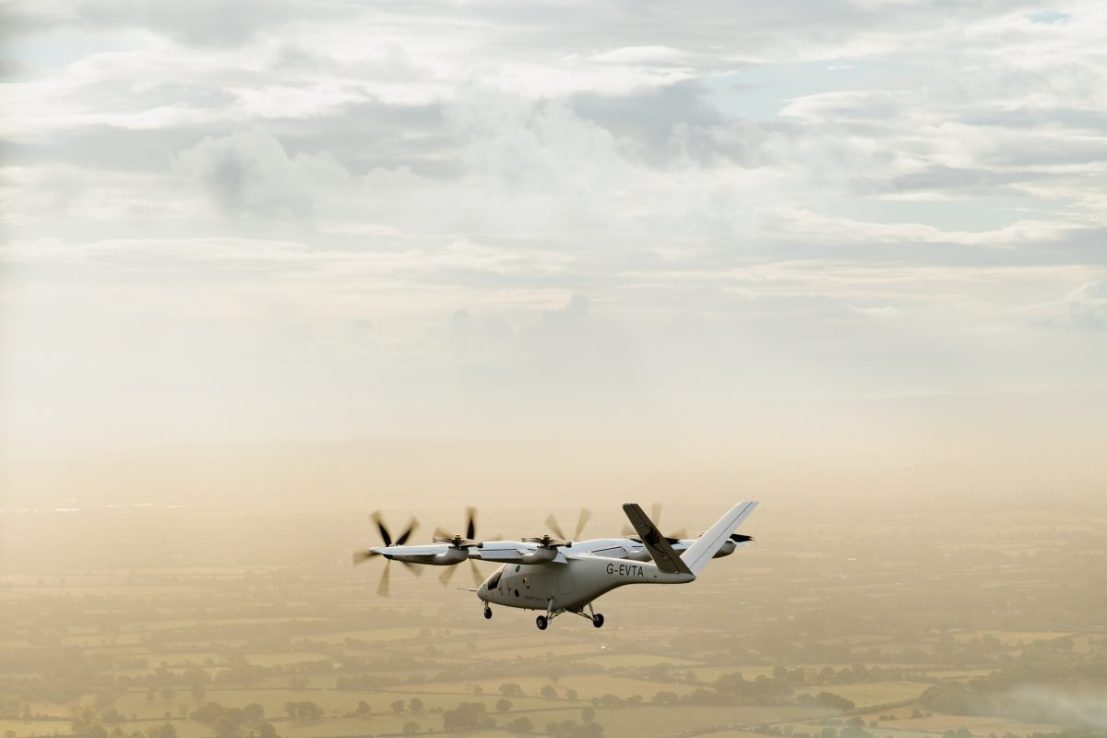
Flying taxis are set to revolutionize travel, making zero-emission, quiet, low-cost short-haul journeys a reality, and Britain can lead the way, says Dómhnal Slattery
Britain once defined the future of flight, leading most of the major advances in aviation. The Spitfire, the Mosquito, the Comet and Concorde were not just machines, but symbols of ingenuity and national pride, proof that Britain could lead the world in engineering. Today, as aviation stands on the verge of the next big step-change, the UK faces a similar choice: lead again, or watch others seize the initiative.
Next generation aviation technology, including electric vertical take-off and landing (eVTOL) aircraft – so-called “flying taxis” – are set to revolutionize travel, making zero-emission, quiet, low-cost short-haul journeys a reality.
Last week, the company which I chair, Vertical Aerospace, has had the opportunity to be part of the Chancellor’s delegation to the Future Investment Initiative in Riyadh, showcasing to the world how innovative UK companies can be.
Huge opportunities for collaboration and growth with the Gulf region were on show. But now back home, the Government must focus relentlessly on creating the conditions for our most innovative businesses to grow and export.
Positive steps are being taken. In the field of electric aviation, The Future of Flight Industry Group, co-chaired by the Aviation Minister, envisages eVTOLs operating in British skies by 2028. The Aerospace Technology Institute (ATI) has committed billions to green aviation research, supported by Innovate UK. Ministers have announced £250m for low-carbon aerospace projects this year alone.
In recent weeks, funding for next generation aviation technology initiatives has been announced, including scaling medical sample deliveries in London and demonstrating the commercial viability of electric air-taxi services between Oxford and Cambridge.
The ambition is clear: Britain intends to be a science and technology superpower, with aerospace at its heart. But leadership is not guaranteed, it needs government and industry working hand in hand to win this race to the skies in a competitive global environment.
America and China are moving aggressively. The US has channelled billions into advanced air mobility through the Department of Defense, NASA and the Federal Aviation Administration, ensuring American companies can accelerate certification and scale. In Asia, Japanese and South Korean champions are already testing eVTOL fleets with government backing. These countries see advanced air mobility as not only an environmental solution but a strategic industry of the future.
The case for action
The case for action is straightforward. First, industrial leadership: Britain can secure first-mover advantage in an industry forecast to be worth tens of billions by the 2030s. Global demand for urban air mobility is expected to surge as cities seek clean, congestion-free transport, and there will be winners and losers.
Second, regional prosperity: aerospace’s supply chain already spans the West of England, the Midlands and beyond. With sustained investment, it has the capacity to generate thousands of well-paid jobs in advanced engineering and to revitalise communities that once relied on aerospace and automotive production.
Third, climate credibility: aviation accounts for seven per cent of UK greenhouse-gas emissions. Supporting eVTOLs strengthens our climate leadership on the global stage and benefits the UK economically as a global exporter of green technology.
Off the back of an Industrial Strategy welcomed by the aerospace industry, and ahead of the Autumn Budget, what is needed now is decisive investment and delivery. To secure Britain’s position in the next generation of aviation, government must back homegrown programmes to accelerate certification and production here in the UK. By anchoring this industry at home, we can create thousands of advanced engineering roles and ensure Britain captures the value of the technologies it has helped pioneer.
That commitment means providing stable, long-term funding through the Aerospace Technology Institute, Future Flight Challenge and Innovate UK and ensuring R&D tax credits are applied consistently to clean aviation technologies. Certainty in policy will give industry the confidence to invest at scale. And beyond capital, Britain must be ambitious in how it positions itself internationally – as we saw in Riyadh – championing the companies and technologies that can become the country’s next aerospace leaders, just as jet engines and supersonic travel once defined our global reputation.
The UK has too often pioneered world-class ideas and industries, only to hesitate and watch others seize the opportunity. From semiconductors to solar panels, electric vehicles to telecoms equipment, we now import technologies that Britain could have led. In September, we saw British companies being forced to test drones abroad because of red tape. We cannot afford to repeat this pattern with eVTOLs.
Britain has the history, the engineering talent, and the policy framework to lead the future of flight. If the government is serious about delivering renewal, it must unleash the full power of British enterprise and spread prosperity beyond London and the South East. Scaling the incredible range of British innovations the delegation showcased in Riyadh to drive investment into the UK. Advanced air mobility offers the perfect opportunity to do exactly that – but it will require action and resolve.
Dómhnal Slattery is chair at Vertical Aerospace