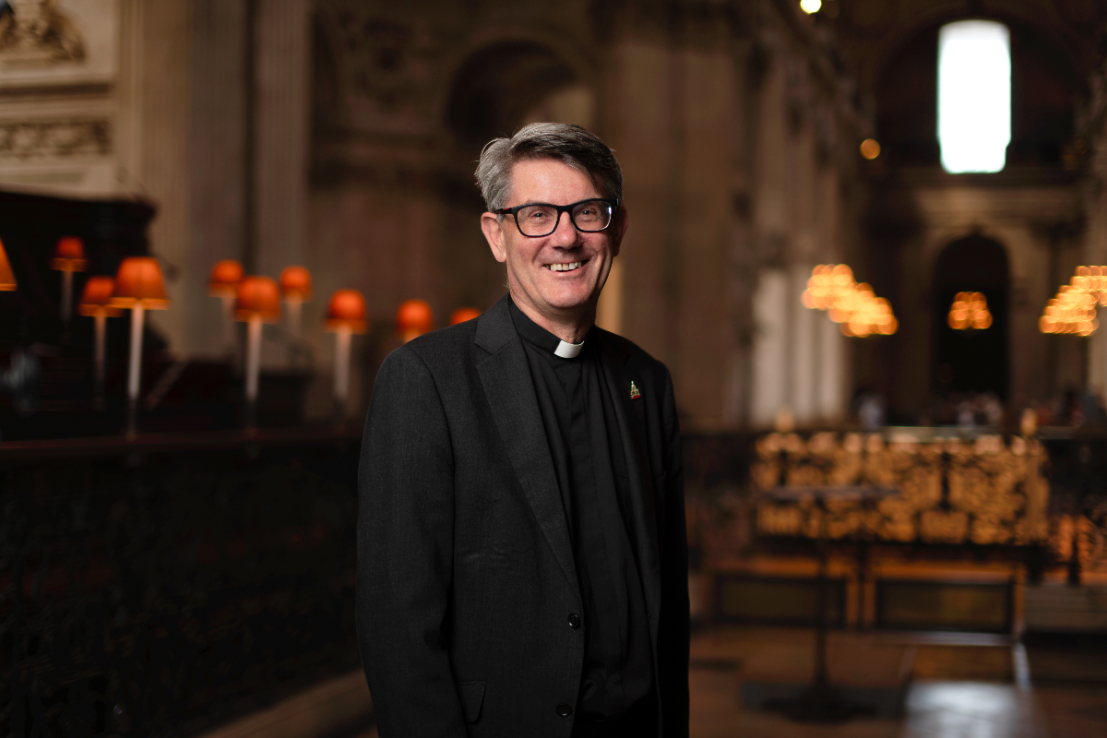
This evening earmarks the inaugural Toast the City awards – the first ever ceremony celebrating Square Mile culture – and as City AM staffers bunk off work to smarten up, the Dean of St Paul’s Cathedral is bestowing us with his good wishes.
The Cathedral has been nominated in our Best Coffee and Best Cultural Experience categories. “Ha!” laughs Reverend Andrew Tremlett, talking to City AM from his office near St Paul’s Cathedral. “I’m delighted.” Outside the window there is a view of Paternoster Square, and in the corner, Tremlett has decorated his office with a set of miniature puppets standing around a stage.
You might not have gone to St Paul’s Cathedral since you were a child, or perhaps you’ve never visited. One-and-a-half million people walk through the doors every year, 400,000 of those are worshippers, and around 800,000 are tourists. Back of fag packet calculations reveal there aren’t many non-worshipping locals going in (although plenty of City workers enjoy Festival Gardens while eating their lunch).
But the Cathedral has long been trying to change that. Aligning itself with our awards is one way, but another is by participating in arts projects that show off the building in new light. The London Design Festival’s Aura installation by Spanish artist Pablo Valbuena and this year’s Luminous by Luxmuralis have welcomed art into the Cathedral, and a cohort of new visitors, although these projects have divided opinion between the worshippers.
St Paul’s Cathedral in new light
The Luminous by Luxmuralis art installation within the Dome at St Paul’s Cathedral
Aura featured an orb hanging from the top of the central St Paul’s Dome that lit up depending on the frequency of the sound. Louder noises made brighter colours and softer sounds made gentler colours. It was fascinating watching it respond to the sounds of the choir during Evensong.
“What was fascinating was that it was totally Marmite,” says Tremlett. “Some people said ‘unless you stop this I’m never coming back,’ and others said ‘this is just utterly amazing and transformational.’ There were very few people in-between.”
It certainly drove more locals to visit: 98 per cent of London Design Festival attendees were Londoners. “It’s almost giving people an excuse,” he says. “I recognise that these cultural ventures like art installations, concerts and corporate events give people ‘permission’ to come into the space.” Were the naysayers convinced when they saw the project? “No, not at all,” laughs Tremlett. “I wish I could say so.”
It’s a misconception to think that St Paul’s is just for worship. Around 20 per cent of the Dean’s workload is networking, and in particular with local Square Mile corporates. “It’s not as if this is a simple religious place, it’s always been quite unusual in that way,” explains Tremlett. “Wren designed the building with worship where the organ pipes are. The rest of the Cathedral was empty, completely bare. Worship happened where the choir is in one small section and the rest of the space was more a temple to the enlightenment. This was Isaac Newton’s time…”
Business and religion are part of the same ecology. They’re different modes but not different spheres
There has been a Cathedral where St Paul’s is since at least 604, and the city has grown up alongside it. If the financial district and the hallowed halls feel diametrically opposed, part of Tremlett’s work is to dispel that idea. “It’s not a business institution here and a religious institution there, they’re part of the same ecology,” he says. “I wouldn’t see those as moving in different worlds, I’d see those as different modes but not different spheres.
“Wren would never have thought of them as different. We’re surrounded by amazing businesses and enterprises. It’s not a separation – actually this is a space where the themes behind these cultural projects can be explored.”
Tremlett hosts intimate groups of around 30 corporates in the Chapter Room, and attends regular events in the City. Outreach extends beyond arts installations into renovations and business strategy. He’s working alongside the City of London Corporation to enhance the Cathedral lighting, taking inspiration from the Notre Dame’s renovation in Paris. “It’s really interesting with a Gothic building which lets less light in, how much more control you have.”
More pressing is a big data project to better understand the demographic of people who visit the Cathedral, in collaboration with FT Consulting. “At the moment our data is somewhat fragmented,” says the Dean. “We’re not in a position where we can track the visitor journey in granular detail, but that’s the absolute focus of this project.”
But Tremlett is clear that none of this is his main job. His core purpose, “frankly”, is around prayer and worship. “That’s what we’re here for, we’re not here to curate a beautiful space, that’s a secondary thing. And our legal framework makes that absolutely clear.”
A visual arts committee and trustee body green light cultural projects only when they “happen in a way that hasn’t interrupted worship”. “We can’t do things for the sake of it. Everything has to feed into those purposes. For me that’s a really helpful set of guard rails.”
One thing he’s particularly proud of is introducing girls to the St Paul’s choir after 900 years. “Better late than never,” he says. More history could be made this evening: will St Paul’s win a Toast the City award, fending off competition from the Barbican and Whitechapel Gallery? “We’re pretty good in both categories,” says the Dean confidently. Fighting talk!
Go to stpauls.co.uk