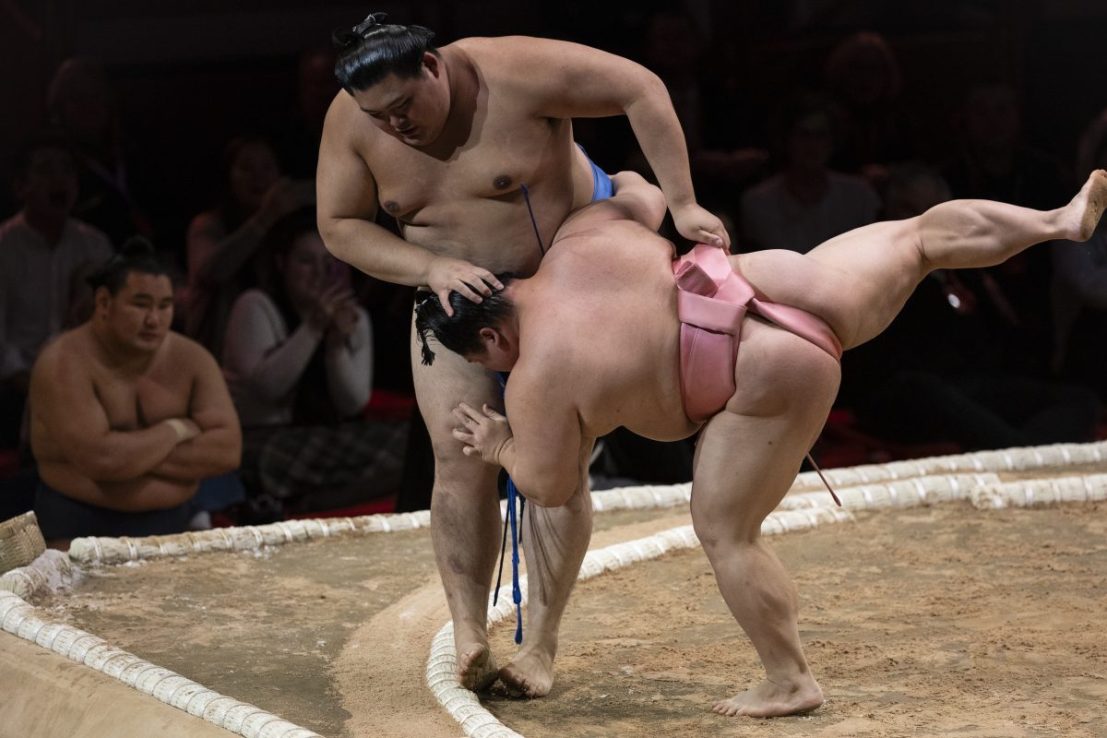
A Grand Sumo Tournament left Japan for the first time since 1991 and in London it has seemingly found its home. Here’s what I thought of it all.
One of London’s greatest surprises will always be turning off Prince Consort Road, just as you reach the Royal College of Music, and being greeted by the magnificent Royal Albert Hall; it’s rounded structure a landmark of times gone bye.
I’ve seen pop concerts there, a couple of Proms, boxing and even tennis. On Thursday, though, I witnessed maybe the best event I will ever see at the historical stalwart of London: sumo.
For a Grand Sumo Tournament this year left Japan for lands overseas for the first time since 1991. 34 years ago the ring (dohyō) was taken to the Royal Albert Hall so it was only fitting that Queen Victoria’s fulfilment to her husband played host to the event once again.
Walking into the hall, you’re greeted with a spectacular set-up – a far cry from a 70-piece orchestra – and you’re quickly emerged in what feels like an enclave of Japan.
Londoners with Japanese heritage are donned up in traditional dress while newbies to the sport are intently listening to encyclopaedic knowledge of commentators through headsets.
Sumo in London
And then suddenly the action begins, though not how one would expect – 45 minutes of demonstrations, rituals and blessings occur before the first bout. Can you imagine 45 minutes of ceremony before a Millwall vs Palace clash, or a Sinner/Alcaraz Wimbledon final? It was perfect.
Then it was ferocious.
Ten bouts, an interval, then 10 more. Every wrestler had their distinctive personality – not as garish as WWE but identifiable enough to see a storyline for each that goes deeper than these five Grand Sumo Tournament days in London.
How the competitors throw their salt, walk into the arena and fight varies wildly – it looks as though push and thrust techniques win out over pulling moves. But what do I know.
A personal highlight was finding out how the officials encourage the fighters, shouting “put some spirit into it” during bouts, and how four judges form a VAR panel if there’s a disagreement – 1,500 years of precedent in sumo and Premier League football still got it wrong?
A wonderful evening was had but more than the 40 wrestlers I experienced on Thursday was just how perfect London was for Sumo’s venture away from Nihon.
The city is perfect for it, the Royal Albert Hall more so – though one could argue these five days of competition could have sold out Wembley. Tickets in the front row were £600, afterall.
The context
Sumo choosing to return to the capital is a homage to its love of tradition, and it is something the capital cannot take for granted.
Cities the world over are bidding for events London once were guaranteed, and the capital needs to fight tooth and nail to ensure that, when Olympic Games and world championships are unlikely, London can compete on the global stage.
It’s great to see the NBA return to London next year, and it’s equally satisfactory to have the Laver Cup back on the banks of the Thames, but we must do more.
Seeing the brilliant warriors of sumo on Lime bikes and red buses, visiting Buckingham Palace and Platform 9 3/4 provides a periscope into the charm of London and what it has to offer.
I’ve seen World Cup finals, British and Irish Lions Tests and remarkable solo sporting feats; but sumo might be up there as one of the most impactful sporting events I’ve witnessed.
On one hand it would be brilliant if Sumo came back in another 34 years, keeping us keen for more, but in reality I’d have it back on Monday morning and I’d be scrambling to get myself a ticket.
That’s what happens when a sport does things right, and London is undoubtedly privileged to host these unbelievable warriors. As privileged as I was to watch them.