Whisky Business: City AM’s monthly look at the world of whisky.
Over the past couple of decades, single malts have become synonymous with the Scotch whisky category.
While blended Scotch, which uses a blend of different whiskies from various distilleries, still accounts for around 90 per cent of industry volume, single malt whisky, matured and distilled at one distillery, has by far the bigger value share.
According to the Scotch Whisky Association, whisky exports for single malts in 2024 accounted for 31 per cent of global export value, compared to 59 per cent for blended whiskies.
This environment would’ve been very strange for the average Scotch whisky drinker in the 1980s.
Single malt Scotch whisky was almost impossible to obtain, and only a few cult followers within Scotland knew how to access the limited market for the liquid.
Pip Hills was one of those whisky lovers lucky enough to get hold of a single malt. He struck gold when the Glenfarclas distillery allowed him and a few friends to buy a one-quarter keg a year from its warehouse.
Enter The Scotch Malt Whisky Society
The whisky made such an impact on Hills and his syndicate that they were soon back for more. What followed was the creation of The Scotch Malt Whisky Society (SMWS) in 1983.
At the time, distilleries often had casks lying around they couldn’t or didn’t want use, so they were more than happy to sell them to a willing buyer. However, due to copyright laws The SMWS couldn’t advertise the name of the distillery on its bottles. So Hills came up with an entirely unique concept.
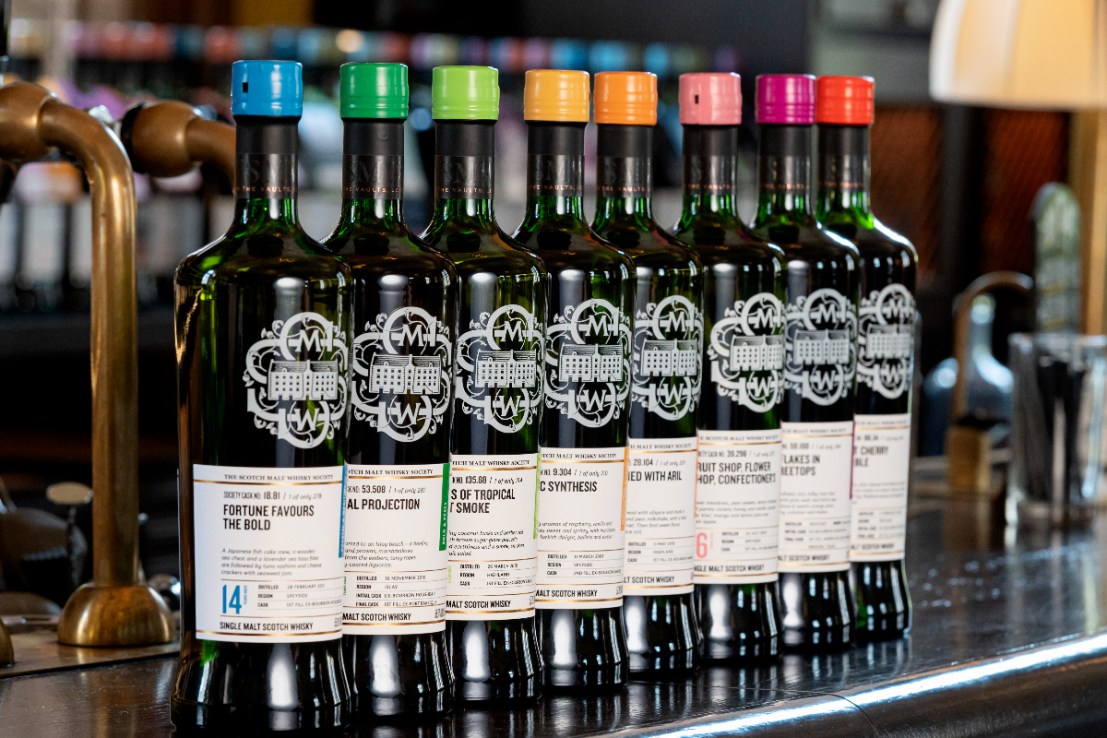
Each bottle of non-chill-filtered cask-strength whisky is stamped with The SMWS logo and a name inspired by the liquid. The only way of identifying where the bottle came from is two numbers, the number of the distillery and the cask number, such as Cask No. 4.395: Red wine and Brine in the Old Coal Mine and Cask no. 4.353: Lavender Honey and Chimney Lobsters.
The SMWS pioneered an entirely new approach of labelling based on flavour profiles. Each release has a unique tasting note, written by a member of the professional tasting panel that reviews all cask samples. The average output of a single cask (the society bottles around 1,000 casks a year) is approximately 225 bottles, and once each release is gone, it’s gone.
The SMWS was acquired by Glenmorangie in 2004, which was itself taken over by international luxury goods and drinks company LVMH in the same year. LVMH sold the business to a group of private investors in 2015, and in December 2021, it was acquired by The Artisanal Spirits Company plc.
Today, The SMWS operates a direct-to-consumer model (90 per cent of revenue) primarily through e-commerce, in addition to four member-only rooms in the UK. There are 41,000 members worldwide, with over a thousand as shareholders in The Artisanal Spirits Company, which offers a shareholder benefit programme for investors owning more than 1,000 shares.
The Scotch whisky evolution
In 2012, The SMWS introduced 12 flavour profiles to categorise its own releases and to further focus on flavour. This year, it’s taken these profiles a step further by refining the 12 down to eight, shifting away from previous age-led categories like ‘Old & Dignified’ and ‘Young & Spritely’ toward eight colour-coded categories. These represent the full spectrum of flavours from ‘Fragrant & Floral’ to ‘Bold & Peaty.’
Andrew Dane, CEO of The Artisanal Spirits Company, told City AM: “The society, is about exploration. Every single release is new, one-of-a-kind, and never to be repeated. Once it’s done, you must explore something new.”
“A couple of years ago, we started a comprehensive range review across everything we were doing,” he continued.
“The flavour profiles were a key part of this. We listened to people about what they could relate to, simplifying the profiles and making them easier to understand and more striking.”
Drinkers are encouraged to begin with Fragrant & Floral, described as a “fresh and breezy affair, where delicate aromas and vibrant flavours come to life.”
The profiles then move onto Sweet & Zesty, Ripe Fruits & Honey, Dried Fruit & Spices, Toasted Oak & Vanilla, Coastal & Maritime Smoky & Fruity and of course, no selection of Scotch would be complete without the Bold & Peaty segment.
New markets for whisky
The new profiles are designed not only to refine the range of whiskies on offer, but also to open the range to new drinkers. The colour-coded bottles and tasting notes have been designed to remind drinkers of “things we take for granted.”
As Dane explains: “Crucially, we now print the name of the flavour profile on the bottle instead of just using a colour and asking people to guess. We also use the space to explain more about the first and second casks, as more of our whiskies spend significant time across multiple casks.”
The company has also made a concerted effort to move away from the more traditional descriptions used by whisky drinkers to define spirits. “This meant simplifying and getting rid of some of the old, age-led flavour descriptions like ‘Old and dignified’ or ‘Young and sprightly.’ What do those even taste like?,” says Dane.
The SMWS also has an eye on the international market. Having launched in both Vietnam and India this year, it now operates in 30 countries around the world, meaning the range has to be just as accessible to drinkers in Vietnam as it is in Scotland.
As whisky producers continue to look for ways to find new markets, The SMWS’s new approach to its tried and tested model is set to bring a splash of colour to the world of Scotch whisky.
The Whisky Exchange
City AM has teamed up with The Whisky Exchange to offer its readers an exclusive offer on whisky tastings.
Readers can get 20 per cent off flights and private tastings at The Whisky Exchange shops in London. Click here to find out more and use code CityAMxTWE when booking.