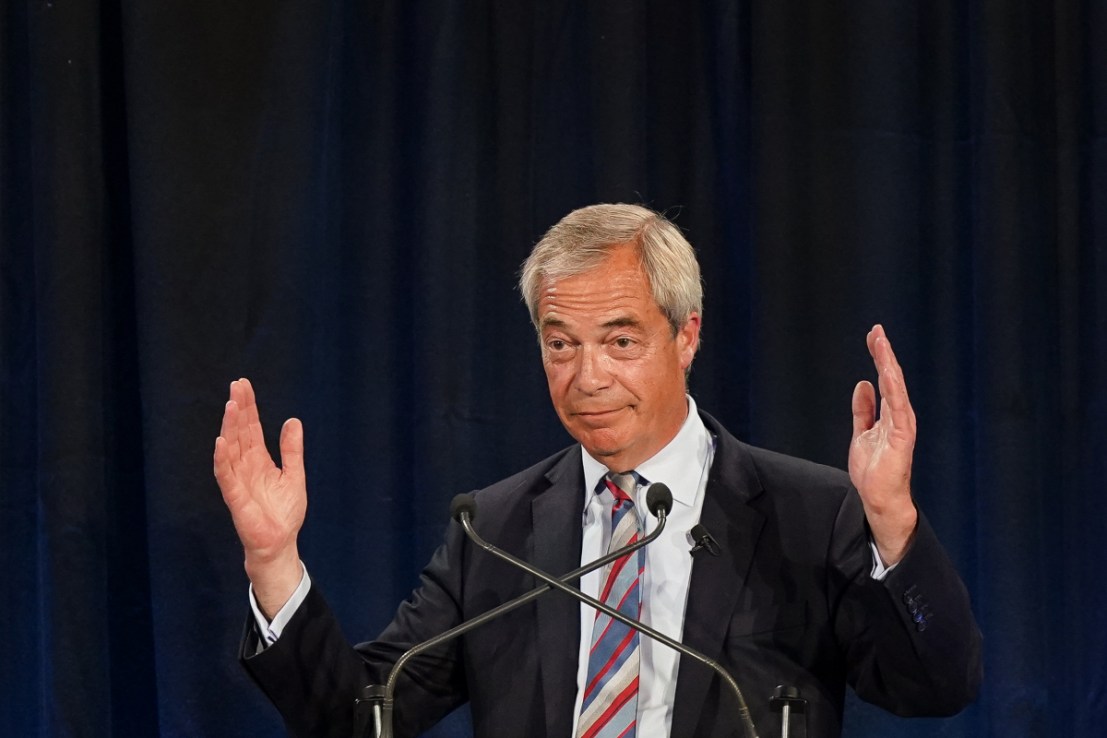
Reform UK’s Nigel Farage has vowed to make sweeping spending cuts before cutting taxes for Brits while hitting out at “cretins” for imposing too much regulation in the City in comments that reflect his moves to take on economic policy head-on.
Farage said the party’s next manifesto would be “fully-costed”, a statement that reflects the party’s commitment to gain economic credibility among financial backers and the British public.
He also suggested that proposals set out last year would be ditched amid criticism from top economists that plans were likely to spook government lenders and City investors.
“At the next election, we will present a rigorous and fully-costed manifesto,” Farage said.
“Reform will never borrow to spend, as Labour and the Tories have done for so long. Instead, we will ensure savings are made before implementing tax cuts.
“I will have more to say on all this in the coming weeks.”
The comments suggest that Reform will draw up new electoral proposals within the next few years. Farage is likely to want to fast-track policy plans given his prediction the next General Election will come as early as 2027 due to the collapse of Keir Starmer’s government.
Among the main policies Reform put forward was a tax cut believed to be worth up to £90bn by raising the personal allowance to £20,000 from its current level of £12,570.
On Times Radio, deputy leader Richard Tice said the tax cut was still the plan “as an aspiration”.
“We cannot do any of this, given the state of the finances, until we deliver on the savings,” he added.
Farage to spell out economic philosophy
In an appearance at a summit in London, the Reform leader also blamed “cretins” for running the UK economy as he said over-regulation and poor financial decisions had left the UK falling behind.
Taking aim at former Chancellor Gordon Brown for selling off gold reserves too cheaply, he said: “These are the kind of cretins, I’m afraid, that have been running this for too long.”
“The big bang of the 1980s, that’s worth mentioning because today is the 100th anniversary of the birth of Margaret Thatcher.
“Love her or not, she broke up the City of London and we got massive investment coming in and we really made London the world’s leading centre.
“If you ever want to have a look at an example of sensible deregulation, getting rid of ridiculous market practices and customs leading to success, big bang in London in the ’80s is one of them.”
“The big bang of the 1980s, that’s worth mentioning because today is the 100th anniversary of the birth of Margaret Thatcher.
“Love her or not, she broke up the City of London and we got massive investment coming in and we really made London the world’s leading centre.”
“If you ever want to have a look at an example of sensible deregulation, getting rid of ridiculous market practices and customs leading to success, big bang in London in the 80s is one of them.”
The Reform leader also suggested that the party would look to claw back losses the Bank of England has suffered from its quantitative tightening (QT) policies.
“Our commitment to ending net-zero policies, benefits for foreigners and wasteful behaviour by the Bank of England remains firm,” he said in an interview.
“We will bring back the biggest taxpayers, encourage businesses — especially small ones — and produce our own oil and gas.”
“The 2024 document proposed reductions in civil service spending, but we will increase those cuts. We will cut overall spending, introduce an industrial policy and drive a cultural shift in attitudes towards work and success.”
In previous policy announcements, Farage has said he would install business leaders into ministerial roles and look to attract more foreign investors into the UK through the ‘Britannia Card’.
He has also suggested that the Bank’s Monetary Policy Committee (MPC) would feature Treasury representatives and that the Office for Budget Responsibility (OBR) would be cut.
Farage and Reform party members have faced criticism from opposition groups over the lack of clarity on its economic policies and philosophy.
Conservative MPs have labelled Farage a “socialist” for backing nationalisation of British Steel and other under-threat companies, and for supporting the lifting of the two-child benefit cap, which could cost the government more than £3bn.
Panmure Liberum’s Simon French also warned that its tax and spending proposals would lead to a rout in the bond markets, prompting fierce backlash from Reform’s head of policy Zia Yusuf.