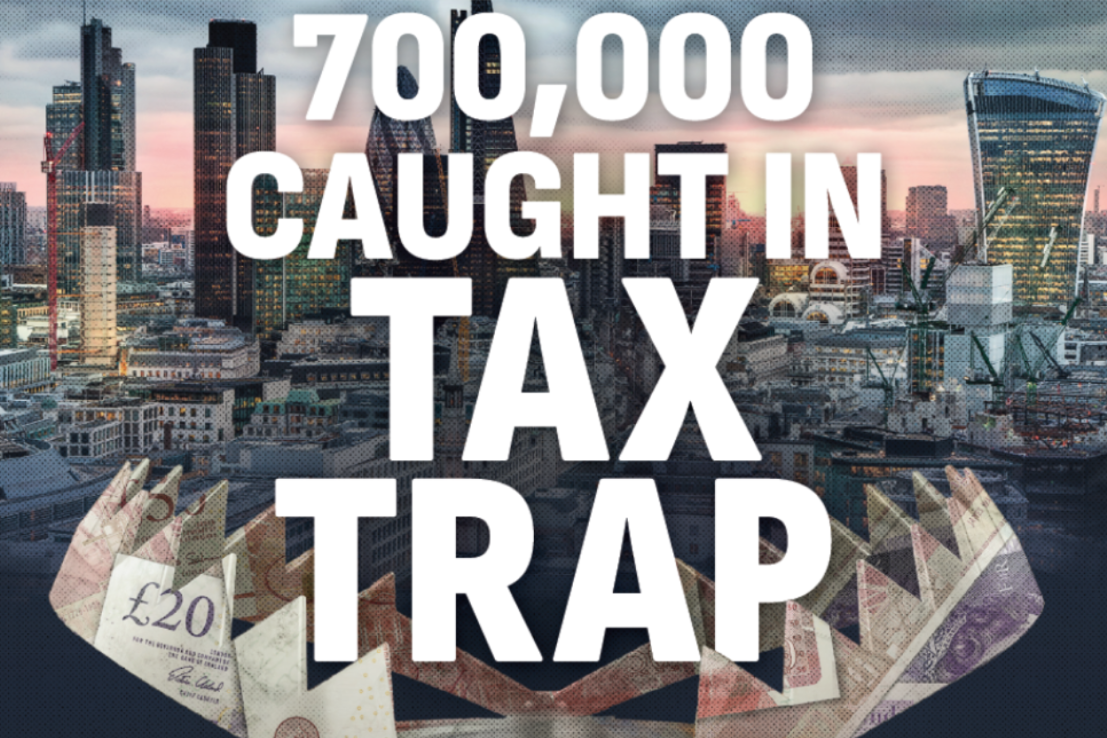
There are growing calls for the government to overhaul tax rules for top earners after fresh data obtained by City AM revealed just under 700,000 Brits are now caught in the so-called 60 per cent tax trap.
Another 74,000 taxpayers were added to the punitive £100,000-£125,000 income bracket during the 2024/25 tax year, according to estimates obtained from HMRC via Freedom of Information request, an increase of 12 per cent on last year and a near-doubling over five years to a total of 698,000.
Taxpayers within the band face an effective marginal rate of 60 per cent due to the tapering away of the tax-free personal allowance, a situation exacerbated for parents by the removal of government-funded childcare support. Wage growth combined with unchanged tax thresholds, a phenomenon known as fiscal drag, has pushed more earners into paying higher tax rates, compounding the problem.
The tax rules means parents on higher salaries could end up significantly worse off if their pay crosses the £100,000 threshold, and will need to earn tens of thousands more to compensate for the loss of tax-free childcare.
Robert Colvile, director of the Centre for Policy Studies, said: “The 60p tax trap is grotesquely unfair – but because it’s ‘the rich’ who are entangled in it, it’s never been a priority for the government.
“However, as City AM’s figures show, more and more people are getting caught in it. This is particularly unfair on single-earner families who will pay hugely more tax on the same income as dual-earners, and lose access to child benefit much earlier too.
“It should be a basic principle of the tax system that it always pays people to work – not just for their sake, but because that’s how you grow the economy, and tax revenues alongside. Our current system does the absolute opposite.”
Half a million Londoners earn six figures
The data also revealed that for the first time, there are now more than half a million Londoners earning six-figure salaries, an increase of 9 per cent compared to last year and representing around one in ten taxpayers, in signs the concerns of those caught in the tax trap are likely to become a growing electoral force for the government to reckon with.
Outside of London and the South East, The South West and North West of England saw some of the fastest rates of increase of six figure earners with an estimated rise of 14,000. In total, the number of six figure earners across the UK rose 10.4 per cent, or 170,000 to 1.8m in the 2024/25 tax year.
A growing number of businesses are also thought to be freezing senior employee pay at £99,000 in order to swerve the tax challenges associated with crossing the £100,000 threshold, while some employees have rejected pay rises.
Philly Ponniah, a London-based financial coach, told City AM she had seen a three-fold increase in enquiries in the past year from clients worried about the tax trap as more and more people are dragged into the earnings bracket.
“A lot of people are anxious about it, especially if they don’t know anyone else who earns as much as them, they feel they can’t complain about it,” Ponniah said.
“There’s real frustration. It’s impacting people’s careers in terms of going down to four days a week…sometimes they’re in a better position to do four days over five because of the impact of childcare costs and that is just a really bad outcome for the economy.”
Chris Sanger, UK tax policy leader at EY, said the government could consider extending the range over which the allowances are tapered, or raise the level at which the tapering starts.
Alternatively, the band could be removed completely by changing the personal allowance so that, rather than being an amount of income that higher earners don’t pay tax on, it was instead a tax credit – a fixed amount of tax they don’t have to pay.
“Under the current rules, some of those impacted, especially those paid on an hourly basis or for overtime, may be encouraged to bring their income level down to below £100,000, whether through working fewer hours, paying more into their pension or through salary sacrifice initiatives,” Sanger told City AM.
“However, while this may be a solution for some, it won’t be for others, and removing this deterrent could help encourage individuals to spend their money elsewhere in the economy, supporting broader UK growth.”
Tax advisory firm Blick Rothenberg has urged the chancellor to remove “tax distortions that discourage growth” in her upcoming autumn Budget, including removing the tapering of personal allowances between £100,000 and £125,000 and revisiting the childcare income threshold, either by removing it or doubling it.