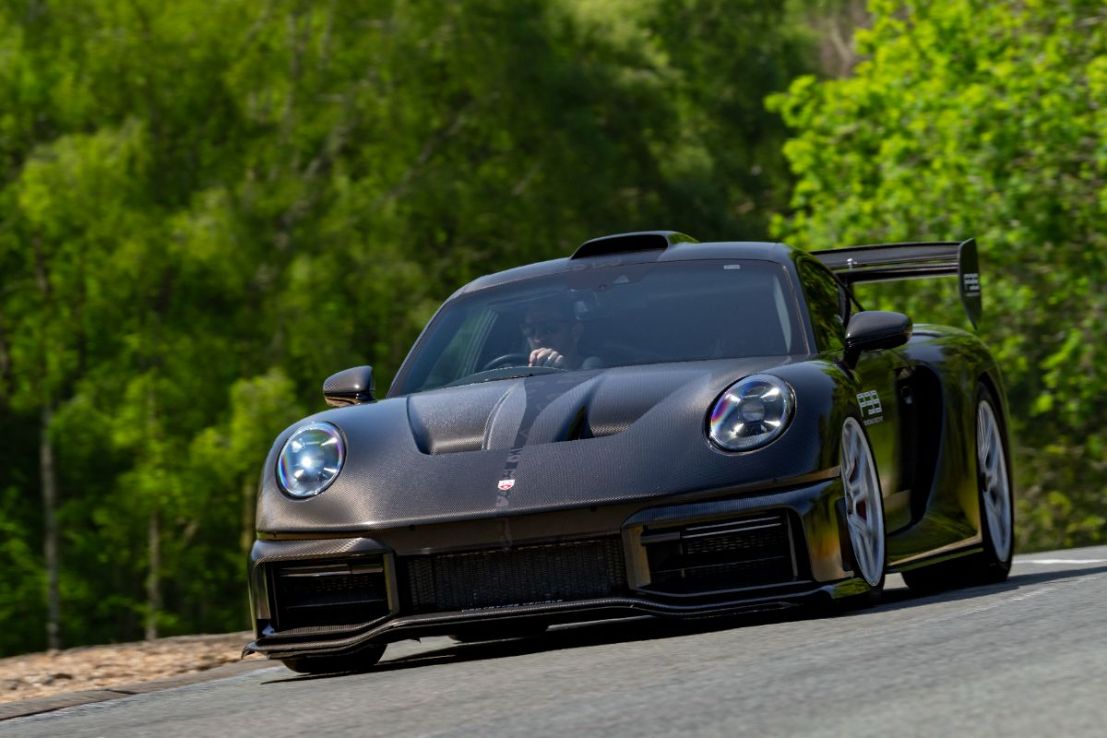
Does the world need another Porsche 911-based restomod? After all, that territory is already fought over by Singer Vehicle Design, Theon Design, Tuthill, Kalmar Automotive, Gunther Werks, Paul Stephens AutoArt, Ruf, Thornley Kelham and many more. The RML GT Hypercar, however, is far removed from a typical ‘backdated’ 964. With a current Porsche platform and cutting-edge tech, using the R-word does it a disservice. What we’re dealing with here is effectively a brand new car.
The GT Hypercar – or GTH for short – is based on the outgoing, 992.1 iteration of the Porsche 911 Turbo S. Already a formidable machine in its own right, the standard car combines a 650hp twin-turbo engine with a dual-clutch PDK transmission and four-wheel drive. My 911 Turbo S review declared: ‘Point-to-point, I’m not sure anything is quicker. And no rival offers greater bandwidth, either’.
A high bar, then. But that hasn’t deterred RML from raising the stakes. The GT Hypercar’s entirely new carbon fibre body is draped over a 100mm wider track and 25mm longer wheelbase. Aero is enhanced by extendable spoilers, a brutal diffuser and a driver-operated DRS system. New motorsport-spec suspension with aluminium wishbones, secondary springs and bespoke top mounts is fitted. And the flat-six pays a visit to Litchfield – a company that built its reputation tuning the Nissan GT-R – where it gains new inlets, improved cooling, larger turbochargers and an Inconel exhaust. The resulting 920hp is enough to embarrass a Porsche 918 Spyder. Hypercar by name…
From serene to savage
Despite all the above, the GTH isn’t the headbanger you might expect. RML’s aim was to blend the everyday, all-weather usability of a Turbo S with the track performance of the latest 911 GT3 RS. “From the outset, we set ourselves the challenge of building a car that could switch personalities at the touch of a button – serene on the road, savage on the circuit,” explains board member Michael Mallock. Damping is three percent softer than the donor 911, yet a simulated Nurburgring lap-time of 6min 45sec is four seconds quicker than the factory Rennsport. BTCC driver Tom Chilton, who has racked up thousands of development miles in the ‘P39’ prototype pictured here, plans to verify that number at the Nordschleife early next year.
Before I put a few more miles beneath P39’s wheels, RML CEO Paul Dickinson shows me around the company’s huge facility in Wellingborough, Northamptonshire. Established in 1984, RML was initially focused on motorsport, then later expanded into ‘white label’ engineering for automotive OEMs. Many of these cars are shrouded in NDA-enforced secrecy, but among the projects made public are the Saleen S7 (widely regarded as America’s first hypercar), the Nio EP9 (a record-breaking performance EV) and the Bizzarrini 5300 GT Corsa Revival (a reborn, carbon-bodied classic).
Three years ago, RML unveiled the first vehicle to wear its own badge. The Ferrari-derived Short Wheelbase transplanted the naturally aspirated V12 and manual gearbox from a 550 Maranello into an elegant body inspired by the 250 GT SWB. At £1.5 million, it was a leftfield and very alluring alternative to a modern hypercar. As my Short Wheelbase review concluded: ‘It isn’t focused or ultimately as fast as a new Ferrari, but that’s exactly the point’.
Spoiling for a fight
As the man credited with relaunching Bentley’s Mulliner division, Dickinson is keen to apply the Short Wheelbase’s bespoke, coachbuilt approach to the GT Hypercar. Options range from hard-shell racing seats to a visual carbon fibre exterior finish – the latter yours for £200,000. Production will be limited to 39 examples and prices start at £595,000, which includes VAT but not a 911 Turbo S donor car. Reckon on the best part of £200,000 for one of those, too.
Back in RML’s clinically clean workshop after its public debut at Blenheim Palace, GTH number 01 – the first customer car – is a prime example of the personalisation offered. Its Storm Purple paint (an Aston Martin colour) is complemented by tinted purple carbon fibre, gold centre-lock wheels and hand-painted gold badges. With a flawless finish and a silhouette akin to the 911 GT1 Le Mans racer, it looks fabulously exotic.
‘My’ P39 prototype is decidedly rougher around the edges. Its unpainted body carries the scuffs and scars of an intensive test programme, along with the residue of peeled-off ‘Safety Car’ stickers. Still, there is something very cool about its austere, battle-worn aesthetic. Even when parked with the engine off, it seems to be spoiling for a fight.
Inside the RML GT Hypercar
Inside, the RML isn’t too far removed from the original 911 Turbo S. You still get air conditioning, a central touchscreen, wireless smartphone connectivity and a Bose audio system. Forgo a roll cage and you can even retain the rear seats. The main difference is a new steering wheel similar to that found on the GT3 RS, with four rotary controllers to adjust drive modes, damper stiffness, ride height and the active aero. There’s no rear window on account of the roof scoop, so a camera and digital mirror are used instead.
If the GT Hypercar looks angry when standing still, it sounds absolutely livid when you fire up its water-cooled flat-six. Impressively, the engine’s “incredibly strong” internals are still stock, as are the PCCB carbon-ceramic brakes. However, the almighty wallop of added boost cuts the 0-62mph time to 2.4 seconds, with 100mph passed in 4.5 seconds – figures that make even most supercars look a little lethargic.
My initial impressions centre on how easy the RML is to drive. In Normal mode, which limits engine output to 750hp, you can leave the eight-speed PDK ’box in auto mode and trundle through traffic, using the hydraulic lift system to clear speed humps when necessary. Throttle response is calmly calibrated and the suspension is pliant enough to take the edge off poorly surfaced roads. Apart from an occasional boomy resonance from the exhaust, it really does feel as amenable as a 911 Turbo S.
A forced introduction
Twist the dial to Sport or Sport Plus, however, and all 920 horses break into a sudden stampede. The dizzying, forced-induction rush feels like a giant hand has scooped you up and hurled you into the next county. For someone who had a classic Porsche 930 Turbo on his bedroom wall (Guards Red, of course), its suck-and-hiss soundtrack is as evocative as the 9,000rpm snarl of the naturally aspirated motor in a GT3 RS. Opportunities to fully flatten your right foot come rarely on the road, but the experience is an addictive one.
Sadly, I wasn’t able to drive P39 on a circuit, so the effects of its shape-shifting aero, which extends the front splitter and pivots the rear wing in Track mode, were somewhat academic. However, with up to 923kg of downforce generated at 177mph, plus the option of semi-slick Michelin Cup 2 R tyres, RML’s target of 6min 45sec to lap the ’Ring seems perfectly plausible.
Frankly, if you turned up at a track day in a GTH, little this side of a fully-fledged GT4 racer could get close. Yet there is much to enjoy on a British B-road, too. Its electric power steering is lucid and traction is plentiful, at least on dry tarmac. Like Porsche’s own 911 GT2 RS cranked up by several notches, there’s an intoxicating mix of raw potency and detailed feedback. My time with the RML was brief, but I wouldn’t hesitate to take it on a driving adventure. The only issue might be a lack of luggage space, as the 911’s front boot is sacrificed to the ‘nostril’ air intakes. But packing light saves more weight, right?
Verdict: RML GT Hypercar
You might think £600,000+ is expensive for a modified 911, and you’d be right. However, the RML has the presence, performance and engineering integrity to rival anything from Weissach, or indeed Modena.
It’s neither a restomod nor a wedge of impractical exotica. Instead, it could be the hypercar that Porsche never built: positioned somewhere between a Carrera GT and a 918 Spyder in terms of ethos, and vastly more exciting than the (allegedly now abandoned) electric Mission X. Me? I can’t even nearly afford one, but I’m mightily glad that cars like this exist.
Tim Pitt writes for Motoring Research