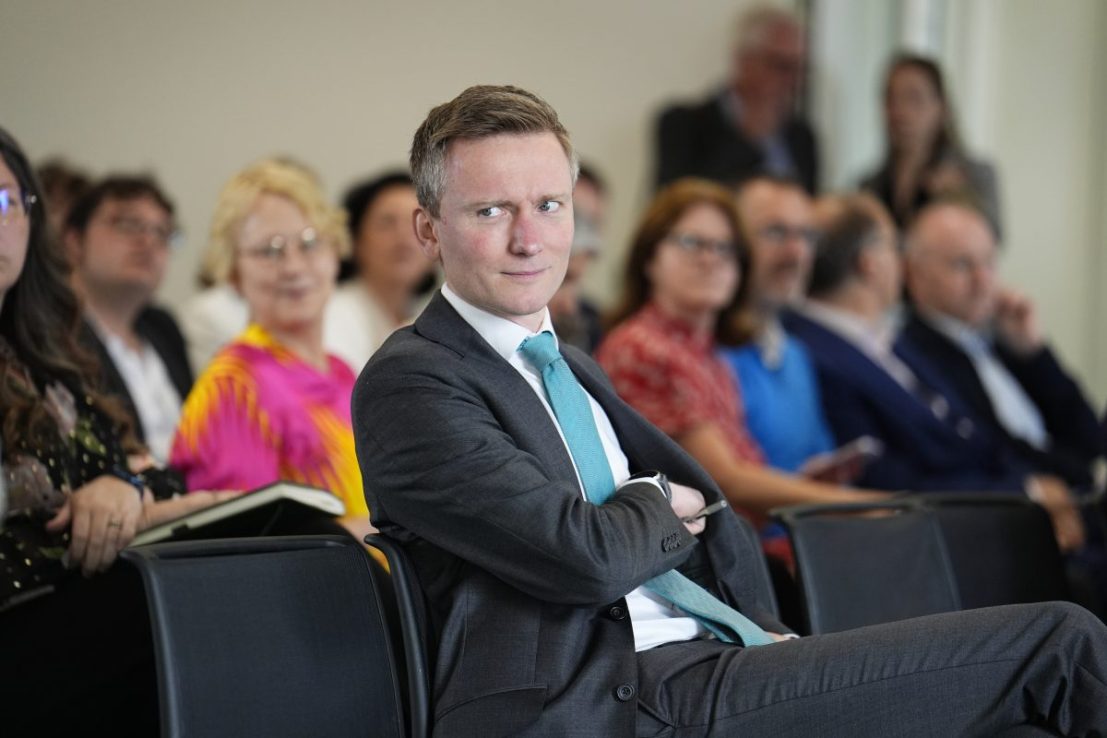
Handing responsibility for the economy to a man who was director of policy for Ed Miliband is a sign of desperation from Rachel Reeves, says Eliot Wilson
Every time I see a new announcement from Rachel Reeves at the Treasury now, it puts me in mind of the poet Stevie Smith:
“I was much further out that you thought
And not waving but drowning.”
As the Chancellor of the Exchequer’s second Budget creeps closer, we were briefed last week that Reeves had reshuffled her “top team” and was now looking to her most junior minister, parliamentary secretary Torsten Bell. In the words of The Times, the MP for Swansea West had “been handed responsibility for economic policy”, which must surely be a slight exaggeration, and the Chancellor “will hope Bell can help her recover from a bruising first year in office, where she has struggled to grow the economy”.
This is a significant moment for Bell, 42, who was only elected to the House of Commons last July. He was made a parliamentary private secretary – those humble but invaluable carriers of ministerial bags – as soon as the new government was formed, then promoted to double-hatted Treasury and Work and Pensions minister in the changes following Tulip Siddiq’s self-immolation.
For whom the Bell tolls…
Labour sources are at great pains to remind us how brilliant Bell is: a PPE graduate from Mansfield College, Oxford, who was Alistair Darling’s special adviser at the Treasury during the 2008 financial crisis, he was then chief executive of the left-leaning economic think tank the Resolution Foundation from 2015 to 2024. He was also made an honorary professor at the UCL Policy Lab, and, as if he could not be more unimpeachably progressive, he was a columnist for The Observer for several years.
Reeves and, by extension, Sir Keir Starmer, are clearly placing a great deal of hope in Bell to unlock some secret elixir which will provide the economic growth on which all of their plans are founded. The appointment of her former deputy, Darren Jones, to a new role in the Cabinet Office as chief secretary to the Prime Minister, “to support the delivery of the Prime Minister’s priorities and the Government’s Plan for Change”, is a desperate attempt to make Reeves’s efforts have some tangible outputs. It is also a tacit admission by Sir Keir Starmer of his reliance on what happens at the Treasury.
But Bell’s promotion to wonk-in-chief as the Budget is drafted must, by definition, mean one of two things: either he will instigate major changes in economic and fiscal policy, or he will cleave to the current plans. Both of these are problematic.
If there are no major changes of direction in policy, Bell is wasting his time. With GDP growing by a whisker over one per cent, the economy is effectively in stasis, and the UK’s recovery towards pre-pandemic levels of performance lags far behind the United States, Canada and the Eurozone average. Inflation is rising and may soon hit double the Bank of England’s target of two per cent, and most commentators agree business confidence is very low and falling. If the Budget turns out to be an exercise in steady-as-she-goes, it really will be the proverbial definition of insanity: doing the same thing again and again, and hoping for a different result.
Bell may bring fresh thinking to Reeves’s policy platform. The problem here is that some of the ideas he has already mooted in recent months and years are terrible
On the other hand, Bell may bring fresh thinking to Reeves’s policy platform. The problem here is that some of the ideas he has already mooted in recent months and years are terrible. A 2023 report from the Resolution Foundation, Ending Stagnation: A New Economic Strategy for Britain, recommended “better, not just higher, taxes”, especially shifting the burden further on to employers; more stringent inheritance tax rules; higher and broader capital gains tax; more investment in net zero; and increasing benefits to track wages rather than prices. There is a theme running through these proposals, that the state must reach deeper into individuals’ pockets.
Bell is also believed to favour imposing National Insurance on landlords’ rental income, which is likely to mean either higher rents or some landlords simply getting out of the sector, which hurts tenants either way. His attitude towards the pensions ‘triple lock’ is hard to divine. As the head of a think tank, he said it was “increasingly inevitable” that the triple lock would end, while as a pensions minister he took to social media to celebrate “an extra £31bn every year to protect the triple lock”.
So what will it be? Will there be barely cosmetic changes in policy as Reeves flounders in the failure of Labour economics so far? Or will the wunderkind who was, let us recall, director of policy for Ed Miliband as Labour leader – not a ringing endorsement of success – bring his own twist to the government’s dogged pursuit of higher taxes and a larger, more expansive state?
Remember, as Rachel Reeves holds the red Budget box aloft outside 11 Downing Street this autumn: not waving, but drowning.
Eliot Wilson is a writer