It’s an e-bike apocalypse out there, or at least it is if you’re trying to cross West London on two wheels.
Hounslow Council’s recent decision to ban Lime, the capital’s most ubiquitous e-bike operator, has turned London’s meticulously planned cycle routes into a geopolitical minefield.
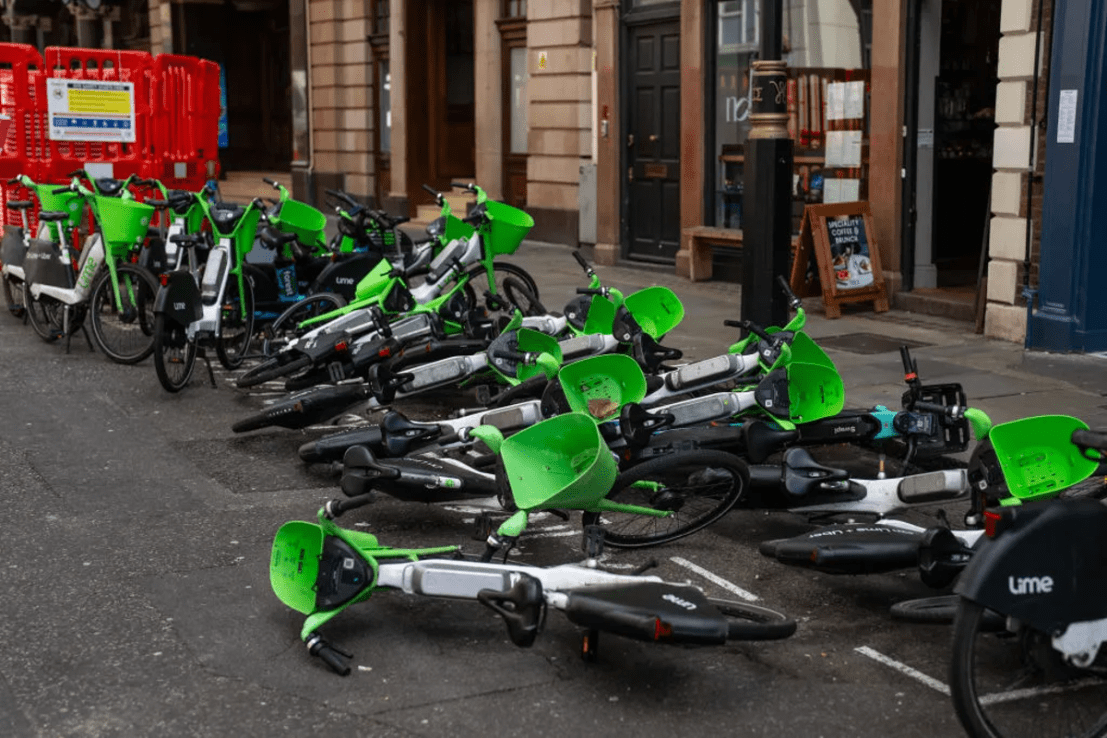
The capital’s commuters are now finding themselves stranded at borough borders, confronted by a chaotic scene of bikes piled up on either side of the Thames.
The latest casualty of this “patchwork of boundaries” is the humble London commuter. Comedian and TV presenter Dara Ó Briain captured this absurdity in a recent viral post on X, formerly twitter, in which he said that bridges between Hounslow and Richmond have become “Checkpoint Charlie,” with clusters of Lime bikes on one side and rival Voi and Forest bikes on the other.
It’s a real, highly inconvenient testament to a problematic and fragmented system where each borough operates as its own mini republic.
Problematic e-bike borders
A local business owner told City AM the change has “disconnected” town centers, making it impossible to cycle seamlessly from Chiswick to Hammersmith as they once did.
In one particularly frustrating instance, his bike’s battery cut out the moment he crossed the border, leaving him to walk the rest of his commute.
And this isn’t exactly an isolated incident. The “geo-fencing” technology used by operators is designed to prevent bikes from leaving their licensed zones.
As a Lime representative, Alan Clarke, told City AM, “nobody in London really knows where the borough boundaries are.”
This means riders can be left high and dry, forced to abandon their journey – and their wheels.
The result is a frustrating physical manifestation of this policy, with photos from the boundary between Hounslow and Richmond showing dozens of bikes piled up, a silent protest from riders who found their journey cut short.
A local resident, Mark Angelo, said the dumped bikes have become an ongoing nuisance, blocking parking spaces and sparking “disruption” with many venting in his neighbourhood group chat.
Cash-strapped councils
Behind the scenes, this logistical nightmare is fueled by a more fundamental issue: a lack of funding.
As City AM recently revealed, Hounslow Council’s decision to award the contract to Forest was heavily influenced by the company’s financial offer.
Forest scored a perfect 40 out of 40 on the ‘fees’ section of its bid, even as its quality metrics lagged behind.
It’s an “inherent temptation for local authorities to look for income,” as industry analyst Beate Kubitz told City AM.
That temptation comes at a cost to consumers. Not long after the new contract began, Forest raised its “pay as you go” service fee by 50 per cent, blaming the move on a doubling of fees charged by boroughs.
This makes its “10 minutes free daily” offer highly misleading, a point that has prompted a local business owner to file a claim with the Advertising Standards Authority.
Meanwhile, Voi is undercutting its competitors with a lower per-minute rate. The lender’s policy manager, Harry Foskin, told City AM the company has no immediate plans to raise prices because “we’re not making money to operate bikes in London at this moment in time.”
He also said Voi is currently sacrificing the “commercial aspect at this moment in time” to “get our foot in the door and prove that… our model is the right one”.
What’s more, he confirmed that the “revenue share aspect is kind of just a sad kind of reflection of where we are, where the industry is”.
Searching for a solution
The industry is united in its call for a “pan-London” approach to regulation.
Richard Dilks of the shared transport charity CoMoUK said a bill going through parliament could make TfL the central licensing authority.
But Foskin cautioned that this legislative process could take up to two years. In the meantime, he said, the goal is to work towards a unified system where riders “don’t need to be… a cartographer” to know where they can ride.
As Alex Berwin, head of policy at Forest, said: ““We’re aware of the challenges that come with the rising demand for e-bikes and the growth of this new form of transport. This is exactly why we have been calling for a pan-London approach to regulation.
“We need a single regulatory framework, one enforcement model, and one operational rulebook across the capital, whilst ensuring services support the local needs of each borough. This will get more people moving in ways that promote healthier, sustainable lifestyles and ease congestion.”
For now, the battle rages on.
While Richmond Councillor Alexander Ehmann publicly stated that Hounslow’s decision “seems to have underestimated the impact on riders,” a Lime spokesperson summed up the shared frustration, saying, “we need to make cycling easier, not harder,” and called for councils to “prioritise service quality and functionality” over financial gains.