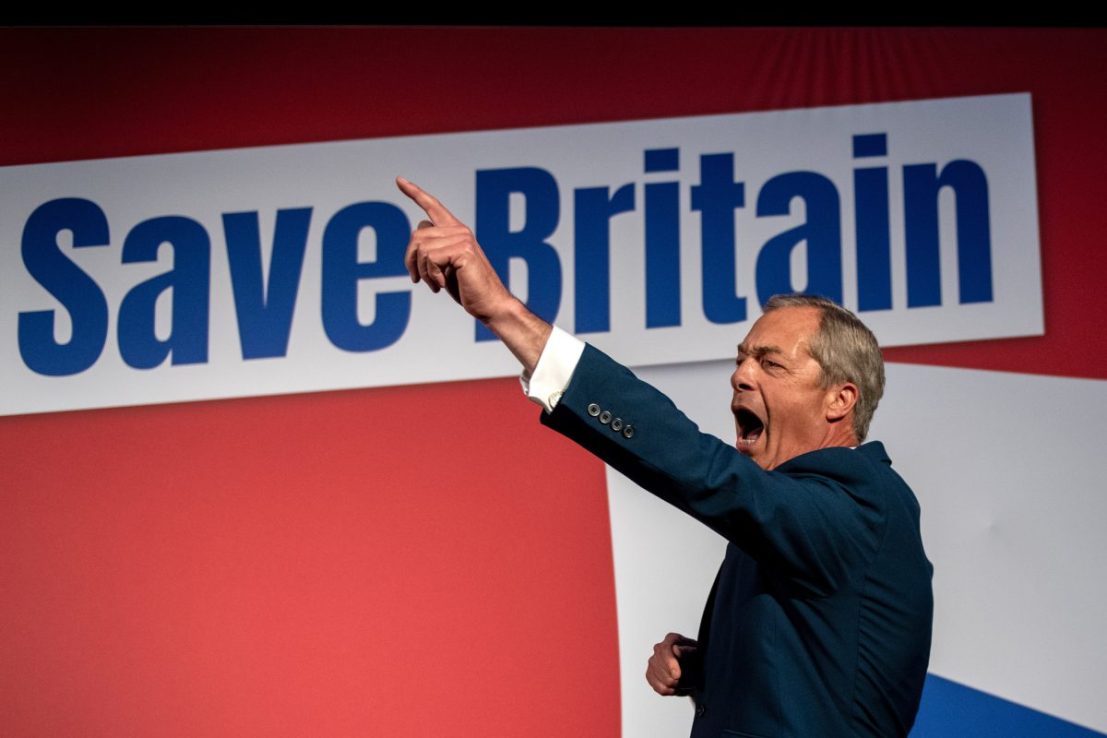
Taking successful people from the business world and putting them in government sounds like a good idea, but history proves otherwise, Nigel, writes Eliot Wilson
It is one of the hoariest and most hackneyed “solutions” to the institutional problems which beset British government: bring in dynamic, no-nonsense leaders from the business world. They will inject Whitehall with a sense of urgency and purpose and an efficiency which will be transformative, sweeping aside the pettifogging, nest-feathering bureaucracy of the civil service.
So hoary and hackneyed is the idea that it was no surprise to find it being articulated by Nigel Farage in June. The Reform UK leader, allowing himself to imagine a future in 10 Downing Street, would appoint “top business leaders” to his cabinet. One anonymous attendee at a breakfast meeting with the insurgent party contrasted it favourably with the Labour government:
“There is no one on that front bench with any real calibre of business experience… whereas [in Reform], you have Tice, who made millions in property, Farage, who knows the City, and Zia Yusuf… also a multimillionaire businessman.”
If it is such an obvious solution to an abiding problem, you might wonder why no-one has had the Faragiste bravery to apply it before. There is only one problem: they have. And the results have been mixed at best.
Business leaders in government: Tried and failed cases
Bringing leading figures from the private sector into the heart of Whitehall goes back more than a century. Arguably the first was Eric Geddes, deputy general manager of the North Eastern Railway, whom Lloyd George appointed to ever more senior positions during and after the First World War: director general of military railways, controller of the navy, first lord of the admiralty, minister of transport. Along the way Geddes became MP for Cambridge, but he had no patience for peacetime government and resigned in 1921.
Geddes had been effective within his domain, but wartime forgave a great deal. Ernest Marples was an energetic minister of transport under Harold Macmillan in 1959-64, but he enthusiastically oversaw Dr Richard Beeching’s culling of Britain’s railways at exactly the time when motorways were expanding: it so happened that many of them were built by Marples Ridgway, the construction firm he had co-founded in 1948. Marples fled to Monaco in 1975, only one step ahead of the Inland Revenue and a host of plaintiffs.
The acme of business success failing to translate is John Davies, director general of the CBI in the late 1960s who was elected as Conservative MP for Knutsford in 1970 and soon found himself heading the new department of trade and industry. As a former MD of Shell-Mex and BP, he was the ideal candidate to supervise policy on business and enterprise, surely?
Not quite. Davies was a disaster. He never got to grips with his department of more than 25,000, or with policy-making, and he never found his feet in the House of Commons; in 1972, Heath moved him to look after relations with Europe, but his credibility was gone.
Of course there have been successful imports, like Lord Young of Graffham, who served Thatcher as employment secretary then trade and industry secretary, or Lord Drayson, who made a better fist than most of defence procurement in the last years of the Blair ministry. But the skills required to be a successful politician and those which commercial success demands are not the same. If readers have any lingering doubts, they can ask David Simon, or Archie Norman, or Digby Jones.
Few in business want the job anyway
You will struggle to find major business leaders who even want to hold the political reins. Mostly, successful entrepreneurs and titans of industry have enough self-awareness to know their strengths and weaknesses, and to know where they are most effective. There is little appetite to be another Elon Musk, who very nearly halved Tesla’s share price in 11 weeks as head of the Department of Government Efficiency; or another Steve Witkoff, Trump’s special envoy to the Middle East and Putin interlocutor, a former attorney and property developer who is comically out of his depth, a parrot repeating the Kremlin’s latest line-to-take.
There is no argument that the bureaucracy of Whitehall needs reforming, and a leavening of ministers with experience of business would be very welcome (terrifyingly, Rachel Reeves’s flimsy banking career probably puts her ahead of any of her cabinet colleagues). But Nigel Farage is echoing an argument which has been proven not to be a magic bullet. Draw on the very best talent business has to offer, but on other sectors too.
It is worth remembering that only one Prime Minister and one US President have been MBA graduates: Rishi Sunak and George W Bush. That should be pause for thought.
Eliot Wilson is a writer, commentator and contributing editor at Defence On The Brink