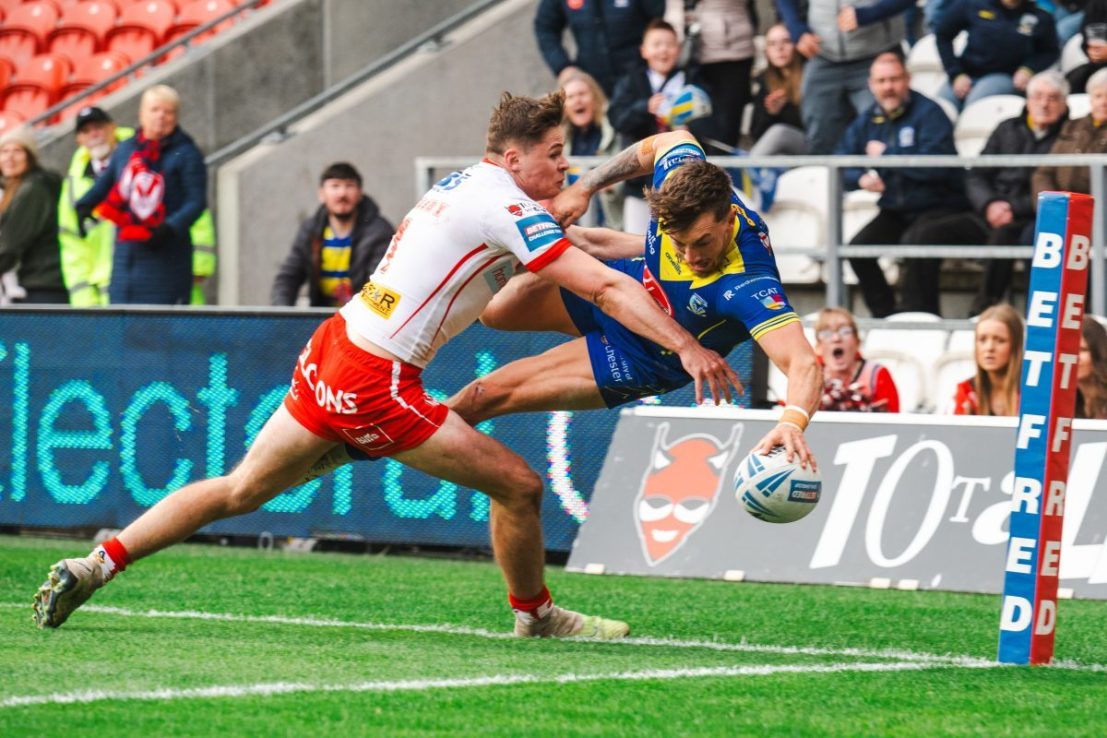
A few months ago the Halliwell Jones Stadium in Warrington was renamed the Luke Littler Stadium after the eponymous darts sensation – and fan of rugby league’s Wolves – had won the world title.
A gimmick? Sure. But it demonstrates how a club like Warrington Wolves in a sport like rugby league can make a splash beyond the traditional fan demographics of the code, which is predominantly concentrated in the north of England.
But Warrington, a large town of 200,000 sandwiched between Liverpool and Manchester, is a bastion of league on these shores, and a respected team in a game under a lot of pressure to modernise.
Enter Karl Fitzpatrick, then, the 44-year-old former Salford player and now Wolves CEO who doesn’t hold back on what the sport needs to do to spread far and wide.
Fitzpatrick explains that following a vote of no confidence in the previous chair and directors, borne out of frustration at Super League’s perceived commercial failures – the value of its TV deal is tanking by the year – a review was led by Nigel Wood with the league voting to expand to 14 teams next season.
“Nigel’s come in with a number of other panel members to go through the RFL, to go through the commercials and to ensure we maximise on commercial potential,” Fitzpatrick tells City AM.
Fitzpatrick with John Vellis, General Manager – US Expansion at NRL
Warrington Wolves standards
In an attempt to drive higher standards across Super League and the Championship below, global sports agency IMG was engaged to draw up plans which involve grading all teams.
The grading combines fanbase with stadium attendances, social media, community initiatives and a range of other factors to determine what score is allocated to each club. “A” graded clubs are guaranteed a spot in Super League, while those below are separated by their scores.
“I think it’s the right direction of travel in terms of minimum standards,” Fitzpatrick adds. “But it probably needs looking at, if I’m being honest.
“Let’s say you take your car for its MOT and you know the car’s a banger and probably shouldn’t pass, but you’re going to patch it up just to get it through its MOT – that’s what it’s like in the grading criteria.
“Some clubs have been given a Grade A license, which I would say is probably not reality – they shouldn’t be really getting the Grade A.”
The Warrington Wolves chief hopes nothing is off the table in the long-term, and one such avenue to explore is the involvement of further outside investment.
Super League and Australia’s NRL are the two main leagues in the sport, and there has been plenty of talk about the pair forging a closer relationship.
Feeder?
While some would prefer that to be in the form of more one-off games, like those held in Las Vegas, others are of the persuasion that the NRL should take a stake in Super League.
“From a league perspective, our experience with the NRL going back to the Vegas game was extremely positive for a number of reasons,” Fitzpatrick says.
“Certainly from conversations we had in Vegas, there was a great deal of appetite for getting involved in Super League. But the devil is going to be the detail. What does that actually mean for Super League and what is it? Equity?
“We’re not in the business of being anybody’s feeder team, absolutely not.”
Rugby league appears to be on a strong domestic footing for the most part. There have been well-documented financial issues at some clubs – such as Salford Red Devils and London Broncos – but the league continues to see full stands and baying crowds.
How this sport takes the next step will be crucial to determining what course it plots for itself for the next two decades. A super Super League could be on the cards, or simple investment. Either way, times are changing.