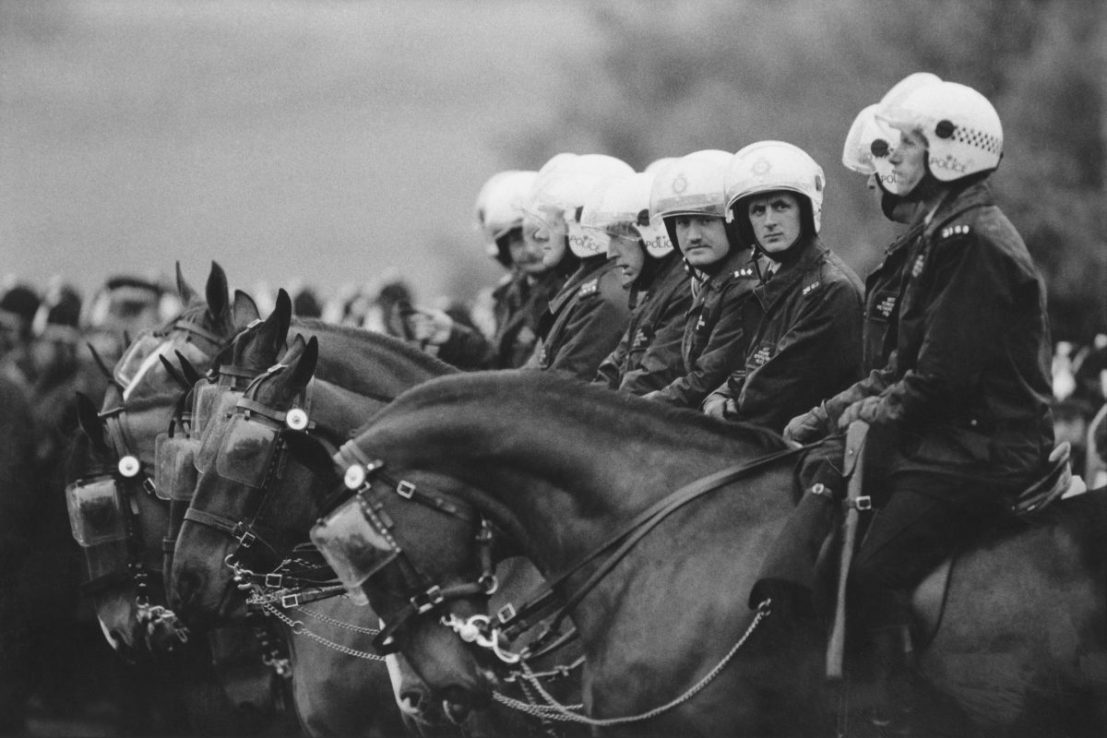
The inquiry into a clash between police and striking miners at Orgreave over 40 years ago has more to do with a left-wing grievance narrative than getting to the truth, says Eliot Wilson
Last week the home secretary, Yvette Cooper, announced a public inquiry into “the events at the Orgreave Coking Plant on 18 June 1984”. This fulfilled a commitment in Labour’s manifesto to examine the violent confrontation between 6,000 police officers and up to 8,000 pickets of the National Union of Mineworkers (NUM) at the British Steel Corporation’s coking plant near Rotherham.
It also promises to be a self-indulgent waste of public money which resolves nothing.
The investigation is being established under the Inquiries Act 2005 and will be chaired by the Bishop of Sheffield, Dr Pete Wilcox. It will have powers to compel disclosure of information, and, if other inquiries conducted under the 2005 Act are any measure, it may cost in the region of £10m.
It would be a cynical observer indeed who pointed out how much more readily the government has assented to an inquiry into an industrial dispute 41 years ago than it did into, say, group-based child sexual exploitation. Perhaps there is a feeling that something which happened when even Sir Keir Starmer, one of the cabinet’s oldest members, was still a student (in Yorkshire, as it happens) is safe ground. But the inquiry is also part of the storytelling of the British Left.
A touchstone for the trades union movement
The events at Orgreave were emblematic of the deep divisions which emerged during the miners’ strike of 1984-85 and have long been a touchstone for the trades union movement and the political left more generally, symbolic of repressive state apparatus brought to bear on miners standing up nobly in defence of their livelihoods and heritage. But, in the phrase authorised by the late Elizabeth II, recollections may vary.
The narrative which the miners and their supporters have always wanted to establish is that the police were not only excessively violent in confronting the pickets at Orgreave, but were acting in a coordinated way, at the behest of the government, to put on a show of force which would deter any further significant industrial action. Dr Tristram Hunt, former Labour MP and director of the Victoria & Albert Museum, described it as “almost mediaeval in its choreography… a brutal example of legalised state violence”.
This inquiry promises to be a self-indulgent waste of public money which resolves nothing
That must be set against other indisputable factors. Firstly, as the High Court would establish a few months after Orgreave, the strike was not legal: the president of the NUM, the autocratic and sinister Arthur Scargill, had refused to hold a national ballot of the union, after three previous ballots in 1982 and 1983 had rejected a strike. He robbed any industrial action of legitimacy under his own union’s rules.
There was undoubtedly violence and many picketing miners were injured. So too, however, were many police officers – official figures put the number at 72, more than the total of injured miners – and it is accepted that pickets as well as police officers were guilty of violence. There were, thankfully, no deaths on either side: nor were there any wrongful convictions, after an attempt to prosecute some miners for riot and unlawful assembly collapsed.
The miners’ strike was an inevitable confrontation. Margaret Thatcher said during the dispute that “what we have got is an attempt to substitute the rule of the mob for the rule of law… we need the support of everyone in this battle which goes to the very heart of our society. The rule of law must prevail over the rule of the mob.” The NUM had broken Edward Heath’s government in 1974 and Scargill intended to do the same to Thatcher’s administration. It was a contest between an elected government and trades union militancy.
The Orgreave Truth and Justice Campaign (OTJC), which has championed the public inquiry, does not want “truth” in the conventional sense. It wants validation of its own interpretation of what happened at Orgreave, confirmation of a government conspiracy to smash the working classes. The current president of the NUM, Chris Kitchen, said “We’re hoping the inquiry will show that our dispute, which we believe was industrial, was political, orchestrated from No 10, or higher up the food chain towards No 10”. (The NUM now has fewer than 200 members.)
What will happen if the inquiry does not exactly bear out the version of events demanded by the OTJC, the NUM and others? What if there is more nuance, what if some responsibility attaches to miners or to the union? Will it be rejected as another part of the conspiracy, with demands for an inquiry into the inquiry?
These are events which took place more than four decades ago. To establish a statutory inquiry necessarily privileges one specific set of circumstances over others. It will not “resolve” issues nor will it tell us anything about modern Britain. But it may, at a cost of millions, create a comforting tale of victimhood, of saintliness over sin. That would be a grotesque distortion of what happened, but then, we live in a post-truth era. It is all about the vibes.
Eliot Wilson is a writer