Man vs machine is the future of sport, whether we like it or not, but what do we want it to look like?
If you want to understand where sport is heading, don’t look at the Olympic programme or the Premier League fixture list. Look instead at the strange, noisy, algorithm‑friendly world growing just outside the mainstream. A world where celebrity boxing sells out arenas, where tennis exhibitions are marketed like rock gigs, and where the line between athletic competition and entertainment content is not so much blurred as gleefully erased.
Nick Kyrgios vs Aryna Sabalenka as a made‑for‑socials tennis confection; Jake Paul turning boxing into a hybrid of WWE and legitimate combat sport (broken jaw and all); the rise of influencer football, darts, padel. These aren’t simply sideshows. They are part of a rapidly expanding ecosystem of spin‑off events designed not for sporting purity but for clicks, clips and cultural heat.
Sport at its best?
The much‑dissected Kyrgios vs Sabalenka match is a perfect example of this new genre’s awkwardness. Critics were quick to frame it as an existential threat to women’s sport, but that feels like an overreach. One slightly contrived hit‑and‑giggle/cringe in December isn’t going to undo decades of progress. The event’s real issue was simpler: it was neither sharp enough to be compelling sport, nor chaotic enough to be comedic entertainment. Had they been more self-aware, the organisers and players might have leant into the absurdity. As it was, the match landed in a dead zone between sport and spectacle – cheap TV filler for the tennis off‑season. Only harmless fun if fun for you has a very low threshold.
Such vaudeville shows are no threat to “real” sport. It’s not clear that the same can be said about the most audacious new entrant to this field: the Enhanced Games. Claiming to be “transforming human potential into superhumanity”, the Games will showcase athletes free to use performance‑enhancing drugs.
This is a provocation, a science experiment, a marketing stunt, a philosophical challenge and – depending on your view – a dystopian nightmare or a thrilling glimpse of the future.
The Enhanced Games is no longer a thought experiment. Its website showcases 14 athletes in a growing roster ahead of the inaugural staging in Las Vegas in May. The real question is whether organisers can attract enough athletes of sufficient calibre – and with enough time to “prepare” in the way the format implicitly encourages – to make the spectacle credible. Signing a handful of swimmers is one thing; assembling a field deep enough to produce world‑class races is another. Even with seven‑figure bonuses for breaking world records, will elite athletes risk the long‑term consequences of enhancement (both physical and reputational) for a one‑off payday?
Robot or enhancement?
If the organisers are right, the Enhanced Games could deliver shock‑and‑awe performances that force the sporting world to confront uncomfortable questions. If they’re wrong, the whole thing risks looking like a curiosity – more hype than hyper‑performance.
Expect the public to tune-in to find out, even if tut-tutting from their sofas. If we’re already comfortable with celebrity boxing mismatches and chemically‑augmented athletics, then what comes next? The next frontier – one that sport has been inching toward for decades – is man vs machine.
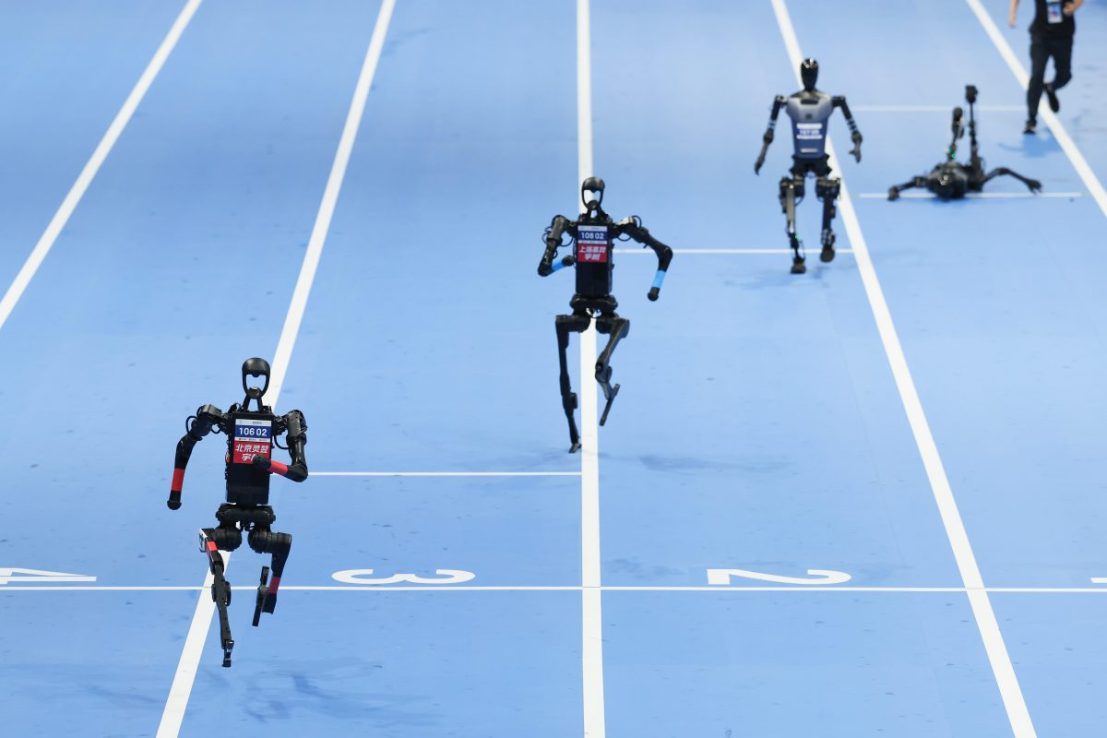
A humanoid robot capable of running 100 meters in seven seconds would be a spectacle. One capable of 9.5 seconds isn’t a threat to sport. It’s a business model.
Such robots can already sprint, jump and navigate obstacles. Give them a few years and a corporate sponsor with deep pockets, and you could easily imagine a race between the world’s fastest sprinter and a robot built to mimic human biomechanics but with perfect stride efficiency and zero fatigue.
Would it be fair? No. Would millions watch? Absolutely.
Testing limits in sport
Sport has always been about testing limits. But what happens when the limits of the human body are no longer the most fascinating, when the ingenuity of the brains behind the creation of machines becomes of greater interest and import?
Cricket has already flirted with automation. Bowling machines can replicate the actions of individual bowlers with uncanny accuracy and consistency. Imagine, then, a new format of the game where the bowlers are machines programmed to mimic the actions, speeds and variations of famous bowlers from history. Want to see today’s star batters face peak Wasim Akram? Shane Warne’s Mike Gatting ball? Harold Larwood at full Bodyline menace? Feed the data in and let the machine loose.
Nostalgia is one of sport’s most monetisable emotions. Machines could prove its facilitator. Think ABBA Voyage in cricket whites, baseball uniforms or sprint suits.
We’ve already accepted one version of man vs machine as mainstream. Chess engines surpassed human grandmasters years ago, and the sport didn’t collapse. Instead, it evolved. Humans now compete both against computers and with their assistance. Esports take this further. Every game is, at its core, man vs programmer. Your direct opponent may be human, but the code is the king.
So perhaps the leap to physical man vs machine sport isn’t as radical as it first appears. In time, grassroots sport could be transformed too. Once technology becomes cheap enough, in any sphere, it inevitably trickles down.
Inevitability
Imagine a local running club with access to a robot pacer capable of holding any speed, over any distance, any terrain. A village cricket team training against a machine that can replicate the exact release point of a county pro. Youth footballers practising penalties against a robot goalkeeper that learns their tendencies and adapts in real time. If machines become part of a sport’s toolkit, they will inevitably become part of its culture, at all levels.
A purist may think this all a step too far, may prefer that sport remains human, hence flawed and unpredictable; that introducing machines risks turning sport into a tech demo. However, the line between human and machine has been blurring for decades. Just think of carbon-fibre bikes, graphite tennis racquets, Hawk-Eye, VAR, altitude tents, smart mouth-guards and GPS tracking.
The issue isn’t whether man vs machine sport will happen. It’s what do we want it to become? 2026 will begin to force us to confront that question.
Ed Warner is chair of GB Wheelchair Rugby and writes his sport column at sportinc.substack.com