Former Prime Minister Lord David Cameron has expressed concern about the exodus of British entrepreneurs and talent, warning that the UK government needs to set aside ‘other goals’ and prioritise business growth.
Speaking at Abu Dhabi Finance Week, Lord Cameron acknowledged British talent leaving for places such as the United Arab Emirates (UAE), stating: “I am worried about it….obviously I want talented people to think ‘I’m welcome to stay in London, I want to build a business in London’”.
According to revisions made by the Office for National Statistics (ONS) in November, 257,000 Britons left the UK in 2024, more than 250 per cent higher than the earlier estimate of 77,000.
“There are issues about how we tax people, but we’ve also got to make sure all the other things we’ve got going for us, whether it is our schools, our universities and the quality of life, you’ve got to work on all of those things,” he added.
“I think one of the things the [Labour] government needs to understand is, if you want to achieve something in politics, if it’s growth that you decide is the priority, everything else has to be subservient to that goal.”
“It’s very hard to get anything done in politics, and you won’t get it done if you’ve got multiple. You say, I want growth, but by the way, I’m going to re-regulate the housing market, and here is a whole lot of new regulation in the labour market, you won’t get the growth,” he added.
Lord Cameron, who also teaches at NYU in Abu Dhabi, and called the emirate “my second home”, when asked about the future of the UK economy, emphasised that changes in regulations, building more homes, and encouraging investment are necessary.
“I say, it’s not simple. There aren’t like two or three decisions. There’s a whole range of plans and decisions that need to be put in place to make our country more competitive, more attractive, and more dynamic,” he said.
He added: “I don’t think we should sort of give up and just accept that Europe is heading for museum status. We have a lot of dynamism in our economy.” He used FinTech as an example, quoting British-based Revolut as a success story.
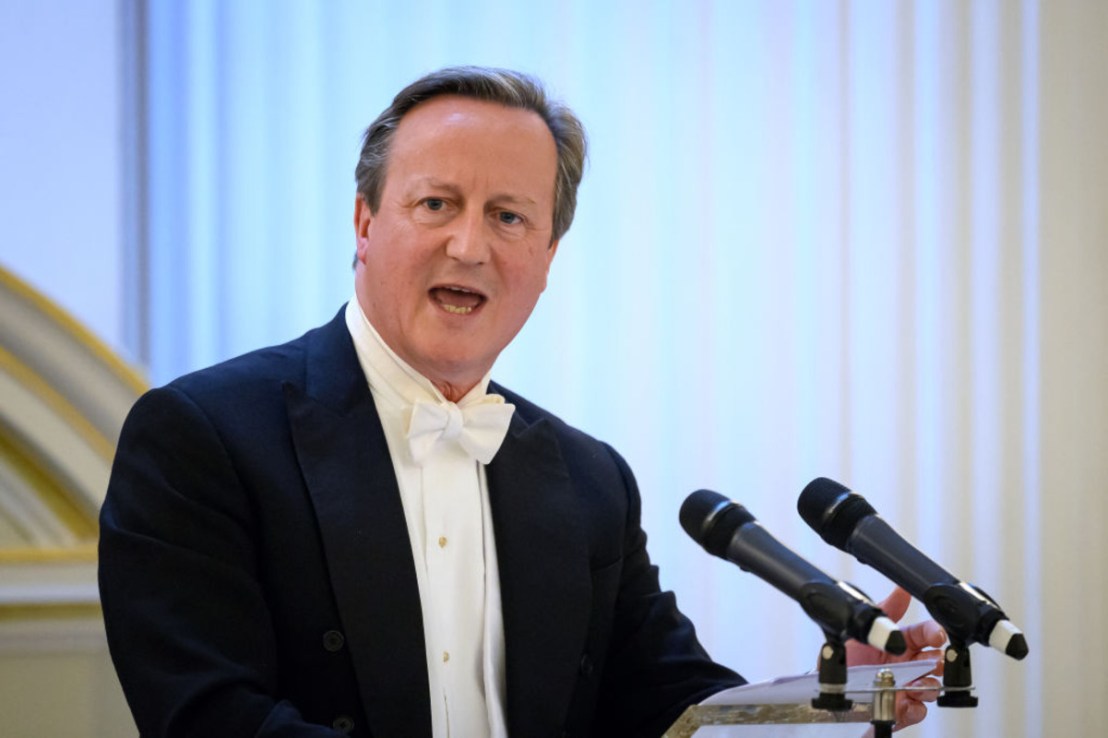
Former UK PM Lord David Cameron speaking at Abu Dhabi Finance Week
‘Reform: Great at raising issues but lacks plans’
When questioned about the rise of populism worldwide, he cited economic stagnation, migration, and social media as drivers.
Honing in on migration, particularly illegal migration, he said the perception is that mainstream politicians have failed to tackle it.
He mentioned the small boats crisis in the UK, stating: “In the UK, it’s clear that the problem of the small boats coming across the channel drives people crazy that politicians cannot seem to deal with this problem and to crack it.
“Ultimately, [you have] to send people back to countries that most people will consider perfectly safe, and currently under our system, that’s not happening.”
“When I returned to government, and I was part of Rishi Sunak’s government, and we have them schemed the agreement with Rwanda, which a lot of people thought was quite an eccentric idea, but actually it was at least an answer to the question, ‘Where are you going to send people that come from countries where you can’t return them?,” he added.
Despite legal challenges and a Supreme Court ruling deeming it unlawful, the previous UK government passed the Safety of Rwanda Act 2024 to enforce it. However, when Labour took office, it officially scrapped the scheme in July 2024.
When questioned on the rise of the Reform Party in the UK, Lord Cameron responded that while the Reform Party is effective at elevating specific issues on the agenda, the real test is whether the party can deliver genuine solutions.
“One of the problems with some of the populist parties, great at raising the issue, great at firing people up, but actually, when you examine the plan, it tends to fall apart,” he said.
David Cameron defends holding Brexit referendum
When pushed on the implications of the Brexit referendum on the UK economy, Lord Cameron said: “Most economists would say that… it has had a bad economic effect, and I see no reason to disagree with that. But ultimately, we got to deal with where we are now and what we need to do.”
He rejected the idea that holding the referendum was reckless, explaining that there had been longstanding public promises about an EU referendum from multiple parties before he came into power in 2010, and that delivering the vote was necessary for legitimacy.
“Ultimately, you can’t govern a country and take people with you if you keep promising them a choice and don’t give them a choice. … It wasn’t some sudden decision,” he said.
However, he said with the UK out of the EU it offers the UK the opportunity to chart its own course, avoid “regulatory mistakes,” and focus on growth in areas like AI, FinTech, and life sciences.
“We should make sure that we don’t make the regulatory mistakes that Europe sometimes makes…I think the European regulation on AI is a mistake. They’re trying to pre-regulate every outcome, and I don’t think that’s going to work,” he said.