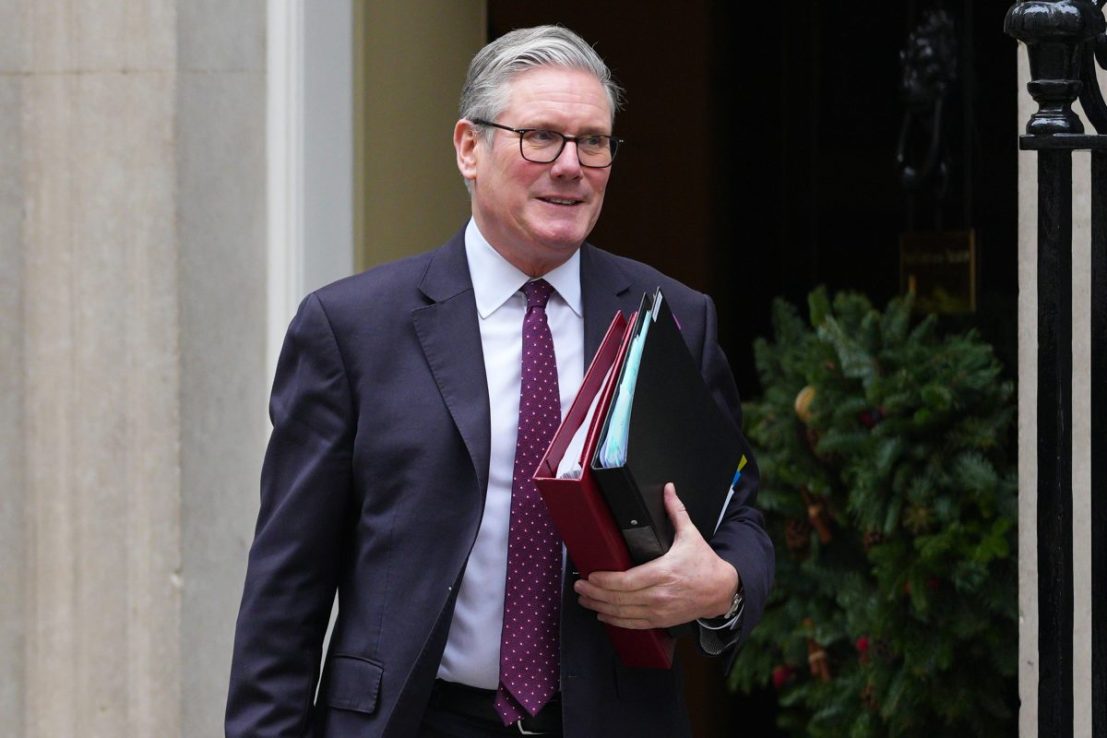
Starmer’s government should be the most powerful in the West. To save the Labour party he must remember that in 2026, writes John McTernan
January, like the Roman god Janus who the month is named after, faces two ways. The turning of a new year allows you to look backwards: it is a time for reflection on achievements measured against aspirations; a moment of honest and searching stocktaking. It is also the opportunity for looking forward and making New Year’s resolutions – what will you change? As Prime Minister Starmer returns to Downing Street for the new political year, what should his resolution be?
The coming year will be a severe test for the Labour government. The Prime Minister and his Chancellor Rachel Reeves are now two of the most unpopular politicians ever to have held their posts – even compared to Margaret Thatcher and Liz Truss at their lowest ebb. This May will bring the closest the UK has to the “mid-terms” in the US.
There will be votes in elections to the Scottish Parliament, the Welsh Senedd, all London Boroughs and many councils across England. In each and every contest, humiliation is expected for Labour – unsurprisingly given the party’s support has nearly halved from 34 per cent to 18 per cent since the 2024 election.
So, in Lenin’s phrase, what is to be done? It is time for Keir Starmer to resolve to be a politician – to wield power for ideological reasons to change the country for good.
Labour’s government should be the most powerful in the West
A first step would be to get No 10 staff to read a copy of Lord Hailsham’s 1976 Dimbleby Lecture in which he coined the phrase “elective dictatorship”. The case Lord Hailsham made was that an elected government in the UK with a working majority in the House of Commons could do what it liked. Despite the innovations of the Human Rights Act and the Supreme Court, this remains true. There is no more powerful elected government in the West than a UK government with a landslide majority.
This fact should be an antidote to the endless whingeing from the centre about “how hard it is to be a government”. It’s the bond markets, the civil service, the regulatory state, even the very layout of 10 Downing Street itself. Willed powerlessness, all of it. Every single unpopular move of the government has been self-inflicted. Cutting winter fuel payments. Refusing to lift the two-child benefit cap until forced by backbenchers. Proposing then abandoning punitive cuts on disability benefits. Being unclear whether the UK is or isn’t an “island of strangers”. The “hokey-cokey” Budget – floating then abandoning income tax increases. All made in No 10 or No 11.
Starmer can be ruthless
The tragic irony is that, when he cares, Keir Starmer is a ruthless political operator. Using the full force of the law against the racist rioters. Deploying King Charles to flatter President Trump. Slashing foreign aid to increase defence spending. Forcing a private member’s bill on assisted dying through parliament as though it is a government legislation. Unsentimentally sacking staff and colleagues.
Now imagine that single-minded energy – plus the firepower of government – aimed at a transformative political project. It could be big, like actually building the promised 1.5m homes by marshalling land, labour and capital. Or small, like by starting with the blindingly obvious: a ban on smartphones in schools – a reform that teachers, parents and pupils would welcome. Or definitional, like negotiating a new deep relationship with the European Union.
That’s what a New Year’s resolution to be a politician would mean. Find a cause, prosecute a case, pick a fight – and win. But it begs a much bigger question – that of political purpose. Technocrats get buried in bureaucracy and process, political leaders have a cause. Whether it is reducing inequality, shifting the balance of power between from capital to labour, the green transition or, as Mayor Mamdani says “affordability”, they have a heuristic.
Great governments have great causes. So, Keir, in the words of a taxi driver to Betrand Russell: “What’s it all about?”
John McTernan is a political strategist and commentator and former adviser to Tony Blair